


In the US, The Daymakers, who play The Underworld tonight, would probably be described as cheesy good fun. But all I've ever heard about the band whispered between girls at their shows -- and the crowds are predominantly girls for some reason -- is that they're very ke-ai (可愛).
Is that because two thirds of the trio are identical twins from Texas with matching mutton-chop sideburns and dorky army-issue glasses? Or is it the band's penchant for awful late-70s zoot-suits and uniforms stolen from the high school marching band's closet? Or maybe it's the high-school puppy love Chinese lyrics sung with an audible foreign twang.

PHOTO: JULES QUARTLY, TAIPEI TIMES
I don't know, it all sounds a bit cheesy. But they've obviously hit on something that connects across lots of boundaries.
The three guys in the band -- JT Long, JD Long and Jason Copps -- started jamming about two years ago in Ilan County, where they work as English teachers, and built up a small repertoire of simple songs while Copps picked up the drums from scratch. It's clear, though, that the songs aren't simple by necessity, but are that way because that's the sound they're going for in a similar vein as Green Day or Offspring.
"The roots are definitely punk, but it's kinda pop punk," said JT.
Along with the jangly four-chord guitar riffs, the pop side shines through in the theatrical element to their shows, starting with the hideous outfits complemented by plenty of over-the-top hip gyrations and choreographed instrument swinging. And most recently the addition of cheerleader-dancers has drawn the band comparisons with Clippers, who also tend to have pom-pom girls flailing about on stage. But the Clippers plumbed Taiwan's nakashi music heritage for inspiration, whereas The Daymakers are clearly rooted in American punk, rockabilly, Dick Dale surf rock and even country music's dark angel, Johnny Cash.
It's the Chinese lyrics, though, that place the band in Taiwan. Like the music, they're intentionally, some might even say studiously, simple with the themes humorously recalling adolescent relationship angst.
"Some students' grades are too bad/They feel the pressure from catching flak from their teacher/Some girls get dumped/They're really sad cuz there's no one with them ..." goes the song The Daymakers on their self-released EP Here Comes Excitement (興奮來了). Or the song Love at First Sight (一見鐘情) that goes: "When I see your pretty smile/It's love at first sight I want to talk to you/When we talk I feel bored/Once you start talking I want to sleep ..."
It's probably the lyrics like these, which sound a lot better in Chinese by the way, that earn the band the description of ke-ai. There's also a healthy measure of happy insouciance in the music that comes from their foreknowledge that they'll never be the next big thing in Taiwan and can just get on with the business of having fun playing music. "We're not going to be the next Mayday (五月天) or anything." But still they have their ambitions. "We'd like to be known as the best live band in Taiwan," JT said.
Tomorrow night at the Underworld, we'll have the last chance for several months to see if they measure up before they take a break to write some new songs. The Underworld is located at B1, 45 Shida Rd, Taipei (台北市師大路45號B1). The show starts at 9:30pm and tickets cost NT$250.

Taiwan’s overtaking of South Korea in GDP per capita is not a temporary anomaly, but the result of deeper structural problems in the South Korean economy says Chang Young-chul, the former CEO of Korea Asset Management Corp. Chang says that while it reflects Taiwan’s own gains, it also highlights weakening growth momentum in South Korea. As design and foundry capabilities become more important in the AI era, Seoul risks losing competitiveness if it relies too heavily on memory chips. IMF forecasts showing Taiwan widening its lead over South Korea have fueled debate in Seoul over memory chip dependence, industrial policy and

“China wants to unify with Taiwan at the lowest possible cost, and it currently believes that unification will become easier and less costly as time passes,” wrote Amanda Hsiao (蕭嫣然) and Bonnie Glaser in Foreign Affairs (“Why China Waits”) this month, describing how the People’s Republic of China (PRC) is playing the long game in its quest to seize Taiwan. This has been a favorite claim of many writers over the years, easy to argue because it is so trite. Very obviously, if the PRC isn’t attacking Taiwan, it is waiting. But for what? Hsiao and Glaser’s main point is trivial,
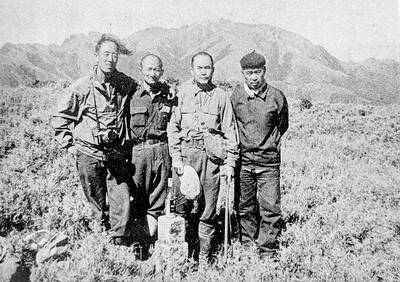
May 18 to May 24 Gathered on Yangtou Mountain (羊頭山) on Dec. 5, 1972, Taiwan’s hiking enthusiasts formally declared the formation of the “100 Peaks Club” (百岳俱樂部) and unveiled the final list of mountains. Famed mountaineer Lin Wen-an (林文安) led this effort for the Chinese Alpine Association (中華山岳協會). Working with other experienced climbers, he chose 100 peaks above 10,000 feet (3,048m) that featured triangulation points and varied in difficulty and character. The list sparked an alpine hiking craze, inspiring many to take up mountaineering and competing to “conquer” the summits. A common misconception is that the 100 Peaks represent Taiwan’s 100 tallest

And so, in the wake of US President Donald Trump’s trip to the People’s Republic of China (PRC), all the experts on the Strait of Hormuz suddenly became experts on US-China-Taiwan relations. The Internet has certainly expanded human knowledge. Lots of these sudden experts made noise this week about Trump’s words after the meeting with PRC dictator Xi Jin-ping (習近平). Trump is going to sell out Taiwan! Longtime Taiwan commentator J. Michael Cole summed the situation up neatly in the Guardian: “We need to keep in mind that he has a tendency to say many things — sometimes contradicting himself within


 RSS
RSS