


Once, the traditional "breaking of the sake barrel" to celebrate opening ceremonies of the Nisei Week Japanese Festival would not have been on Nicole Miyako Cherry's to-do list.
As a Southern California teenager growing up in the suburban comfort of South Pasadena, Cherry was into inline skating on the beach, playing intramural soccer and scoring tickets for Boyz II Men concerts.
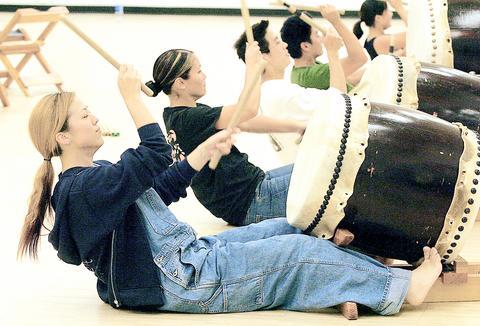
PHOTO: NY TIMES
The daughter of a Japanese-American mother and a white American father, Cherry, now 24, said her integrated lifestyle allowed for few conspicuous ethnic markers other than perhaps wearing a kimono for Halloween or attending an obon festival.
But last year, she competed for, and won, the title of Nisei Week queen, becoming the official representative of the oldest Japanese-American cultural event in the region with the nation's largest concentration of Japanese-Americans outside of Honolulu.
"If people in my generation don't get involved, who's going to take over?" she asked.
Cherry's transformation from typical American teenager to ethnic ambassador is a statement about the uncertain cultural path of young Japanese-Americans who often find themselves lost. Shrinking population numbers, high intermarriage rates and the legacy of the rush to assimilate after the World War II internment experience have all combined to leave the sansei (third generation,) yonsei (fourth generation) and gosei (fifth generation) struggling to hold on to an identity they can call their own.
Cherry is among a number of Japanese-Americans awakening to an unsettling realization: that it may be up to them to fight to preserve their culture, even if most of them may not speak Japanese, or may not have visited Japan or may not even look Japanese.
Gil Asakawa, author of Being Japanese American (Stone Bridge Press, 2004), said another reason for the fervor among some young Japanese-Americans to assert their ethnic identity may be that it has become cool to be Japanese.
"Japanese culture is hip in American mainstream so the door has been opened for these Japanese-Americans to embrace the culture more," said Asakawa, who said he was jolted into consciousness about his heritage by the death of his father in the early 1990s.
But even as Japan's exports like anime (Japanese animation) and karaoke, not to mention its influences in food, technology and design, have become popular globally, many among the younger generations of Japanese-Americans say they are also looking at what it means to be Japanese-American, not just of Japanese descent. Central to Japanese-American pride is progenitors who survived and thrived in the US after their experiences during World War II.
"The culture and the traditional aspects go back to Japan, but I tend to look at the Japanese-American experience -- my grandfather being in an internment camp," Cherry said. "That's huge."
Many other groups also struggle to nourish their ethnic roots, but many Japanese-Americans seem to be going about it with a sense of urgency.
The Japanese-American population is in decline: Immigrant populations from other parts of Asia, including China, South Korea and the Philippines, now dwarf the number of Japanese-Americans, who once made up the largest Asian group in the US.
The trend has left some Japanese-Americans feeling as if they are disappearing.
Although Buddhist temples, sports leagues and families promote cultural identity, many longtime Japanese-American organizations and institutions are losing members or eroding. Only three Japantowns are left in California, including Little Tokyo here.
And "outmarriage," mostly to whites and other Asians, is diluting the Japanese-American ethnicity to the point that Larry Hajime Shinagawa, director of the Center for the Study of Culture, Race and Ethnicity at Ithaca College in New York, present Japanese-Americans with a dilemma: assimilating into "whiteness" or adopting a "pan-Asian" identity.
But that choice is not limiting people like Cherry, who just spent a year immersed in Japanese culture.
Nor is it limiting places like the University of California at Los Angeles, UCLA, where taiko drumming is suddenly the rage. With an undergraduate student body that is about 41 percent Asian-American, there is a dynamic pan-Asian youth culture on campus, said Don Nakanishi, director of the Asian American Studies Center, but half of more than 60 Asian-American student groups are still "ethnic specific."
Among these is the Nikkei Student Union, formed when Japanese-American students predominated among Asians enrolled at UCLA, but which is now open to "anyone interested in Japanese culture," said Tracy Ohara, 22, a past president.
One member, Jason Osajima, 19, said his parents sent him to Japanese-American "cultural summer camps" and basketball leagues as a child, but that he grew up mostly with Caucasian friends and not particularly connected to his Japanese heritage. But last fall, when he enrolled as a freshman, he said, "I realized I really wanted to get involved with the Japanese community."
"Before college, I didn't realize how important that was, but in college you have so many cultural resources," he said.
Osajima now spends some of his time planning Japanese cultural events and commemorative pilgrimages to the sites of World War II internment camps.
And on a recent Thursday night, he could be found at UCLA's athletic center barefoot, with legs spread and sticks wielded like swords, pounding a fat drum used in the ancient art of taiko drumming.
He was in a practice session of Kyodo Taiko, UCLA's drumming ensemble and a group so popular that it holds auditions and has formed a second, non-performing group and recreational classes.
The group includes members with names like Lee, Fuller and Avila, and its Japanese-American version of taiko includes swing, hip-hop and other American genres. Osajima said some friends of an aunt visiting from Japan were "shocked" when they saw a performance, but for him, he said, "You just feel you're preserving a part of your Japanese ancestry."
Older Japanese-Americans said that time has given the latest generations distance from the traumatizing effects of the internment during World War II.
"They had to prove they were American" after Japan's attack on Pearl Harbor, Cherry said, "and that pushed more for assimilation. Our generation is kind of reclaiming that. I'm lucky to have my grandparents around, so I'm trying to get all this information now."
Bill Seki, a 43-year-old Los Angeles lawyer, said his "awakening" to the culture came in his late 30s as he realized that the Niseis, the generation that was interned during the war, were dying off. Last year, for the first time, he went to Japan as part of delegation put together by Japanese-American National Museum, which sponsors programs designed to spark interest in Japan among Japanese-Americans.
"Others don't feel like we have a separate identity but our story is so compelling," he said. "People just take Japanese-Americans for granted. One comment you commonly get is, `You're just like another white guy.' No, that's completely wrong."
Seki said both his parents were interned in US camps before they met (his father was released by volunteering to serve in the US military). After they married, no Japanese was ever spoken in their home as a way of proving, Seki said, "that they were Americans first, not enemy aliens."
In their movement to maintain their ethnicity, many Japanese-Americans have become more accepting of those with only partial Japanese ancestry, known as "hapas," or part Asian.
Eric Tate, a 34-year-old lawyer in San Jose whose mother is Japanese and whose father is black, said he co-founded one of the first hapa student groups in the early 1990s as a student at the University of California at Berkeley in response to feeling unwelcome by Japanese-American groups and sports leagues that restricted membership on the basis of Japanese heritage.
Tate said the tide had turned. In the 2000 census, more than 30 percent of married Japanese-Americans said their spouses were members of a different ethnic group or race, one of the highest intermarriage rate of any group. The offspring of such marriages added more than 300,000 people to the Japanese-American population.
"There's being a shift in paradigms from `Oh, outmarriage is a problem' to `Aw, shucks, we have to make these people embrace the culture because there won't be anybody left to embrace it,"' Tate said.
Phenotype and experiences like today's shared Asian culture may be part of an evolving ethnic identity, but Japanese-Americans from various generations said there is plenty to hand down.
Cherry, whose boyfriend is Mexican-American, clings to her biracial identity. "I won't take sides," she said.
But Cherry, who just completed a master's degree and is about to start a job as a social work therapist, said she would like her own children to learn Japanese, go to Japanese festivals, play in Japanese sports leagues and have a Japanese first name.

In late October of 1873 the government of Japan decided against sending a military expedition to Korea to force that nation to open trade relations. Across the government supporters of the expedition resigned immediately. The spectacle of revolt by disaffected samurai began to loom over Japanese politics. In January of 1874 disaffected samurai attacked a senior minister in Tokyo. A month later, a group of pro-Korea expedition and anti-foreign elements from Saga prefecture in Kyushu revolted, driven in part by high food prices stemming from poor harvests. Their leader, according to Edward Drea’s classic Japan’s Imperial Army, was a samurai

The following three paragraphs are just some of what the local Chinese-language press is reporting on breathlessly and following every twist and turn with the eagerness of a soap opera fan. For many English-language readers, it probably comes across as incomprehensibly opaque, so bear with me briefly dear reader: To the surprise of many, former pop singer and Democratic Progressive Party (DPP) ex-lawmaker Yu Tien (余天) of the Taiwan Normal Country Promotion Association (TNCPA) at the last minute dropped out of the running for committee chair of the DPP’s New Taipei City chapter, paving the way for DPP legislator Su

It’s hard to know where to begin with Mark Tovell’s Taiwan: Roads Above the Clouds. Having published a travelogue myself, as well as having contributed to several guidebooks, at first glance Tovell’s book appears to inhabit a middle ground — the kind of hard-to-sell nowheresville publishers detest. Leaf through the pages and you’ll find them suffuse with the purple prose best associated with travel literature: “When the sun is low on a warm, clear morning, and with the heat already rising, we stand at the riverside bike path leading south from Sanxia’s old cobble streets.” Hardly the stuff of your
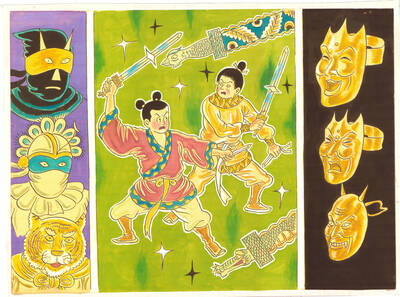
April 22 to April 28 The true identity of the mastermind behind the Demon Gang (魔鬼黨) was undoubtedly on the minds of countless schoolchildren in late 1958. In the days leading up to the big reveal, more than 10,000 guesses were sent to Ta Hwa Publishing Co (大華文化社) for a chance to win prizes. The smash success of the comic series Great Battle Against the Demon Gang (大戰魔鬼黨) came as a surprise to author Yeh Hung-chia (葉宏甲), who had long given up on his dream after being jailed for 10 months in 1947 over political cartoons. Protagonist


 RSS
RSS