


The Minor Arts of Daily Life is a fascinating collection of essays about modern Taiwanese life aimed at college students. They're by no means all pleasant and up-beat, however. In fact I found the chapters on the popular attitudes to foreign domestic helpers, and another on the methods of US-based direct-sales companies active in Taiwan, quite exceptionally depressing.
Following a general introduction on Taiwan's history, you have chapters on the following: chicken-beheading accompanying oaths, popular images of the horrors of purgatory, gay and lesbian lifestyles, TV political call-in shows, domestic helpers, night markets, Amway's direct-sales techniques, baseball, and yang-sucking she-demons in Chinese-language ghost movies.
The chapter on foreign domestic helpers is shocking. Whereas the English-language newspapers tend to focus on stories of mistreatment and exploitation by their employers, the local media apparently present a very different image. Foreign maids are all too often seen as backward, potential sources of disease and even of crime. This parallels attitudes to migrant workers in other parts of the world, notably Europe, and the author (Academia Sinica's Chin-ju Lin) sees the situation, surely rightly, as an attempt by newly-affluent Taiwanese to establish their
superiority over their less prosperous Asian neighbors. Employers perceive themselves as imitation Americans and try to reinforce this adopted identity by finding groups they can patronize and despise. All too often these are the migrant workers laboring away in their own kitchens (and not infrequently in the master bedroom as well).
The chapter on the Amway direct sales organization is also somber. Writing about employees of this US company, which has been successful in Taiwan, the author claims that while embracing the dream of wealth and freedom, distributors (Amway's term for its sales people) are actually trapped in an endless process of labor. The depiction is in places almost nightmarish. All these characteristics feature Amway as a quasi-religious community -- or simply as a cult, the author writes. This state of affairs is made possible by a society where there the acquisition of wealth is a high priority, she proposes, and the tendency of such organizations to brainwash distributors and unify their vocabularies and behaviors is no effective barrier to this, any more than the derogatory popular perception of such workers as mouse people.
By contrast, the chapter on Taiwan's political talk or call-in shows is much more up-beat. They're enormously popular here, the writer claims, largely because for so long the expression of individual political views was taboo. Today outrageous opinions are positively welcomed, and Taiwan's democratic spirit is given a boost, even though the motives of the TV companies involved are essentially profit-oriented.
Taiwanese baseball is also presented as an adjunct to democratic feeling. It's effectively Taiwan's national game, the author writes, and though American in origin, is nowadays a mark of Taiwan's distinctive identity in Asia. It was introduced over a hundred years ago by the Japanese, but quickly came to show how a colonized people could display their equality with the colonizing power by beating them in a competitive sport. In Taiwan's case, the success continued dramatically with its Little League teams' truly extraordinary feats of winning 10 US Little League World Series between 1969 and 1981, and 16 over the 27-year period 1969 to 1995. This helped keep the island on the map as a distinctive social and political unit, in many American minds, in an era when formal diplomatic attention was moving relentlessly towards Beijing.
Beheading a cockerel at the same time as swearing you're telling the truth is an old tradition, apparently originating in Fujian province. It's probably rare in Taiwan today, but is still recognized by everyone as a gesture of the cross-my-heart-and-swear-to-die variety, reappearing in political cartoons in the confident knowledge that everyone will immediately understand its significance.
As for Taiwan's night markets, the contributor argues that they've become politicized, in so far as such popular phenomena are nowadays claimed as embodying a Taiwanese identity. Though common all over China too, they've been seen as typically Taiwanese in their robust combination of informal eating and the availability of a huge variety of goods, albeit some of dubious origin. However the middle classes may disdain them, they're even in danger of becoming officially adopted as tourist attractions.
Writing on gay and lesbian identity, Scott Simon calls Taiwan "one of the most rational and secular states in the world." The chapter on the 1987 Hong Kong movie, A Chinese Ghost Story, perceives in the film, among many other things, a fear of women as potential bringers of chaos; and images of purgatory are viewed as counterbalances to filial piety.
The book contains fair-minded yet astute introductions to each chapter by the editors, David Jordan, Andrew Morris and Marc Moskowitz. Two of the contributors have written full-length books already reviewed in Taipei Times. Simon was the author of Sweet and Sour, a study of small businesses run by Taiwanese women (reviewed Jan. 4, 2004), while Moskowitz wrote The Haunting Fetus (reviewed Aug. 12, 2001), an interesting book on the propitiation of the ghosts of aborted fetuses in modern Taiwese society.
In many ways this book does all it can to be favorable to Taiwan, but its contributors are honest enough to confront aspects of the society they feel are unpleasant or even disreputable. These uncompromising qualities thus give it great strength, and the book deserves a wider readership that the students it's aimed at.

In late October of 1873 the government of Japan decided against sending a military expedition to Korea to force that nation to open trade relations. Across the government supporters of the expedition resigned immediately. The spectacle of revolt by disaffected samurai began to loom over Japanese politics. In January of 1874 disaffected samurai attacked a senior minister in Tokyo. A month later, a group of pro-Korea expedition and anti-foreign elements from Saga prefecture in Kyushu revolted, driven in part by high food prices stemming from poor harvests. Their leader, according to Edward Drea’s classic Japan’s Imperial Army, was a samurai

The following three paragraphs are just some of what the local Chinese-language press is reporting on breathlessly and following every twist and turn with the eagerness of a soap opera fan. For many English-language readers, it probably comes across as incomprehensibly opaque, so bear with me briefly dear reader: To the surprise of many, former pop singer and Democratic Progressive Party (DPP) ex-lawmaker Yu Tien (余天) of the Taiwan Normal Country Promotion Association (TNCPA) at the last minute dropped out of the running for committee chair of the DPP’s New Taipei City chapter, paving the way for DPP legislator Su

It’s hard to know where to begin with Mark Tovell’s Taiwan: Roads Above the Clouds. Having published a travelogue myself, as well as having contributed to several guidebooks, at first glance Tovell’s book appears to inhabit a middle ground — the kind of hard-to-sell nowheresville publishers detest. Leaf through the pages and you’ll find them suffuse with the purple prose best associated with travel literature: “When the sun is low on a warm, clear morning, and with the heat already rising, we stand at the riverside bike path leading south from Sanxia’s old cobble streets.” Hardly the stuff of your
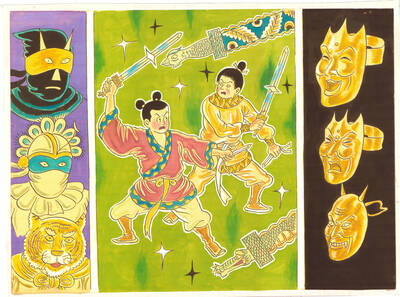
April 22 to April 28 The true identity of the mastermind behind the Demon Gang (魔鬼黨) was undoubtedly on the minds of countless schoolchildren in late 1958. In the days leading up to the big reveal, more than 10,000 guesses were sent to Ta Hwa Publishing Co (大華文化社) for a chance to win prizes. The smash success of the comic series Great Battle Against the Demon Gang (大戰魔鬼黨) came as a surprise to author Yeh Hung-chia (葉宏甲), who had long given up on his dream after being jailed for 10 months in 1947 over political cartoons. Protagonist


 RSS
RSS