


Taipei's Shilin night market is known for stocking just about every item you'd ever need. But now there is a line of products on offer that few Taiwanese have ever needed before: bongs and pipes and widgets and wallets emblazoned with bright green pot leaves. The place where they're being sold is turning more than a few curious heads and -- more to the point -- its owner is turning a handsome profit.
"This stuff is becoming more accepted," said A-Xiang (阿翔), a lanky 20-something whose multi-colored hair and tattooed skin mark him as the man selling the merchandise.
"I don't think anyone could have sold these items even a few years ago. But attitudes are changing."
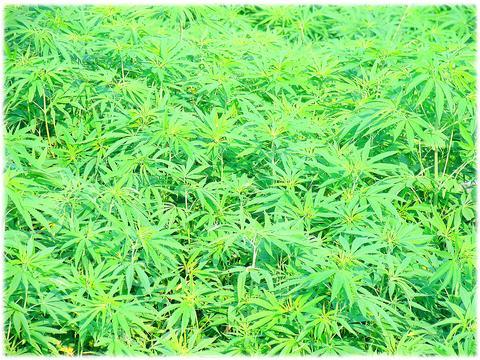
PHOTO: JULES QUARTLY, TAIPEI TIMES
Indeed. Within a span of 20 minutes, A-Xiang is visited by a dozen young passersby who seem to know exactly what they want.
"Do you have one of those pipes that looks like a credit card?" asks a girl who doesn't look old enough to use a credit card, let alone a pipe.
"Sold out," A-Xiang says.
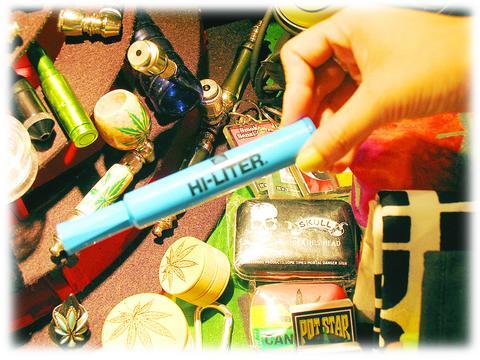
PHOTO: DAVID MOMPHARD, TAIPEI TIMES
"How much for screens?" one young man wants to know.
A-Xiang hands him a free package of five.
A more curious exchange comes from a customer of few words. "Hey," the man says, coyly nodding at A-Xiang.
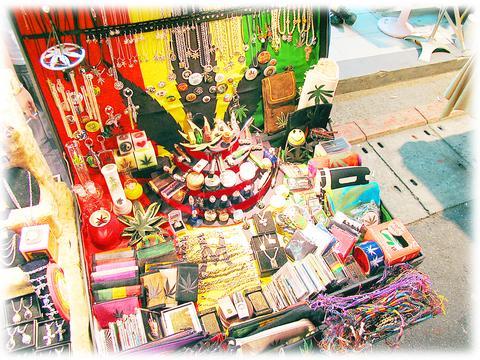
Without a word, A-Xiang hands him a pack of rolling papers and is handed exact change. Deal done. The man nods again and saunters away. A-Xiang adds NT$80 to a till that averages NT$80,000 in monthly profits.
CHANGING TIMES
Attitudes are changing -- at least A-Xiang's booming business is evidence of as much -- but laws are not. Marijuana use is listed as a Schedule 2 narcotic, in the same league as codeine, ecstasy (or MDMA) and LSD and is punishable by no less than seven years in prison, according to the Statue for Narcotics Hazard Control.
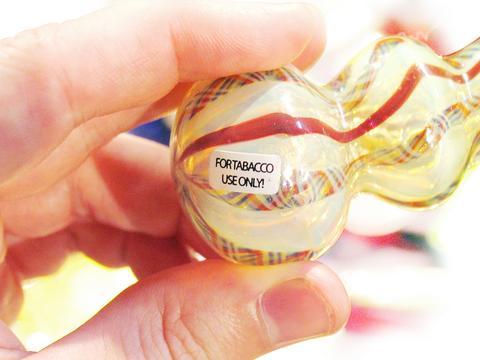
His clientele may be growing, but it's A-Xiang's creative use of nouns that keeps him in business. He claims not to have any trouble with law enforcement authorities as it's not illegal to sell "tobacco pipes" -- which is what all of A-Xiang's chrome-plated merchandise is meant for, of course, despite the decorative pot leaf.
Still, like most street-side salesmen, he keeps all his products in a large case that can be moved at a moment's notice. With the help of a large battery and clip lights, he can set up most anywhere.
A-Xiang, whose name means "flying in circles," can be found most nights at the same spot in Shilin night market. Other nights he might set up shop closer to the vendors selling snacks.
"I come here pretty hungry some nights," he said.
He's not likely to incur the wrath of the law. Apart from the Statue for Narcotics Hazard Control, the Criminal Code for the Republic of China makes no mention of marijuana in its "Chapter 20, Offenses Related to the Use of Opium," the only section in the ROC Civil Code to address illicit drugs. It lists cocaine, heroin and amphetamines in addition to its namesake, but stops short of proscribing punishment for the sale or possession of paraphernalia, including "tobacco pipes."
Rather, the scourge of law enforcement authorities in the past decade has been amphetamines and heroin. More recently, ketamine and ecstasy have become the drugs found frequently by police in raids on nightclubs. Marijuana has been barely a blip on the radar -- until recently, that is.
There were 8,500kg of illicit drugs seized in Taiwan last year, according to the Department of Health's Director-General, Li Jih-heng (李志恆), nearly three times the amount grabbed in 2002. Of that, nearly half was amphetamines, followed by ketamine, heroin, ecstasy then marijuana. Last year marked the first time the amount of ketamine seized surpassed that of heroin. While weighing in far lighter, the 121kg of marijuana seized last year marked a 10-fold increase from the 11kg seized the previous year, perhaps the biggest indicator of the drug's surging
popularity.
"I don't believe the statistics," said one senior police officer who asked not to be identified. "Just because those are the drugs that were confiscated, doesn't mean those are the most commonly used drugs." He illustrated his point by saying another statistic shows that the most commonly violated traffic law among scooter drivers is an illegal left turn.
"Traffic officers know exactly where people make illegal left turns and they wait for them to make it. If you spend all year waiting for people to make illegal left turns, of course your statistics will show that left-turns are the most common traffic violation."
STATISTICAL HAZE
Authorities believe that amphetamines, ketamine and ecstasy are the nation' s biggest problem drugs, he said, exactly because police frequently crack down on nightclubs, where the use of such drugs is high.
In his opinion, is marijuana as big a problem as the more commonly confiscated drugs?
"All drugs are a problem," he said. "But if you're asking which is the biggest problem, it's alcohol."
Even with it's newfound popularity, marijuana use in Taiwan remains far below the global average. The United Nations' Office on Drugs and Crime has, since 1999, compiled an annual report titled Global Illicit Drug Trends. Last year's report listed Taiwan's annual prevalence of cannabis abuse (as a percentage of the population) at 0.5 percent. (For opiates, the figure was 0.4 percent and for amphetamines, 1.2 percent, though that figure was from 2000).
Of Taiwan's neighbors, Japan ranked lowest (0.06 percent), and the Philippines was highest (3.5 percent). Taiwan's rate was far below China's (2 percent) and nearly the same as Hong Kong (0.6 percent). In Asia overall, according to the report, 2.17 percent of the population abuses cannabis, an estimated 55 million users.
By comparison, 9.3 percent of Americans are mad for reefer, 10.6 percent of Britons, and a whopping 15 percent of Australians. Papua New Guinea topped the global chart with 29.5 percent, though the last time anyone there bothered checking was 1995.) The full UN report is available on the Web at http://www.unodc.org/unodc/en/research.html.
ANALYSIS of URINALYSIS
Annual global seizures of cannabis herb and resins rose some 40 percent between 1998 and 2001, the last year for complete statistics. Almost 5,600 tonnes of cannabis products were seized in 2001, 15 times the amount of cocaine and more than 100 times the amount of heroin -- a trend opposite that found in Taiwan.
The major shortcoming of most of these statistics in attempting to gauge cannabis use among a given population is that they look only at the amount and types of drugs taken off the streets. What remains and how it's consumed, as the senior police officer suggested, isn't known.
A different set of statistical information was compiled in a survey jointly conducted by Taiwan's National Bureau of Controlled Drugs and scientists at the University of Alabama at Birmingham. The survey, titled Use of MDMA and Marijuana Among Arrestees in Taiwan, compiled the results of urine samples taken from people arrested in either Taipei, Taichung or Kaohsiung between September 2000 and February 2001.
Of the 2,944 samples, 11 people tested positive for cannabis use (0.37 percent) and 34 people (1.15 percent) screened positive for ecstasy. An alarming 1,815 people (61.7 percent) tested positive for use of amphetamines.
Here again, the samples were taken from people in nightclubs, where the use of marijuana is not particularly rampant.
"I think most people who like to smoke marijuana stay home and sleep," the senior police officer said. "But we've been finding a lot more of it and so we'll be looking for it a lot more."
But where marijuana is now seen as a problem, it was once considered a solution. Kuo Chou-mei (郭周美) is a Chinese herbal pharmacist whose store on Minsheng West Road has been open since 1946. While marijuana isn't included among the 2,000-odd plants and minerals that Kuo keeps in stock, he says that it is nonetheless part of the traditional Chinese pharmacopoeia. The seeds of the plant were ground up to become a mild laxative for the elderly and the leaves were used as an early anti-depressant.
"Yes, attitudes towards marijuana have changed," Kuo said. "And they will continue to change. What's important is that young people realize that it is strong medicine."
While it's medicine for Kuo, for A-Xiang, marijuana is merchandise. He says his most popular items aren't pipes and bongs but the many pendants, pins and purses hanging in his case. He suspects this is partly because they're less expensive than the pipes, but also because the leaf signifies a rebelliousness that many young people are embracing.
"It's cool," he says simply.
He wraps up one such pendant for a young woman and includes his business card in the bag. Like his merchandise, it carries a glossy green pot leaf and the words, "Is Marijuana Really So Bad For Me?"
It's a question many Taiwanese are asking.
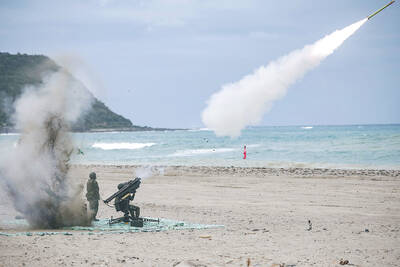
In late October of 1873 the government of Japan decided against sending a military expedition to Korea to force that nation to open trade relations. Across the government supporters of the expedition resigned immediately. The spectacle of revolt by disaffected samurai began to loom over Japanese politics. In January of 1874 disaffected samurai attacked a senior minister in Tokyo. A month later, a group of pro-Korea expedition and anti-foreign elements from Saga prefecture in Kyushu revolted, driven in part by high food prices stemming from poor harvests. Their leader, according to Edward Drea’s classic Japan’s Imperial Army, was a samurai

The following three paragraphs are just some of what the local Chinese-language press is reporting on breathlessly and following every twist and turn with the eagerness of a soap opera fan. For many English-language readers, it probably comes across as incomprehensibly opaque, so bear with me briefly dear reader: To the surprise of many, former pop singer and Democratic Progressive Party (DPP) ex-lawmaker Yu Tien (余天) of the Taiwan Normal Country Promotion Association (TNCPA) at the last minute dropped out of the running for committee chair of the DPP’s New Taipei City chapter, paving the way for DPP legislator Su
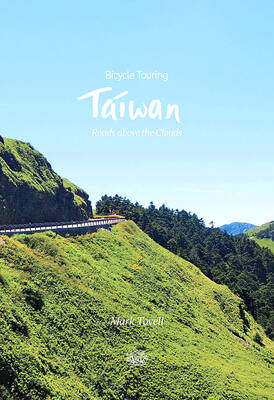
It’s hard to know where to begin with Mark Tovell’s Taiwan: Roads Above the Clouds. Having published a travelogue myself, as well as having contributed to several guidebooks, at first glance Tovell’s book appears to inhabit a middle ground — the kind of hard-to-sell nowheresville publishers detest. Leaf through the pages and you’ll find them suffuse with the purple prose best associated with travel literature: “When the sun is low on a warm, clear morning, and with the heat already rising, we stand at the riverside bike path leading south from Sanxia’s old cobble streets.” Hardly the stuff of your
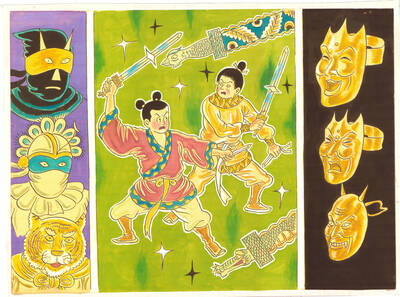
April 22 to April 28 The true identity of the mastermind behind the Demon Gang (魔鬼黨) was undoubtedly on the minds of countless schoolchildren in late 1958. In the days leading up to the big reveal, more than 10,000 guesses were sent to Ta Hwa Publishing Co (大華文化社) for a chance to win prizes. The smash success of the comic series Great Battle Against the Demon Gang (大戰魔鬼黨) came as a surprise to author Yeh Hung-chia (葉宏甲), who had long given up on his dream after being jailed for 10 months in 1947 over political cartoons. Protagonist


 RSS
RSS