


Appearing in Quentin Tarantino's Kill Bill: Vol. 1 in 2002, The 5,6,7,8's stepped into the international limelight. But this weekend, for the first time, they step onto Taiwan. As the retro-pop punk band rehearsed two days before coming, they spoke to the Taipei Times and showed they're not just about their quirky retro outfits, but are all about the music.
Taipei Times: This is the first time to Taiwan. What do you want to do when you get here?
Ronnie Fujiyama (lead singer): Honestly I don't know much about Taiwan except that there are a lot of good foods there. So we hope to try out different foods.

TT: Can you introduce the members of your band?
RF: There are more than three vocalists working on the band, but as we are not a mainstream musical band, and don't make enough money everyone has other jobs to make a living.
For the three vocals there's me, Yoshiko Ronnie Fujiyama ? my real name is actually Yoshiko Fuji, but it gets confused with the second member, Sachiko Fuji. I've changed my family name to Fujiyama. Ronnie was added to my name cuz on the set of Kill Bill there was another girl called Yoshiko.
Sachiko Fuji works at a vintage costume store. And Akiko Omo is the busiest. She's a graphic designer.
TT: How did the idea of retro "punk pop music" come about?
RF: We all like 1960s music.
TT: Where do you get your costumes?
RF: We make them ourselves. And we also got some from the set of Kill Bill.
TT: What about the hair? Is that real hair?
RF: It's real. I just really like the retro look. I asked the hairdresser to teach me how to make our hair like that. It takes about 30 minutes every time to set it up.
TT: Quentin Tarantino said you girls are his favorite band. What do you think of that?
RF: Well, we are happy to hear about that. We're happy if anyone likes our music. It doesn't matter if it's someone as famous as Tarantino. Even if it was the ojisan (old grandpa) next door saying that it would make us happy.
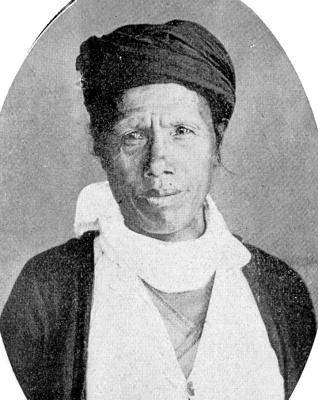
May 11 to May 17 Traversing the southern slopes of the Yushan Range in 1931, Japanese naturalist Tadao Kano knew he was approaching the last swath of Taiwan still beyond colonial control. The “vast, unknown territory,” protected by the “fierce” Bunun headman Dahu Ali, was “filled with an utterly endless jungle that choked the mountains and valleys,” Kano wrote. He noted how the group had “refused to submit to the measures of our authorities and entrenched themselves deep in these mountains … living a free existence spent chasing deer in the morning and seeking serow in the evening,” even describing them as

Yesterday, the Democratic Progressive Party (DPP) nominated legislator Puma Shen (沈伯洋) as their Taipei mayoral candidate, the Chinese Nationalist Party (KMT) put their stamp of approval on Wei Ping-cheng (魏平政) as their candidate for Changhua County commissioner and former legislator Tsai Pi-ru (蔡壁如) of the Taiwan People’s Party (TPP) has begun the process to also run in Changhua, though she has not yet been formally nominated. All three news items are bizarre. The DPP has struggled with settling on a Taipei nominee. The only candidate who declared interest was Enoch Wu (吳怡農), but the party seemed determined to nominate anyone

In a sudden move last week, opposition lawmakers of the Chinese Nationalist Party (KMT) and Taiwan People’s Party (TPP) passed a NT$780 billion special defense budget as a preemptive measure to stop either Chinese leader Xi Jinping (習近平) or US President Donald Trump from blocking US arms sales to Taiwan at their summit in Beijing, said KMT heavyweight Jaw Shaw-kong (趙少康), speaking to the Taipei Foreign Correspondents Club on Wednesday night in Taipei. The 76-year-old Jaw, a political talk show host who ran as the KMT’s vice presidential candidate in 2024, says that he personally brokered the deal to resolve
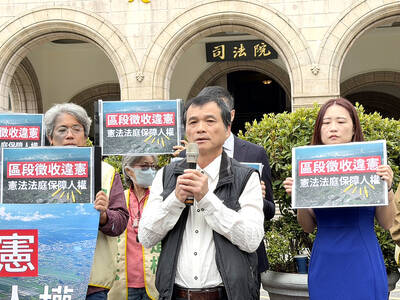
What government project has expropriated the most land in Taiwan? According to local media reports, it is the Taoyuan Aerotropolis, eating 2,500 hectares of land in its first phase, with more to come. Forty thousand people are expected to be displaced by the project. Naturally that enormous land grab is generating powerful pushback. Last week Chen Chien-ho (陳健和), a local resident of Jhuwei Borough (竹圍) in Taoyuan City’s Dayuan District (大園) filed a petition for constitutional review of the project after losing his case at the Taipei Administrative Court. The Administrative Court found in favor of nine other local landowners, but


 RSS
RSS