


The record-breaking success of Michael Moore's Fahrenheit 9/11 may mark a turning point in the acceptance of documentaries by audiences as mass entertainment and by movie distributors as potential profit centers.
This anti-Bush documentary is merely the latest and most successful of many feature-length documentaries that have hit it big at the box office in the last few years, among them the current release Super Size Me, about the perils of eating fast food, which has taken in close to US$10 million so far; Winged Migration, a nature film that took in US$11 million last year; and Spellbound, about spelling bees, which took in US$5.7 million.
Fahrenheit 9/11, the satirical critique of US President George W. Bush and his decision to go to war in Iraq, had earned US$56 million by Sunday, adding to the initial ticket sales that made it the highest-grossing feature-length documentary ever.
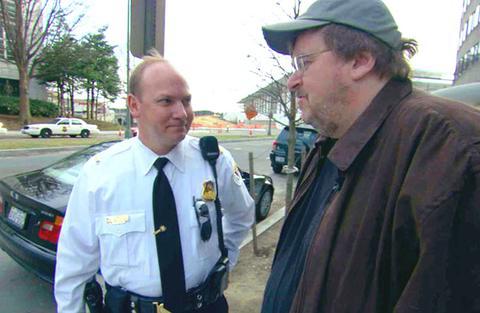
PHOTO: NY TIMES
The sight of movie audiences lining up to see Moore's film, which the Walt Disney Company declined to distribute out of concern over its political nature, has not escaped the notice of Hollywood distributors, which have been growing receptive to the idea of documentaries in the last few years.
Howard Cohen, the co-president of Roadside Attractions, which is distributing Super Size Me, said: "Are documentaries going to be taken more seriously? The short answer is yes. But Michael Moore is still a special case. He's become a star, almost like any other star. That said, I do think audiences are getting used to going to documentaries in a way they haven't before."
Harvey Weinstein, the co-chairman of Miramax, who was instrumental in popularizing both independent and foreign films with broad audiences, agrees. "I think we're beginning to see the audience's fascination with nonfiction when its done well," said Weinstein, who bought Fahrenheit 9/11 back from Disney and released it independently.

PHOTO: NY TIMES
"It reminds me of the breakthrough with Sex, Lies and Videotape for indie movies, and years later with Cinema Paradiso, all the way to Life Is Beautiful for foreign-language movies," he added. "There have been some moments in our film history where all of a sudden it has all changed."
Evolution of tastes
Some movie executives attribute the shift to the popularity of reality television and others to the expanding definition of documentaries to include narrative, nonfiction entertainment.
"It's part of an evolution that has been coming for quite some time," said Michael Barker, co-president of Sony Pictures Classics, which released Winged Migration and has the forthcoming Riding Giants, a feature-length documentary about big-wave surfing. "I think the success of reality television has made documentaries more a part of the mainstream, not just a kind of movie for intellectual aesthetes."
But it is also due, he said, to the high entertainment value of the latest group of documentaries. In Super Size Me, the filmmaker Morgan Spurlock makes a serious point while poking fun at fast-food culture by going on an all-McDonald's diet. Likewise, though Moore's latest film is intensely barbed, it shares the mocking tone and humorous, grandstanding gestures of his previous features, including Roger & Me and Bowling for Columbine.
"One of the reasons that these films are doing so well at the theaters is this old strict rule -- that documentaries have to be pure reality -- has been thrown out the window," Barker said. "There's a much more flexible definition of a documentary. It includes what you'd read on the Op-Ed page of The New York Times."
Given the growing popularity of documentaries, some filmmakers and movie executives say there is a need for a more vigorous debate about definitions and standards. In nominations for the best-documentary Oscar, for example, voters from the Academy of Motion Picture Arts and Sciences do not scrutinize the accuracy of a film.
And unlike investigations undertaken by television news programs like Frontline and 60 Minutes, nonfiction films reflect the point of view of the filmmaker without editorial oversight. Some recent documentaries that have involved journalism-style investigations, notably the Oscar-nominated Capturing the Friedmans, have drawn questions about their balance and accuracy.
"There are a whole number of really important questions here," said Errol Morris, a documentary pioneer whose Fog of War, about former US Defense Secretary Robert McNamara, won the Oscar this year. "Does it makes sense to talk about a movie being true or false? I'm not sure it does. In fact I'm pretty sure it doesn't. Movies are movies."
Still, he said, investigative documentaries have a responsibility to seek clear facts and clear answers. His 1988 film The Thin Blue Line contributed to the freeing of a man wrongly convicted of murder.
"It's not a question of the movie but of the ethics of the person making the movie," Morris said. "Journalism is not infallible, but we depend on journalists to do something of a good job in investigating a story, whatever that means -- to be motivated by a desire to find out stuff."
Otherwise, he said, "you're just using the legal troubles of people as fodder for entertainment."
Lawsuit troubles
As their interest in documentaries grows, some movie executives are beginning to think about these issues too. Many studios passed on distributing Super Size Me for fear of provoking a lawsuit from McDonald's.
"A lot of times I'm looking at documentaries, and I have no idea of the credibility of the people putting together the information," said Joe Pichirallo, an executive at Focus Features who was formerly an investigative reporter at The Washington Post. "It's the responsibility of the distributor to evaluate and make judgments about the credibility of people putting the film together, but we're not set up to be fact checkers in the way news organizations are."
Either way, some industry professionals say that documentaries are going to continue to take up more space at the multiplexes.
"This is going to be the fastest-growing genre over the next few years," said Paul Dergarabedian, the president of Exhibitor Relations, which tracks box office results. "We may not see more US$20-million grosses. But audiences are always complaining that movies are dumb, or they talk down to them. Here you go. These movies are decidedly low-tech, and audiences are responding to that."

In late October of 1873 the government of Japan decided against sending a military expedition to Korea to force that nation to open trade relations. Across the government supporters of the expedition resigned immediately. The spectacle of revolt by disaffected samurai began to loom over Japanese politics. In January of 1874 disaffected samurai attacked a senior minister in Tokyo. A month later, a group of pro-Korea expedition and anti-foreign elements from Saga prefecture in Kyushu revolted, driven in part by high food prices stemming from poor harvests. Their leader, according to Edward Drea’s classic Japan’s Imperial Army, was a samurai

The following three paragraphs are just some of what the local Chinese-language press is reporting on breathlessly and following every twist and turn with the eagerness of a soap opera fan. For many English-language readers, it probably comes across as incomprehensibly opaque, so bear with me briefly dear reader: To the surprise of many, former pop singer and Democratic Progressive Party (DPP) ex-lawmaker Yu Tien (余天) of the Taiwan Normal Country Promotion Association (TNCPA) at the last minute dropped out of the running for committee chair of the DPP’s New Taipei City chapter, paving the way for DPP legislator Su

It’s hard to know where to begin with Mark Tovell’s Taiwan: Roads Above the Clouds. Having published a travelogue myself, as well as having contributed to several guidebooks, at first glance Tovell’s book appears to inhabit a middle ground — the kind of hard-to-sell nowheresville publishers detest. Leaf through the pages and you’ll find them suffuse with the purple prose best associated with travel literature: “When the sun is low on a warm, clear morning, and with the heat already rising, we stand at the riverside bike path leading south from Sanxia’s old cobble streets.” Hardly the stuff of your

April 22 to April 28 The true identity of the mastermind behind the Demon Gang (魔鬼黨) was undoubtedly on the minds of countless schoolchildren in late 1958. In the days leading up to the big reveal, more than 10,000 guesses were sent to Ta Hwa Publishing Co (大華文化社) for a chance to win prizes. The smash success of the comic series Great Battle Against the Demon Gang (大戰魔鬼黨) came as a surprise to author Yeh Hung-chia (葉宏甲), who had long given up on his dream after being jailed for 10 months in 1947 over political cartoons. Protagonist


 RSS
RSS