


When King Arthur, Hollywood's big-budget retelling of the legend opens on in the US tomorrow, its main stars will not be American. Keira Knightley and Clive Owen, famous in their native Britain, play Guinevere and Arthur and share the Round Table with Til Schweiger, a popular German celebrity and television star who plays the knight Cynric.
Walt Disney Studios, which produced the film, plans to open the movie in 53 territories, mostly in the weeks soon after its American debut. Given the price tag for King Arthur of nearly US$120 million, Richard Cook, the chairman of the studio, said having stars who are popular abroad was more important than ever.
"If we thought it would only reach a domestic audience, we wouldn't have made it," Cook said.
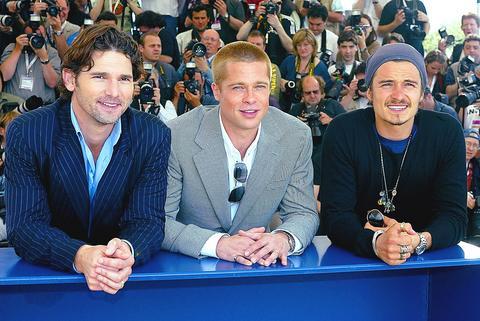
PHOTO: NY TIMES
As Hollywood stakes more of its success on selling films abroad, filling starring roles with international celebrities is becoming more common. Around the World in 80 Days, which opened recently in a limited number of countries, is a UN of actors, including stars like Jackie Chan from Hong Kong and Steve Coogan from England, as well as cameos by the German film director Wim Wenders and California Governor Arnold Schwarzenegger, who plays a Turkish prince. The movie has failed to ignite with moviegoers here, making it even more critical for the movie's investors to recoup their investment abroad.
"Hiring international talent is a movie-making law," said Stephen Moore, president of international film and home entertainment for Twentieth Century Fox.
As recently as two years ago, international ticket sales were around 40 percent of the worldwide box office, studio executives say. Today, international sales more often account for 60 percent or more of box-office receipts. And as production budgets soar -- some as high as US$200 million -- and the number of big-budget movies rises, the pressure on worldwide sales is growing.
In Troy, Brad Pitt, whose movies have rarely earned more than US$100 million at the domestic box office, was cast as Achilles largely because of his international appeal, studio executives at Warner Brothers Pictures said. He starred alongside Eric Bana, who plays the sympathetic Hector and is well known in his native Australia; the British actor Orlando Bloom, one of the latest heartthrobs for teenagers, played Paris.
Consider, too, last year's The Last Samurai. That movie brought in US$111 million at the US box office, which was disappointing given its US$140 million production budget. Then, many in Hollywood predicted the movie would lose money. Instead the movie exceeded expectations in Japan, bringing in US$127 million. That raised the worldwide total to US$455 million.
Jeff Robinov, president of production at Warner Brothers, which is owned by Time Warner Inc., said the Japanese actor Ken Watanabe was hired for the film because he was widely recognized in Japan and would attract moviegoers there. "Clearly, the market responded," Robinov said.
But the changes in casting seem also to reflect an underlying shift in global attitudes toward American popular culture. In the 1980s and early 1990s, movies that sold well abroad starred distinctly American heroes, like Sylvester Stallone of the Rambo series and Bruce Willis in the Die Hard movies. Foreign stars were relegated to small parts, most often the villain who dies at the end.
Many in Hollywood think that tastes shifted after the terrorist attacks on Sept. 11, 2001, and the subsequent invasion of Iraq.
"Anything with a US bent won't get made," said Bill Mechanic, who worked at both Disney and Fox. Added the producer Graham King, who bought the overseas rights to Gangs of New York for US$65 million: "Since 9/11 there has been a definite change and the genres have opened up."
Two of those genres are the family film and the old-style epic, both blissfully free of modern politics. China, for instance, where the government imposes strict standards on foreign imports, is interested in movies which are apolitical, family driven and not particularly violent, King said.
Studio executives say that movies are also being released far more quickly overseas, chiefly out of fear that pirated copies of movies will be selling on street corners before the movies hit theaters and because of the increasingly saturated market for entertainment news fueled by the Internet.
"Information is traveling faster and the international audience is now more aware of event films in the US," said Veronika Kwan-Rubinek, president of international distribution for Warner Brothers.
Some industry analysts suggest that Warner Brothers released the second and third installment of The Matrix worldwide in part to circumvent bad publicity about the films and earn as much money as possible in the film's opening weekends. (Warner executives deny this.)
But studios have taken such an approach before. In 1997, Sony Pictures Entertainment released Devil's Own starring Brad Pitt and Harrison Ford, but the studio feared it would tank after it received poor reviews. Sony, a division of the Sony Corporation, decided on a worldwide release, according to Jeff Blake, a vice chairman at Sony, who said the studio was betting on foreign audiences' interest in the two stars, not the plot. The strategy worked; the movie earned US$43 million in the US and US$100 million internationally.
Studios, too, are expanding overseas to take advantage of the worldwide audience. In fact, Twentieth Century Fox plans to open a distribution office in Russia in six months, according to Peter Chernin, the president of the News Corporation, which owns the studio.
Last year, Warner Brothers International Cinemas opened a nine-screen multiplex theater in Shanghai.
But not everyone agrees that global releases are a path to quick profits. "It's gotten ridiculous," said Rolf Mittweg, an executive at New Line Cinema, which released the Lord of the Rings trilogy. Mittweg prefers a more staggered approach, which means picking the best dates, as each territory has its own peculiarities. In particular, he pointed to the opening of the global-warming disaster film The Day After Tomorrow in 110 territories.
"Most people open in 58 markets. They are boasting. It's not healthy for the business. These movies are killing each other off. Unless you have a film that can stand on its own, a real event, it is better to pick the best dates."

In late October of 1873 the government of Japan decided against sending a military expedition to Korea to force that nation to open trade relations. Across the government supporters of the expedition resigned immediately. The spectacle of revolt by disaffected samurai began to loom over Japanese politics. In January of 1874 disaffected samurai attacked a senior minister in Tokyo. A month later, a group of pro-Korea expedition and anti-foreign elements from Saga prefecture in Kyushu revolted, driven in part by high food prices stemming from poor harvests. Their leader, according to Edward Drea’s classic Japan’s Imperial Army, was a samurai

The following three paragraphs are just some of what the local Chinese-language press is reporting on breathlessly and following every twist and turn with the eagerness of a soap opera fan. For many English-language readers, it probably comes across as incomprehensibly opaque, so bear with me briefly dear reader: To the surprise of many, former pop singer and Democratic Progressive Party (DPP) ex-lawmaker Yu Tien (余天) of the Taiwan Normal Country Promotion Association (TNCPA) at the last minute dropped out of the running for committee chair of the DPP’s New Taipei City chapter, paving the way for DPP legislator Su

It’s hard to know where to begin with Mark Tovell’s Taiwan: Roads Above the Clouds. Having published a travelogue myself, as well as having contributed to several guidebooks, at first glance Tovell’s book appears to inhabit a middle ground — the kind of hard-to-sell nowheresville publishers detest. Leaf through the pages and you’ll find them suffuse with the purple prose best associated with travel literature: “When the sun is low on a warm, clear morning, and with the heat already rising, we stand at the riverside bike path leading south from Sanxia’s old cobble streets.” Hardly the stuff of your

April 22 to April 28 The true identity of the mastermind behind the Demon Gang (魔鬼黨) was undoubtedly on the minds of countless schoolchildren in late 1958. In the days leading up to the big reveal, more than 10,000 guesses were sent to Ta Hwa Publishing Co (大華文化社) for a chance to win prizes. The smash success of the comic series Great Battle Against the Demon Gang (大戰魔鬼黨) came as a surprise to author Yeh Hung-chia (葉宏甲), who had long given up on his dream after being jailed for 10 months in 1947 over political cartoons. Protagonist


 RSS
RSS