


Andre Tolme sized up the day's golfing terrain -- thousands of yards of treeless steppe rolling toward a distant horizon. Without another golfer to be seen anywhere on the horizon, he loosened up at his own pace, taking practice swings with a 3-iron.
Then, with a powerful whirl and a satisfying swak, he sent the little white ball soaring far into the clear blue Mongolian sky.
"I feel good about that shot," Tolme said, intently tracking the ball until it disappeared from view. "You could just hit the ball forever here."
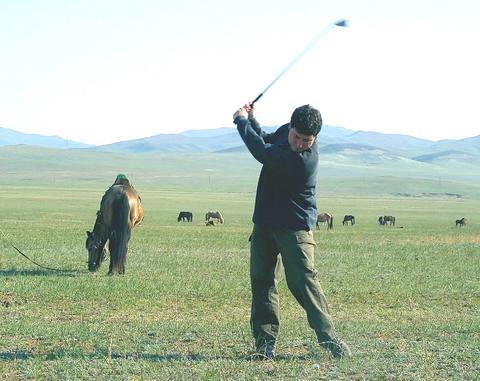
PHOTO: NY TIMES
In a sense, he is. This summer, Tolme, a civil engineer from New Hampshire, is golfing across Mongolia. Treating this enormous Central Asian nation as his private course, he has divided Mongolia into 18 holes. The total fairway distance is 2,322,000 yards. Par is 11,880 strokes.
"You hit the ball," he said, explaining his technique in a land without fences, a nation that is twice the size of Texas. "Then you go and find it. Then you hit it again. And again. And again."
Moving across the rolling steppe, Tolme is walking a route favored almost a millennium ago by Genghis Khan. The fairway may be something less than manicured, but to the north are Siberian forests and to the south is the Gobi Desert, one of the world's largest sand traps.
With his caddy, Khatanbaatar, carrying water, food and a tent in a Russian jeep customized with an upholstery of handwoven rugs, Tolme teed off May 28 and calculates he will finish his game in the trading center of Khovd sometime around the end of July.
That a lone American, armed only with a 3-iron and an easy, impish smile, can golf across Mongolia reflects several factors: the friendliness of largely Buddhist Mongolia to Americans; Mongolia's geography of vast unfenced expanses; and a new extreme golf movement that is prompting young Americans and Europeans to break way out of country clubs.
For Tolme, 35, it is also a summer adventure: a night listening to a chorus of howling wolves; standing dumbstruck as children race horses down the steppe toward him; enjoying the hospitality of the nomads, drinking fermented mare's milk inside a yurt; and watching as sheets of rain and lightning bolts march down the open plain.
"Hey, I watched the movie Caddyshack, I know to keep my club down when there is lightning around," he said. A few minutes later an early summer hail storm struck, driving him into his jeep.
To Khatanbaatar, Tolme's golfing style is a bit of a mystery. "I don't know anything about golf, but what I saw on TV, they put the little ball in a little hole," said Khatanbaatar, a retired soldier who still wears camouflage military fatigues.
Tolme, who learned rudimentary Mongolian while golfing across the eastern half of the country last summer, explains that he considers each major town to be a golf hole. Pocketing the ball upon arrival, he walks through the town and then tees up on the other side.
"I only use the tee when I start a hole," Tolme said, adding that he plays by "winter rules because Mongolia can be often cold."
Last summer, Tolme teed off on June 5 in Choybalsan, an old Soviet Army garrison town in Mongolia's far east, facing the Chinese border. Fifty days and 352 lost balls later he surrendered to nettles and high weeds and halted his march in this interior town, his ninth hole, a place described in the Lonely Planet Mongolia guide as of "little interest" with "dreary hotels."
But Arvayheer is about 160km west of Mongolia's geographical center, and Tolme is confident that, about 5,000 strokes from now, he will putt his last ball into Khovd, reaching a Western Mongolian destination popular with tourists for its deep lakes, high mountains and fast rivers.
Guided by a hand-held Global Positioning System device, he expects to golf about 16km a day, skirting mountain ranges and passing sites like crumbling monasteries and a dinosaur bone quarry.
Tolme's only deadline is to beat the late July rains and the subsequent weed explosion. On the steppe, one of his greatest pleasures is meeting people. Alone under the big sky, chatting occasionally with sympathetic sheep, he now places a new value on human relations.
"I am amazed at how easy it is to live very happily with very little, without gadgets and toys," he said as he bounced along a potholed road leading from Ulan Bator, the capital, to here for his second summer tee-off date. "When I meet people living in a yurt, simple homes in the country side, they laugh, they joke, they all know how to have fun."
Tolme's Web site about his adventure -- www.golfmongolia.com -- is filled with amiable encounters with nomads: a pair of teenage boys teaching him how to shear a sheep and how to hobble a horse; free golfing lessons that left a few more rock scratches on his 3-iron; and major drinking sessions that left everyone fast asleep in a cozy yurt.
The human encounters, Tolme said, more than made up for the flies, the blisters, the sunburn and the poisonous snake that once curled around a ball, protecting it as if it were an egg.
"When I say I am American, the universal response is, `Ah, American, very good country, we like Americans,'" he recalled. Part of the response is geopolitical. Treated as a colony of China for hundreds of years, Mongolia won its independence in 1911, only to fall a decade later under the Soviet orbit. Today, the Mongolian government cultivates friends beyond Russia and China. Many Mongolians are followers of Tibetan Buddhism, and suspicion of China is high.
There are signs that Mongolians are awakening to their golf potential. Last year in Ulan Bator, the first golf course opened, complete with horse-mounted caddies who charge after balls, marking their locations with flags on arrows. Last month, the first indoor driving range opened, also in the capital, which was Tolme's sixth hole.
But, some argue, Mongolia could skip the country club phase of golfing, and embark directly on cross golfing, a populist new trend for hitting balls through unorthodox settings like city parks and streets.
With an open, rolling countryside and fairways cut by roughly 30 million grazing animals, Mongolia is ideal for the casual backyard duffer. Here at a roadside yurt camp, a Mongolian man named Bayara looked at one of his five children preparing to take a hack at the ball and predicted, "Within a few years, these kids will probably be holding sticks of their own."

In late October of 1873 the government of Japan decided against sending a military expedition to Korea to force that nation to open trade relations. Across the government supporters of the expedition resigned immediately. The spectacle of revolt by disaffected samurai began to loom over Japanese politics. In January of 1874 disaffected samurai attacked a senior minister in Tokyo. A month later, a group of pro-Korea expedition and anti-foreign elements from Saga prefecture in Kyushu revolted, driven in part by high food prices stemming from poor harvests. Their leader, according to Edward Drea’s classic Japan’s Imperial Army, was a samurai

The following three paragraphs are just some of what the local Chinese-language press is reporting on breathlessly and following every twist and turn with the eagerness of a soap opera fan. For many English-language readers, it probably comes across as incomprehensibly opaque, so bear with me briefly dear reader: To the surprise of many, former pop singer and Democratic Progressive Party (DPP) ex-lawmaker Yu Tien (余天) of the Taiwan Normal Country Promotion Association (TNCPA) at the last minute dropped out of the running for committee chair of the DPP’s New Taipei City chapter, paving the way for DPP legislator Su
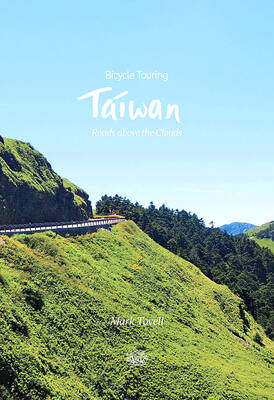
It’s hard to know where to begin with Mark Tovell’s Taiwan: Roads Above the Clouds. Having published a travelogue myself, as well as having contributed to several guidebooks, at first glance Tovell’s book appears to inhabit a middle ground — the kind of hard-to-sell nowheresville publishers detest. Leaf through the pages and you’ll find them suffuse with the purple prose best associated with travel literature: “When the sun is low on a warm, clear morning, and with the heat already rising, we stand at the riverside bike path leading south from Sanxia’s old cobble streets.” Hardly the stuff of your
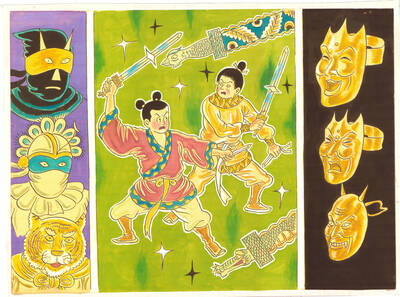
April 22 to April 28 The true identity of the mastermind behind the Demon Gang (魔鬼黨) was undoubtedly on the minds of countless schoolchildren in late 1958. In the days leading up to the big reveal, more than 10,000 guesses were sent to Ta Hwa Publishing Co (大華文化社) for a chance to win prizes. The smash success of the comic series Great Battle Against the Demon Gang (大戰魔鬼黨) came as a surprise to author Yeh Hung-chia (葉宏甲), who had long given up on his dream after being jailed for 10 months in 1947 over political cartoons. Protagonist


 RSS
RSS