


The destination is within clear view, and a beckoning sight it is. Saturn and its creamy pastel bands of thick atmosphere shimmer in pale sunlight, and the majestic rings of dust and rock set it apart from the sun's other worlds.
Dancing about in rhythmic orbits are 31 known satellites, of which the most mysterious and inviting is the planet-size Titan.
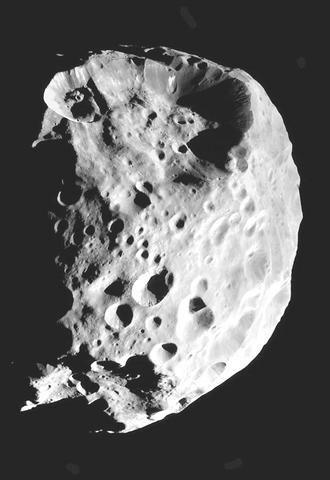
PHOTO: NY TIMES
After a nearly seven-year voyage from Earth, the Cassini spacecraft is fast approaching the moment that scientists have dreamed of and planned for over the better part of their careers. The spacecraft is scheduled to swing into orbit around Saturn on the evening of June 30.
Expectations are high for the US$3.3 billion American-European mission, which is planned to last at least four years and could keep going for as much as a decade.
"The Saturn system represents an unsurpassed laboratory, where we can look for answers to many fundamental questions about the physics, chemistry and evolution of the planets and the conditions that give rise to life," Edward Weiler, associate administrator for science at NASA, said in a statement.
Scientists dare not predict the discoveries waiting to be made as the spacecraft focuses its cameras and instruments repeatedly on Saturn and its signature rings and takes the measure of the icy moons during at least 76 orbits.
"Prepare to be amazed," Carolyn Porco, chief of the mission's imaging team, said in an interview last week.
Anxiety also is rising, though a compensating air of optimism seems to prevail. The spacecraft's performance over the 4.34 billion-kilometer flight so far has been virtually trouble free.
"There's not a single thing to point to and say, `I'm worried about that,"' said Robert Mitchell, the project manager at the Jet Propulsion Laboratory in Pasadena, California, where the mission is being directed.
Still, when the time comes for the Cassini to thread the gap between two dust rings, and the main engine to kick on and burn 96 minutes, slowing for capture by Saturn's strong gravity, Mitchell confessed, "I'll be in mission control with my fingers crossed."
The spacecraft has already had its first Saturn encounter, passing by Phoebe, the planet's small dark outermost moon last Friday. Scientists theorize that in Phoebe they may be getting their first close examination of an object from the outer reaches of the solar system. Everything about its appearance and motions suggests that the 220km-diameter Phoebe originated far beyond the outer planets and that it was flung toward Saturn, which captured it into its orbit.
Saturn itself, second to Jupiter in size, now looms so large with respect to Cassini that it's the planet's full girth no longer fits inside the frame of the craft's narrow-angle camera. The Cassini's two cameras are expected to take as many as 500,000 pictures in the next four years.
If all continues to go well, the spacecraft -- the 2,131kg Cassini orbiter and the attached 317kg Huygens, to be released in December to investigate the atmosphere and surface of Titan -- will arrive at Saturn below the plane of the spreading rings. It is to pass through the gap between the F and G rings.
Recent photography, including observations by the Hubble Space Telescope, shows no sign of hazardous debris in Cassini's path, Mitchell said. Three previous spacecraft have flown through the region without harm.
Once through the passage, the 96-minute firing of the engine is to begin braking the Cassini's velocity. Should the main engine fail, there is a backup. As soon as the Cassini settles into orbit, it is to turn its cameras down for a long close look at the rings, searching for evidence of how particles of dust cluster there, then dissipate and gather again in ever transient structures.
The spacecraft will also be taking some of its closest pictures of Saturn at this point, as it begins the first of its orbits among the planet's family of moons.
Porco, a planetary scientist at the Space Science Institute in Boulder, Colorado, said the initial four-year orbital tour had been plotted in detail "to give us great flexibility in observing all the important targets in the Saturn system."
In the 45 years of space-age exploration of the solar system, spacecraft have visited all the planets, save Pluto. They have orbited Venus, Mars and Jupiter, and landed on Venus and Mars. Three spacecraft have flown by Saturn, but this will be the first attempt to orbit the giant planet.
The object of greatest curiosity for the mission is Titan. Forty-five of the 76 Cassini orbits will include Titan flybys, coming as close as 800km from its surface on some encounters.
The icy moon is larger than Mercury or Pluto and somewhat smaller than Mars. Its substantial atmosphere, like Earth's, is thick with nitrogen, though it has no free oxygen. The other atmospheric components are methane, ethane, propane and other organic materials containing hydrogen and carbon. Titan has a greenhouse-warmed climate with methane clouds and rain, perhaps even lakes.
"Titan is like a time machine taking us to the past to see what Earth might have been like," said Dennis Matson, the project's chief scientist at the Jet Propulsion Laboratory. "The hazy moon may hold clues to how the primitive Earth evolved into a life-bearing planet."
But scientists cautioned that they did not expect that the Cassini mission would find life on Titan.
The large moon has not made it easy for inquiring scientists. A dense haze obscures the surface, except for glimpses of shadowy dark regions that contrast with the occasional bright patch. The approaching cameras of the Cassini have taken some pictures that show surface traces, but no details. In October and again in December, the spacecraft is to fly close enough for its radar to penetrate the clouds and haze for the best mapping yet of a broad swath of Titan's topography.
The European-built Huygens spacecraft will undertake the mission's most ambitious effort to explore Titan. On Dec. 24, the Cassini is to release the wok-shape spacecraft on its 20-day freefall journey to enter Titan's atmosphere. It is to deploy parachutes and begin two and a half hours of intensive observations of the atmosphere for the rest of the descent.
No one is making promises as to if or how long the Huygens will continue transmitting data from the surface -- perhaps three minutes, possibly a half-hour. The European Space Agency managed the development of the spacecraft and is in charge of its operations from a control center in Darmstadt, Germany.
The two spacecraft are named for Europeans who had prominent roles in the early history of Saturn astronomy. Although Galileo in 1610 was the first to observe Saturn's rings, he died never knowing that was what they were. He vaguely described them as "arms" that seemed to grow on Saturn and then disappear for unknown reasons. The mystery was solved a half-century later by the Dutch scientist Christiaan Huygens, who also discovered Titan. Huygens' ring findings were confirmed by observations by the Italian-French astronomer Jean Dominique Cassini.
Scientists and flight controllers of the Cassini mission expect that four years will not be long enough to satisfy their curiosity about Saturn and environs. If they come upon a surprising discovery that cries out for further investigation, they would probably have to wait to pursue that quest after the prime four-year mission is over, said Mitchell, the project manager.
Space craft facts:
* The 'Cassini-Huygens' probe was launched Oct. 15, 1997 and is to start orbiting Saturn on June 30.
* Cassini-Huygens is a US$3 billion joint mission between the National Aeronautics and Space Administration (NASA) and the European Space Agency. NASA built 'Cassini,' ESA built `Huygens.'
* `Cassini-Huygens' will study Saturn, its rings and principal moons for four years.
* Once the probe reaches its destination, it will have traveled 3.5km billion, in nearly seven years.
* It will pass 31 of Saturn's moons during the voyage.
* On Dec. 25, the Cassini orbiter will release its Huygens probe so it can land three weeks later on Saturn's largest moon, Titan.
* Titan has a diameter of more than 5,000km.

In late October of 1873 the government of Japan decided against sending a military expedition to Korea to force that nation to open trade relations. Across the government supporters of the expedition resigned immediately. The spectacle of revolt by disaffected samurai began to loom over Japanese politics. In January of 1874 disaffected samurai attacked a senior minister in Tokyo. A month later, a group of pro-Korea expedition and anti-foreign elements from Saga prefecture in Kyushu revolted, driven in part by high food prices stemming from poor harvests. Their leader, according to Edward Drea’s classic Japan’s Imperial Army, was a samurai

The following three paragraphs are just some of what the local Chinese-language press is reporting on breathlessly and following every twist and turn with the eagerness of a soap opera fan. For many English-language readers, it probably comes across as incomprehensibly opaque, so bear with me briefly dear reader: To the surprise of many, former pop singer and Democratic Progressive Party (DPP) ex-lawmaker Yu Tien (余天) of the Taiwan Normal Country Promotion Association (TNCPA) at the last minute dropped out of the running for committee chair of the DPP’s New Taipei City chapter, paving the way for DPP legislator Su

It’s hard to know where to begin with Mark Tovell’s Taiwan: Roads Above the Clouds. Having published a travelogue myself, as well as having contributed to several guidebooks, at first glance Tovell’s book appears to inhabit a middle ground — the kind of hard-to-sell nowheresville publishers detest. Leaf through the pages and you’ll find them suffuse with the purple prose best associated with travel literature: “When the sun is low on a warm, clear morning, and with the heat already rising, we stand at the riverside bike path leading south from Sanxia’s old cobble streets.” Hardly the stuff of your

April 22 to April 28 The true identity of the mastermind behind the Demon Gang (魔鬼黨) was undoubtedly on the minds of countless schoolchildren in late 1958. In the days leading up to the big reveal, more than 10,000 guesses were sent to Ta Hwa Publishing Co (大華文化社) for a chance to win prizes. The smash success of the comic series Great Battle Against the Demon Gang (大戰魔鬼黨) came as a surprise to author Yeh Hung-chia (葉宏甲), who had long given up on his dream after being jailed for 10 months in 1947 over political cartoons. Protagonist


 RSS
RSS