


It's not as fast as a speeding bullet, but it is the fastest thing on rails. Or rather, just above the rails.
Japan's so-called maglev train, which is levitated and propelled forward by magnetic force, is so fast it presses passengers back in their seats as it accelerates to 500kph in a little more than a minute.
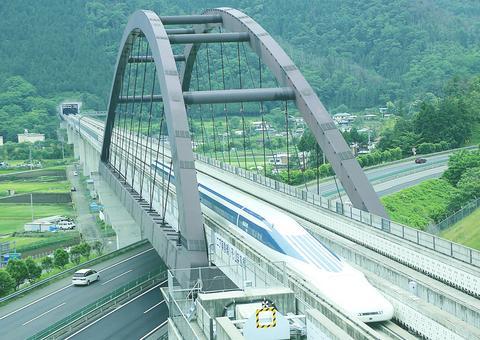
PHOTO: REUTERS
Central Japan Railway Co, the company developing Japan's version of the train, is pushing for a commercial line between Tokyo and the western city of Osaka, a distance that is about the same as going from Washington to New York.
Theoretically, people would be able to travel between Tokyo and Osaka -- a nearly three-hour ride with current high-speed trains -- in an hour flat. That would make it the same time as an average commute in Tokyo and surrounding areas.
"It will be possible to finish work in Tokyo, catch a concert in Osaka and return home that evening," said Akio Seki, director general of Central Japan Railway's maglev system development division.
"Tokyo, Nagoya [in central Japan] and Osaka will become like one city."
Except for one problem: There is currently only one station and just 18.4km of test track.
There are no current plans for building a maglev line despite nearly four decades of research, 15 years of testing and more than US$2 billion invested, including government subsidies.
JR Central has said it is prepared to shoulder the operational costs, but it believes the government should pay the cost of building the infrastructure, which is estimated to be US$64 billion to US$77 billion, or upwards of US$128 million per kilometer.
That's a steep price to pay in a country that already has shinkansen bullet trains that connect major cities and can take passengers from Tokyo to Osaka in two-and-a-half hours. Travelers in a hurry can fly.
"The government will likely build shinkansen tracks in Kyushu and Hokkaido before they consider building a maglev track. Maglev service is a long way away," said Douglas Hayashi, an analyst with HSBC, referring to Japan's northern- and southern-most islands. "There's no guarantee it will become a reality."
The technology, first invented in the US in the mid-1960s, uses superconducting magnets to float the train about 10cm above the track, eliminating friction between the wheels and track. The train is propelled by a linear motor.
In test runs, the maglev train runs on wheels until it reaches 130kph, at which point it begins to glide smoothly. The train lurches a bit and is noisy inside because of air disturbance, but officials say they know how to fix both.
Last December, the maglev won the Guiness World Record for fastest train by going 581kph. It has beaten its own world record twice since it overtook France's TGV, the previous record-holder, in 1997.
Besides Japan, Germany and the US have tested maglev technology. China in January started the world's first commercial high-speed maglev service between Shanghai's international airport and its financial district.
Detractors of a Japanese maglev system say travelers won't shell out the estimated 15,000 to 20,000 yen (US$135 to US$180) for a one-way maglev ticket, especially when a shinkansen costs 14,000 yen and a plane ticket costs as little as 10,000 yen.
In Shanghai, ticket prices have already been slashed by a third because customers found prices to be too high.
JR Central officials say that's precisely the reason why they are doing everything to keep costs down.
While maglevs use three times more energy than shinkansen, the operational and maintenance costs are significantly lower, said JR Central's Seki.
The maglev is also computer-operated, so it doesn't need a driver and it is expected to carry more passengers and log greater daily distances than current shinkansen trains.
"We are confident the maglev will be realized," said Seki, adding that a 1973 law already approves a second shinkansen line between Tokyo and Osaka in anticipation of overcapacity on the first line and to serve as insurance against an earthquake.
"The government must change its investment priority."
Satoru Sone, an engineering professor at Kogakuin University believes commercialization of the maglev would be possible if the infrastructure costs fell to between five to six trillion yen, or about 35 percent lower than current estimates.

In late October of 1873 the government of Japan decided against sending a military expedition to Korea to force that nation to open trade relations. Across the government supporters of the expedition resigned immediately. The spectacle of revolt by disaffected samurai began to loom over Japanese politics. In January of 1874 disaffected samurai attacked a senior minister in Tokyo. A month later, a group of pro-Korea expedition and anti-foreign elements from Saga prefecture in Kyushu revolted, driven in part by high food prices stemming from poor harvests. Their leader, according to Edward Drea’s classic Japan’s Imperial Army, was a samurai

The following three paragraphs are just some of what the local Chinese-language press is reporting on breathlessly and following every twist and turn with the eagerness of a soap opera fan. For many English-language readers, it probably comes across as incomprehensibly opaque, so bear with me briefly dear reader: To the surprise of many, former pop singer and Democratic Progressive Party (DPP) ex-lawmaker Yu Tien (余天) of the Taiwan Normal Country Promotion Association (TNCPA) at the last minute dropped out of the running for committee chair of the DPP’s New Taipei City chapter, paving the way for DPP legislator Su
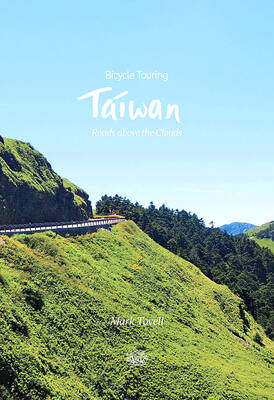
It’s hard to know where to begin with Mark Tovell’s Taiwan: Roads Above the Clouds. Having published a travelogue myself, as well as having contributed to several guidebooks, at first glance Tovell’s book appears to inhabit a middle ground — the kind of hard-to-sell nowheresville publishers detest. Leaf through the pages and you’ll find them suffuse with the purple prose best associated with travel literature: “When the sun is low on a warm, clear morning, and with the heat already rising, we stand at the riverside bike path leading south from Sanxia’s old cobble streets.” Hardly the stuff of your

April 22 to April 28 The true identity of the mastermind behind the Demon Gang (魔鬼黨) was undoubtedly on the minds of countless schoolchildren in late 1958. In the days leading up to the big reveal, more than 10,000 guesses were sent to Ta Hwa Publishing Co (大華文化社) for a chance to win prizes. The smash success of the comic series Great Battle Against the Demon Gang (大戰魔鬼黨) came as a surprise to author Yeh Hung-chia (葉宏甲), who had long given up on his dream after being jailed for 10 months in 1947 over political cartoons. Protagonist


 RSS
RSS