


Driving into the Baimi Community in Suao, Ilan County, a pair of giant wooden clogs standing in the park caught my sight. And then, in front of the Wood Clog Museum (
It was a day of pouring rain and they said a typhoon was coming. But there were still 70 people in the small museum.
Ten years ago, Chen Hsin-hsiung (
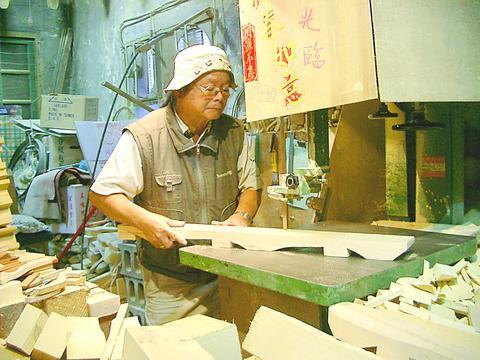
PHOTO: YU SEN-LUN, TAIPEI TIMES
Chen now makes clogs behind the display window in the museum, ensuring that every passing guest to the museum can see how a pair of clogs is made, from cutting the wood to nailing the leather parts together.
"This pair is in a Japanese style. The ones with sharp, warped heads are the Harry Potter clogs. Even sharper heads is my new invention, the `Queen's Clog,'" the 67 year-old Chen said, who has been making the wooden shoes since he was 14.
Chen's Baimi (
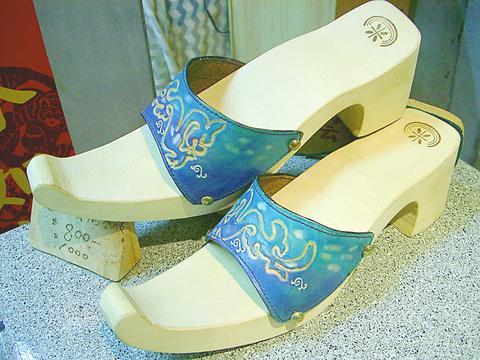
PHOTO: YU SEN-LUN, TAIPEI TIMES
In Taiwan, there are less than 10 clog-making masters like Chen. Baimi community is one of the remaining villages with clog-making masters. The golden days of clog making in Taiwan was the 1930s to 1970s.
"In the old days, only rich people could afford a pair of clogs. Clogs were for high-class people. It is not as you would imagine, that only gangsters wear clogs," Chen said, recounting that in the past he made a lot of money from his trade. The demand was so high that he had to finish up to 10 pairs a day.
"During that time, a pair of clogs cost NT$35, which was the same price as a gold necklace."
PHOTOS: YU SEN-LUN, TAIPEI TIMES
The clog business was good until in the 1980s when Taiwan's plastic industry took off and a pair of plastic shoes cost only NT$15.
Chen retired from making clogs in 1993, and became a carpenter for 10 years and more than 10 clog shops in the town closed down.
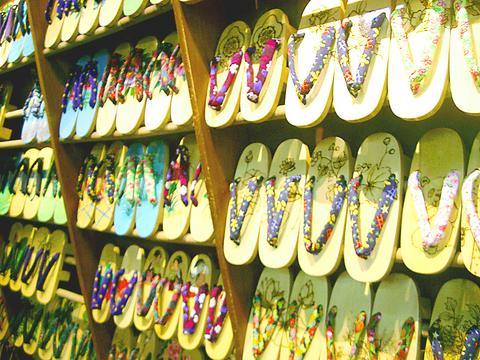
But Baimi revived the clog-making business and now the community of 1,000 has said good-bye to the dusty pollution of its cement industry and welcomed its hand-made clog business. Eventually the Wood Clog Museum was set up in 1997. Now, clog-sales are around NT$900,000 per month. About 30 people make a living by making, decorating or selling the clogs.
Chen was first asked to give classes on clog making when the mini industry was revived and most of his students were housewives.
In the first year, the monthly revenue of the Wood Clog Museum was less than NT$100,000, but after the museum was reported on TV shows, the community gained some measure of fame and revenues rose.
"We now make about NT$20,000 a month. It's not big, but enough to give my kids a better education," said a housewife in charge of leather carving at the museum, who did not want to be named.
As more tourists arrived to visit the museum, local cement factories began to modify their facilities to reduce the amount of dust.
Chen said that, for him, clog-making is a means of making money, but also a way of life.
"I not only work behind the display window, but I also focus more on inventing new styles of clogs," he said.
His most recent work is a pair of giant clogs 80m long that weigh 1,500kg. "This is the pair that I'm going to challenge the Guiness world record for," he said.
Next week, in the final part of the series, we look at the job of the road-side jasmine seller

Sept.16 to Sept. 22 The “anti-communist train” with then-president Chiang Kai-shek’s (蔣介石) face plastered on the engine puffed along the “sugar railway” (糖業鐵路) in May 1955, drawing enthusiastic crowds at 103 stops covering nearly 1,200km. An estimated 1.58 million spectators were treated to propaganda films, plays and received free sugar products. By this time, the state-run Taiwan Sugar Corporation (台糖, Taisugar) had managed to connect the previously separate east-west lines established by Japanese-era sugar factories, allowing the anti-communist train to travel easily from Taichung to Pingtung’s Donggang Township (東港). Last Sunday’s feature (Taiwan in Time: The sugar express) covered the inauguration of the

The corruption cases surrounding former Taipei Mayor and Taiwan People’s Party (TPP) head Ko Wen-je (柯文哲) are just one item in the endless cycle of noise and fuss obscuring Taiwan’s deep and urgent structural and social problems. Even the case itself, as James Baron observed in an excellent piece at the Diplomat last week, is only one manifestation of the greater problem of deep-rooted corruption in land development. Last week the government announced a program to permit 25,000 foreign university students, primarily from the Philippines, Indonesia and Malaysia, to work in Taiwan after graduation for 2-4 years. That number is a

In a stark demonstration of how award-winning breakthroughs can come from the most unlikely directions, researchers have won an Ig Nobel prize for discovering that mammals can breathe through their anuses. After a series of tests on mice, rats and pigs, Japanese scientists found the animals absorb oxygen delivered through the rectum, work that underpins a clinical trial to see whether the procedure can treat respiratory failure. The team is among 10 recognized in this year’s Ig Nobel awards (see below for more), the irreverent accolades given for achievements that “first make people laugh, and then make them think.” They are not

This Qing Dynasty trail takes hikers from renowned hot springs in the East Rift Valley, up to the top of the Coastal Mountain Range, and down to the Pacific Short vacations to eastern Taiwan often require choosing between the Rift Valley with its pineapple fields, rice paddies and broader range of amenities, or the less populated coastal route for its ocean scenery. For those who can’t decide, why not try both? The Antong Traversing Trail (安通越嶺道) provides just such an opportunity. Built 149 years ago, the trail linked up these two formerly isolated parts of the island by crossing over the Coastal Mountain Range. After decades of serving as a convenient path for local Amis, Han settlers, missionaries and smugglers, the trail fell into disuse once modern roadways were built


 RSS
RSS