


Borobudur temple rises in an immense dark stone pyramid from a fertile volcanic plain, a spiritual monument at the center of a battle over tourism and commerce.
Indonesia's fortunes have waned since the Asian financial crisis of the late 1990s and the world's largest Buddhist monument with its tourist pulling power is a cash honey pot in tough times.
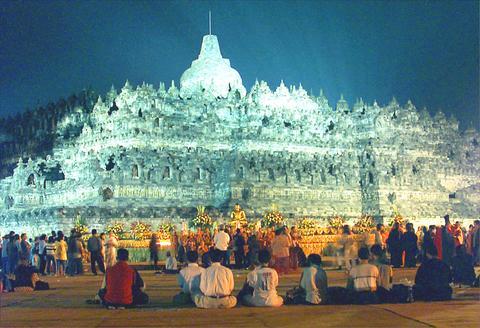
PHOTO: REUTERS
But hawker numbers at the UNESCO World Heritage site have exploded and tourists find themselves besieged by sometimes aggressive sellers of everything from postcards to toys.
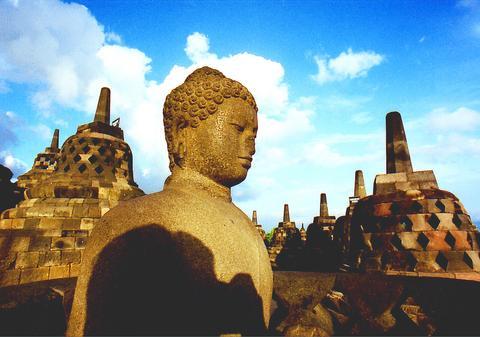
PHOTO: REUTERS
Now, regional authorities want to clean up the area with new shopping projects that critics say are an even greater threat to the integrity of the site in the heart of Java, Indonesia's main island.
"Promotion of shopping tourism within the preservation precinct of Borobudur is simply not acceptable," said Richard Engelhardt, UNESCO Regional Adviser for Culture in Asia and the Pacific.
"The site is supposed to be a site of solitude and meditation where you can bring yourself to a point where you and nature become one, and you can't do this if you are ringed by a shopping mall."
VOLCANIC ASH AND JUNGLE
Borobudur, not far from Java's ancient royal capital Yogyakarta, dates back to around AD 800, long before Islam became the dominant religion in the world's most populous Muslim nation.
The monument was neglected and abandoned for almost a thousand years before it was rediscovered under volcanic ash and jungle in the 1800s, when a survey team investigated talk of a great ruin in central Java.
For many Indonesians, the religious nature of the site is of little importance to them and this partly explains the planned commercialisation, say some experts.
Borobudur represents a Buddhist view of the universe, comprising a series of square and circular terraces that allow visitors to move upward from the everyday world to a large bell-shaped stupa representing nirvana.
The square terraces lie within stone walls carved in intricate detail which provide lessons to pilgrims through scenes illustrating Buddhist thought and the life of Buddha.
Steep stairways rise to the wide-open circular terraces, where stone-lattice stupas contain Buddha statues overlooking the tropical green plain and its distant volcanoes.
It's a landscape that evokes a sense of calm, enhanced by the the monument's peaceful, if mysterious, atmosphere. The detail of the stone reliefs and serene expressions of the statues add to the effect.
But serenity is missing in the car park where calls of, "Look madame, batik postcard," "Hello...water?" "Like pen?" "This book," "Maybe later?" is the typical chorus following tourists.
Dutch tourists Rob and Angela Joosten from Amsterdam said the temple held a mystique, but the hawkers were irritating.
"They are quite aggressive and pushy ... Some I can understand, but there are too many," said Rob Joosten.
Borobudur is not the only monument of global significance where tourists run a gauntlet of sales people.
But Ken Scott of Pacific Asia Travel Association said it was toward the bad end of the spectrum.
"If people travel around the world to see this acclaimed Buddhist structure you want to make sure that they enjoy the experience and are not hassled to buy irrelevant goods or to have the experience downgraded by commercial elements," he said.
SHOPPING MALL EYESORE
Last year Borobudur attracted more than 2 million tourists, mostly Indonesians, as foreign numbers fell after the 2002 Bali bombings and a wider international travel downturn.
But the enduring drawing power of the site and the existing problems have sparked retail plans that have horrified UNESCO, the cultural arm of the United Nations.
These include the Jagad Jawa, or "Spirit World of Java" retail shopping complex and light rail system proposal suggested last year by the Central Java authorities and later put on hold after a widespread outcry.
Engelhardt said various concepts were still circling.
"The issue of the shopping mall keeps coming up in many different forms and guises," he said.
UNESCO and the International Council on Monuments and Sites, which advises on world heritage listings, favor some retailing, but prefer a lower-key local arts and crafts bazaar that would assist and involve the nearby community.
Current items sold are mostly viewed as low quality, generic goods that benefit traders from outside the region.
The issues are to be considered at a UNESCO World Heritage Committee meeting in China from June 28 to July 9.
UNESCO also wants more emphasis at Borobudur on the historic, cultural and spiritual values that are often lost on visitors scrambling to the top for the view and a photo.
Wiendu Nuryanti, director of Tourism Research and Development at the Yogyakarta-based research group Stuppa Indonesia, said there was great pride and appreciation of Borobudur within Indonesia.
But she said the issues at the site partly reflected a disconnect between a predominantly Muslim community and a site seen as a relic from a long-ago era.
"There is no direct religious link between the temple and the (Muslim) community," she said. "If this monument lived in the middle of a Buddhist society I think it would be different."

In late October of 1873 the government of Japan decided against sending a military expedition to Korea to force that nation to open trade relations. Across the government supporters of the expedition resigned immediately. The spectacle of revolt by disaffected samurai began to loom over Japanese politics. In January of 1874 disaffected samurai attacked a senior minister in Tokyo. A month later, a group of pro-Korea expedition and anti-foreign elements from Saga prefecture in Kyushu revolted, driven in part by high food prices stemming from poor harvests. Their leader, according to Edward Drea’s classic Japan’s Imperial Army, was a samurai

The following three paragraphs are just some of what the local Chinese-language press is reporting on breathlessly and following every twist and turn with the eagerness of a soap opera fan. For many English-language readers, it probably comes across as incomprehensibly opaque, so bear with me briefly dear reader: To the surprise of many, former pop singer and Democratic Progressive Party (DPP) ex-lawmaker Yu Tien (余天) of the Taiwan Normal Country Promotion Association (TNCPA) at the last minute dropped out of the running for committee chair of the DPP’s New Taipei City chapter, paving the way for DPP legislator Su

It’s hard to know where to begin with Mark Tovell’s Taiwan: Roads Above the Clouds. Having published a travelogue myself, as well as having contributed to several guidebooks, at first glance Tovell’s book appears to inhabit a middle ground — the kind of hard-to-sell nowheresville publishers detest. Leaf through the pages and you’ll find them suffuse with the purple prose best associated with travel literature: “When the sun is low on a warm, clear morning, and with the heat already rising, we stand at the riverside bike path leading south from Sanxia’s old cobble streets.” Hardly the stuff of your
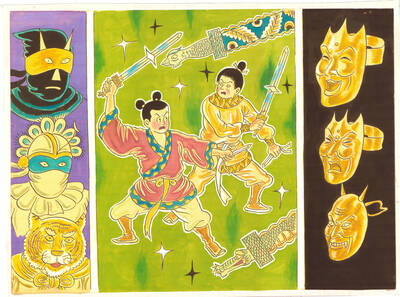
April 22 to April 28 The true identity of the mastermind behind the Demon Gang (魔鬼黨) was undoubtedly on the minds of countless schoolchildren in late 1958. In the days leading up to the big reveal, more than 10,000 guesses were sent to Ta Hwa Publishing Co (大華文化社) for a chance to win prizes. The smash success of the comic series Great Battle Against the Demon Gang (大戰魔鬼黨) came as a surprise to author Yeh Hung-chia (葉宏甲), who had long given up on his dream after being jailed for 10 months in 1947 over political cartoons. Protagonist


 RSS
RSS