


For the Maya of Central America, cocoa was the drink of the gods, and for years after it was introduced to Europe it was the preserve of the aristocracy.
More recently it has been seen as a children's drink, but now it is making a comeback among gourmets and top chefs, who are rediscovering drinking chocolate.
Health experts are simultaneously finding out that some of the chemicals in cocoa can have a positive effect on the heart and blood circulation.
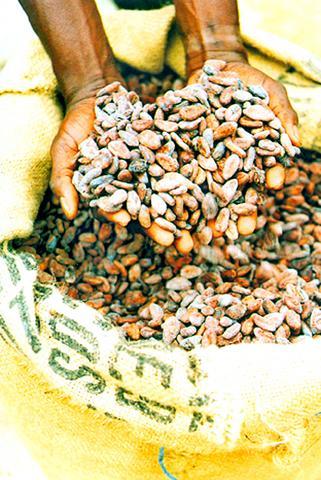
PHOTO: DPA
For decades the image of cocoa was that of a commercially prepared drink turned into a sweetened instant powder and directed at the children's market.
Shops and supermarkets stopped stocking pure cocoa, which is characterized by its dark brown color and bitter tang, but now the unadulterated product is finding new markets.
"Once the sugar is removed and replaced by more interesting tastes, such as ginger, even men begin to take an interest," says Martin van Almsinck, who works for the Chocolate Museum Imhoff-Stollwerck in Cologne.
The art of making good cocoa consists in adding spices and other ingredients. In the museum's cafe there are 14 different kinds of drinking chocolate.
For example the "Pink Pepper" flavor has a piquant tang, while the "Grande Aroma Fromboise," with its spirit of raspberries, has a fruity nose.
The Dutch Cocoa House in Hanover, which has specialized in drinking chocolate since 1921, offers a similarly wide range of hot drinks.
"Our Chocolate Hawaii is a hit, with Cointreau and a dollop of cream," says Monika Schneider, who works there.
Amaretto, rum, brandy or egg liqueur can all provide that special lift for cocoa, but it can also be turned into a delicious drink without the addition of alcohol.
Michael Beck, a top chef from the Old Rose Restaurant in Hofheim-Wildsachsen in the German state of Hesse believes well-spiced cocoa is an ideal pick-me-up during the cold and dark times of the year.
"Bring milk to the boil, add the finely chopped chocolate and stir thoroughly with a pinch of salt. Then add nutmeg, cinammon, cloves and green cardamom," Beck says.
Cocoa's stimulative effect -- it was once regarded as an aphrodisiac -- comes from some of the chemicals in the cocoa bean. The plant, which carries the scientific name theobroma cacao, contains caffeine along with another stimulant theobromine.
In addition it contains substances that are needed for the body to make the hormone serotonin, which induces a happy feeling.
"Nowhere else has nature compressed such a store of the most valuable nutrients into such a small place as it has with the cocoa bean," the researcher Alexander von Humboldt (1769 to 1859) once said.
The trace elements potassium and magnesium are found in cocoa, along with polyphenols, chemicals that have only recently been studied.
Susanne Schelosky, a scientist at the Institute for Nutrition Studies at Nuthetal near Potsdam, says: "Bitter chocolate with a high cocoa content can have the effect of depressing the blood pressure slightly."
Cocoa also contains anti-oxidants, which are thought to protect against heart disease and cancer, although experts certainly do not advise that patients should start consuming large quantities of chocolate, as the negative effects of the high fat content outweigh the benefits.
Drinking chocolate, however, usually contains much less fat.
"The cocoa bean has a natural fat content of more than 50 percent, while cocoa powder only contains 10 to 20 percent," Van Almsinck says.
After being roasted most cocoa bean kernels are ground up into a a fatty mass, but to make cocoa powder alkalis are used and the resultant liquid allowed to dry. Most cocoa beans these days come from the Ivory Coast and Ghana, which together account for more than half the world's production.
While the Forastero strain accounts for the bulk of world production, the variety Criollo, grown in Madagascar and the Caribbean is regarded by many experts to be of better quality and with a stronger aroma.
The Olmeks gave the plant the name "kakawa" some 3,000 years ago. When the Spanish conquered Mexico around 1500 they at first dismissed cocoa as too bitter, but soon found the addition of sugar made it more palatable.

In late October of 1873 the government of Japan decided against sending a military expedition to Korea to force that nation to open trade relations. Across the government supporters of the expedition resigned immediately. The spectacle of revolt by disaffected samurai began to loom over Japanese politics. In January of 1874 disaffected samurai attacked a senior minister in Tokyo. A month later, a group of pro-Korea expedition and anti-foreign elements from Saga prefecture in Kyushu revolted, driven in part by high food prices stemming from poor harvests. Their leader, according to Edward Drea’s classic Japan’s Imperial Army, was a samurai

The following three paragraphs are just some of what the local Chinese-language press is reporting on breathlessly and following every twist and turn with the eagerness of a soap opera fan. For many English-language readers, it probably comes across as incomprehensibly opaque, so bear with me briefly dear reader: To the surprise of many, former pop singer and Democratic Progressive Party (DPP) ex-lawmaker Yu Tien (余天) of the Taiwan Normal Country Promotion Association (TNCPA) at the last minute dropped out of the running for committee chair of the DPP’s New Taipei City chapter, paving the way for DPP legislator Su
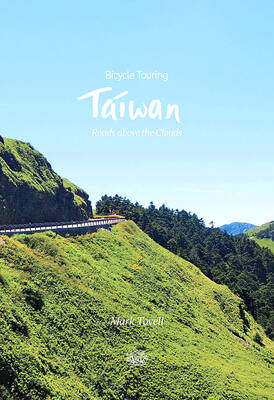
It’s hard to know where to begin with Mark Tovell’s Taiwan: Roads Above the Clouds. Having published a travelogue myself, as well as having contributed to several guidebooks, at first glance Tovell’s book appears to inhabit a middle ground — the kind of hard-to-sell nowheresville publishers detest. Leaf through the pages and you’ll find them suffuse with the purple prose best associated with travel literature: “When the sun is low on a warm, clear morning, and with the heat already rising, we stand at the riverside bike path leading south from Sanxia’s old cobble streets.” Hardly the stuff of your
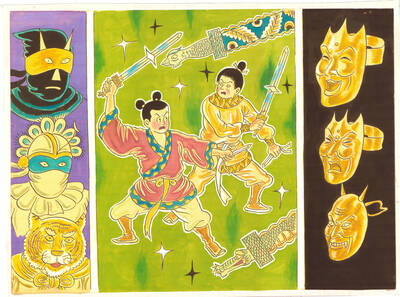
April 22 to April 28 The true identity of the mastermind behind the Demon Gang (魔鬼黨) was undoubtedly on the minds of countless schoolchildren in late 1958. In the days leading up to the big reveal, more than 10,000 guesses were sent to Ta Hwa Publishing Co (大華文化社) for a chance to win prizes. The smash success of the comic series Great Battle Against the Demon Gang (大戰魔鬼黨) came as a surprise to author Yeh Hung-chia (葉宏甲), who had long given up on his dream after being jailed for 10 months in 1947 over political cartoons. Protagonist


 RSS
RSS