


While all too many exhibitions relating to China's social, agricultural and scientific developments rely on yellowing pages of drab printed matter and a few lifeless artifacts, The National Museum of Science's (
Divided into six units, the exhibition rooms give visitors an insightful glimpse into Chinese scientific and technological discoveries, early irrigation and farming techniques, religion, medicine, spirituality and the area's indigenous peoples.
The hall's central and most breathtaking unit is that dedicated to science and technology. Here visitors get to view artifacts and -- at the touch of a button -- can listen to commentaries explaining the history of early experiments with gunpowder, the earliest forms of printing and the invention of the compass. While all very interesting, it is the exhibition hall's impressive collection of models that make for the most fascinating viewing.
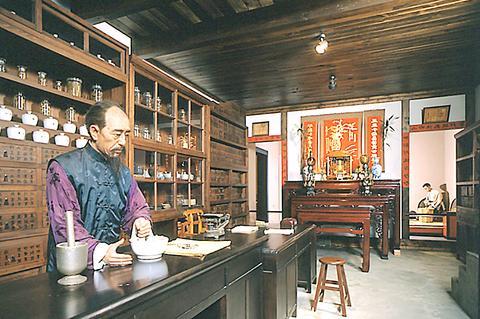
PHOTO COURTESY OF THE NATIONAL MUSEUM OF SCIENCE
Wooden scaled-down replicas of sand junks show how Chinese shipbuilders employed bulkheads, a model of a 13th century Equatorial Torquetum shows how early astronomers determined the locations of constellations and a reconstruction of a Tang Dynasty (618 to 907) structure lets visitors see how Chinese construction was developed.
Although all the models are remarkable, the most striking is the huge working replica of a water-powered armillary sphere, which was invented during the northern Sung Dynasty (960 to 1127) and used to tell both the time and make astronomical observations. The 12m high true-to-scale fully functional wooden model is an exact copy of one that stood in the imperial palace in 1088.
Moving on from technology and science, the Chinese Medicine hall gives visitors insight into the development of herbal medicine and oriental therapies such as acupuncture. This area includes an informative film, which tells of the therapeutic values of flora, and shows some rather gruesome early healing tools.
The only part of the exhibition that deals in any depth with Taiwan is the Taiwan Aborigines and Austronesian area, where wax dummies bedecked in the traditional costumes of Taiwan's dozen Aboriginal tribes pale in comparison with the Science Hall's other more creative and accurate models.
Possibly the hall's least visited -- but it is still an insightful exhibition space -- is the Agricultural Development section. Well organized and sometimes free of screaming children, the area includes a selection of early farming implements dating back to the eastern Han Dynasty (25 to 220) and a collection of stone inscriptions portraying early farming methods.
While the exhibition is not without its faults (no English-language material is one irritation), a visit to The National Museum of Science's Chinese Hall makes for an interesting hour or so.

In late October of 1873 the government of Japan decided against sending a military expedition to Korea to force that nation to open trade relations. Across the government supporters of the expedition resigned immediately. The spectacle of revolt by disaffected samurai began to loom over Japanese politics. In January of 1874 disaffected samurai attacked a senior minister in Tokyo. A month later, a group of pro-Korea expedition and anti-foreign elements from Saga prefecture in Kyushu revolted, driven in part by high food prices stemming from poor harvests. Their leader, according to Edward Drea’s classic Japan’s Imperial Army, was a samurai

The following three paragraphs are just some of what the local Chinese-language press is reporting on breathlessly and following every twist and turn with the eagerness of a soap opera fan. For many English-language readers, it probably comes across as incomprehensibly opaque, so bear with me briefly dear reader: To the surprise of many, former pop singer and Democratic Progressive Party (DPP) ex-lawmaker Yu Tien (余天) of the Taiwan Normal Country Promotion Association (TNCPA) at the last minute dropped out of the running for committee chair of the DPP’s New Taipei City chapter, paving the way for DPP legislator Su
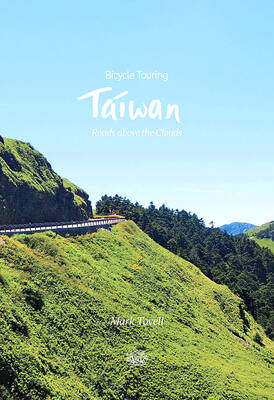
It’s hard to know where to begin with Mark Tovell’s Taiwan: Roads Above the Clouds. Having published a travelogue myself, as well as having contributed to several guidebooks, at first glance Tovell’s book appears to inhabit a middle ground — the kind of hard-to-sell nowheresville publishers detest. Leaf through the pages and you’ll find them suffuse with the purple prose best associated with travel literature: “When the sun is low on a warm, clear morning, and with the heat already rising, we stand at the riverside bike path leading south from Sanxia’s old cobble streets.” Hardly the stuff of your
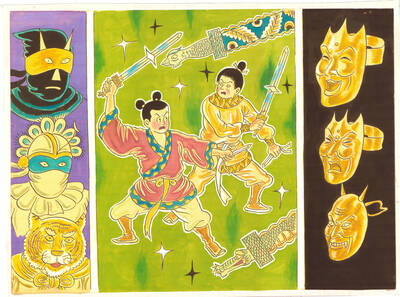
April 22 to April 28 The true identity of the mastermind behind the Demon Gang (魔鬼黨) was undoubtedly on the minds of countless schoolchildren in late 1958. In the days leading up to the big reveal, more than 10,000 guesses were sent to Ta Hwa Publishing Co (大華文化社) for a chance to win prizes. The smash success of the comic series Great Battle Against the Demon Gang (大戰魔鬼黨) came as a surprise to author Yeh Hung-chia (葉宏甲), who had long given up on his dream after being jailed for 10 months in 1947 over political cartoons. Protagonist


 RSS
RSS