


Hoang Hiep Binh is a fiddler in a music band who never goes on stage to perform and doesn't even play at home to relax since most people within earshot would not want to listen to his tunes.
Binh plays a two-stringed fiddle in a band that serves the dead.
Unlike in Western countries where hymns, classical, jazz or pop music can be heard at funerals, Vietnam has a specific musical genre for mourning the dead and comforting the living with the belief that the strains accompany the soul to the Land of Buddha.
Having disappeared during the 1960s and the 1970s under the communist government opposed to superstition, and interrupted by the Vietnam War that ended in 1975, funeral music was only revived two decades ago as living standards rose.
In Thailand, also a heavily Buddhist country, the music is not as popular, but live bands and tapes of funeral songs are sometimes heard at funerals.
Playing funeral music is one of Vietnam's oldest professions, often passed down within families and used not just at Buddhist ceremonies but also at non-religious ones.
Yet its practitioners and fans say the music does not get enough respect.
"It has an important position in the life of the Vietnamese but people do not look at it as an artistic activity," said Dang Hoanh Loan, deputy head of the Vietnam Institute for Musicology and a traditional music researcher.
Binh, who has an athlete's build, said most of the fault lies with the musicians themselves who were mostly less-educated rice farmers more accustomed to hard labor than to fine art. Their crude demeanor spoiled the image of funeral musicians, he said.
"They have themselves caused the disrespect," he said. "Sometimes I wanted to quit because of that social concept."
Originally, the eight-piece band -- including a bell, a drum, a two-stringed fiddle, a three-stringed lute, a flute and a pair of cymbals -- played continuously from the moment the deceased was placed in a coffin until burial.
"But the picture of the funeral music nowadays is a musical mixture of several types," Loan said. "There are no more eight-piece bands. ... It is no longer genuine."
Band members have always been men because in the old feudal era women were not allowed access to sacred places, he said.
With nearly a decade in the job, Binh is able to play the drum, a monochord or a fiddle in order to stand in for anyone in his band of five. Other bands have four to six members.
Musicians said the better bands play at about a dozen funerals a month. A qualified player can earn three to four million dong (US$190 to US$255) monthly. Per capita income is about $400 a year in Vietnam.
The bands are often hired for funerals held at home, often playing until midnight.
"The busiest time is from October, it could be a funeral every two days. When the business is less, I have to do other jobs," said musician Hanh who, in his late 40s, is also a motorcycle taxi driver.
The colder months, particularly in north Vietnam, tend to result in more illnesses.
But growth in the bands is limited by factionalism. Loan said each commune or village has its own band and the job is only passed from father to son.
"That has led to limits in the creativeness, in compositions and so there is no school," Loan said. His facility, set up in 1951, is the state body charged with preserving national music.
Bands compete not just against each other, but also against taped music that is played when the players take a breather and sometimes as a substitute for live performers.
Hanoi city's main funeral hall often uses a taped revolutionary song glorifying fallen soldiers for state officials.
Loan said even if little research had been done on Vietnam's music for the dead, he believes it will stand the test of time to comfort future generations.
"This music never dies in the heart of the Vietnamese people. Part of it was lost and then resurrected, having entered the spiritual life of the Vietnamese," Loan said.
Hanoi resident Le Vinh Ha agrees. "The music is very much in need because, without it, nothing can fill in the emptiness (in the heart)," she said after attending her grandmother's funeral.

In late October of 1873 the government of Japan decided against sending a military expedition to Korea to force that nation to open trade relations. Across the government supporters of the expedition resigned immediately. The spectacle of revolt by disaffected samurai began to loom over Japanese politics. In January of 1874 disaffected samurai attacked a senior minister in Tokyo. A month later, a group of pro-Korea expedition and anti-foreign elements from Saga prefecture in Kyushu revolted, driven in part by high food prices stemming from poor harvests. Their leader, according to Edward Drea’s classic Japan’s Imperial Army, was a samurai

The following three paragraphs are just some of what the local Chinese-language press is reporting on breathlessly and following every twist and turn with the eagerness of a soap opera fan. For many English-language readers, it probably comes across as incomprehensibly opaque, so bear with me briefly dear reader: To the surprise of many, former pop singer and Democratic Progressive Party (DPP) ex-lawmaker Yu Tien (余天) of the Taiwan Normal Country Promotion Association (TNCPA) at the last minute dropped out of the running for committee chair of the DPP’s New Taipei City chapter, paving the way for DPP legislator Su

It’s hard to know where to begin with Mark Tovell’s Taiwan: Roads Above the Clouds. Having published a travelogue myself, as well as having contributed to several guidebooks, at first glance Tovell’s book appears to inhabit a middle ground — the kind of hard-to-sell nowheresville publishers detest. Leaf through the pages and you’ll find them suffuse with the purple prose best associated with travel literature: “When the sun is low on a warm, clear morning, and with the heat already rising, we stand at the riverside bike path leading south from Sanxia’s old cobble streets.” Hardly the stuff of your
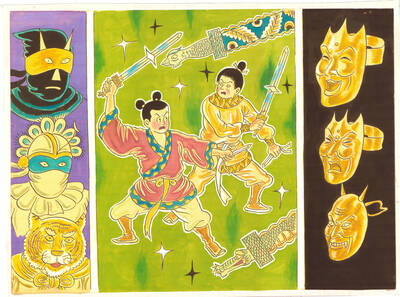
April 22 to April 28 The true identity of the mastermind behind the Demon Gang (魔鬼黨) was undoubtedly on the minds of countless schoolchildren in late 1958. In the days leading up to the big reveal, more than 10,000 guesses were sent to Ta Hwa Publishing Co (大華文化社) for a chance to win prizes. The smash success of the comic series Great Battle Against the Demon Gang (大戰魔鬼黨) came as a surprise to author Yeh Hung-chia (葉宏甲), who had long given up on his dream after being jailed for 10 months in 1947 over political cartoons. Protagonist


 RSS
RSS