


First introduced to Taiwan in the early 1970s by US soldiers stationed here during the Vietnam War, hockey has never taken off in the same way as basketball and baseball. Along with the need for expensive equipment, the difficulties and costs surrounding the construction and maintenance of ice rinks has always proved a stumbling block to the development of the sport.
Over the past 30 years, the opening and often sudden closure of many rinks has become a common occurrence. According to Peter Liao (廖伯祥), who began playing hockey in 1974 and is a member of Taiwan's first official team, the Snowmen, rink problems have meant that he's played unhindered hockey for an average of once in every four years.
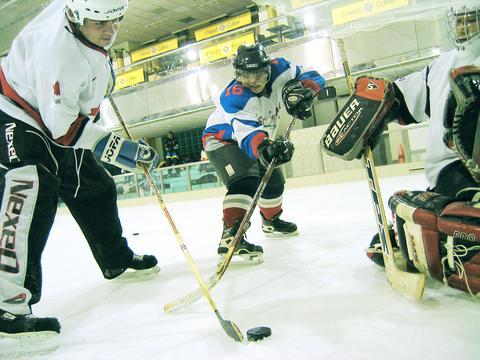
PHOTO: GAVIN PHIPPS, TAIPEI TIMES
"The rinks come and go. Everything has to begin again whenever somebody opens a new rink. It has got better in recent years, with rinks staying open for longer periods of time, but it's still hard to keep a rink open in Taiwan," said Liao. "They're costly to maintain and without the proper marketing they don't make a lot of money. The investment is certainly greater than the income they generate."
Since he began playing hockey, Liao has skated his way around countless rinks of all shapes and sizes. The only thing the rinks have had in common is the fact that they all closed down within relatively short periods of time. The most recent rink to close down was Taichung's A-1 Ice World. Home to the Typhoon Ice Hockey Club for six years, the rink closed last September, leaving Taiwan's hockey players out in the cold once again.
The seemingly never-ending stop/start phenomenon that has plagued the local hockey scene over the past 30 years could be set to change this year, however, with the inception of a glitzy new ice rink near Taipei. Local and expat players alike are hoping that the new Taipei Ice Sports Arena (TISA, 台灣冰動) -- which is located adjacent to the Acer building in Hsichih (汐止) -- -- will give their sport the long-term incentive it needs to thrive and develop.
As well as acting as a regular venue for competitive and friendly games, many hope the rink's popularity will lead to an increase in the number of players and in turn act as a base from where the nation's clubs can nurture talent.
Although open for just over one month, classes have already begun in earnest at TISA and it is attracting a large numbers.
Coaches like Kiwi expat Geoffrey Le Cren, who runs a skate shop in Taipei and has been responsible for the development of in-line skating in Taiwan, view the rink as an opportunity for Taiwan to create a center of hockey excellence.
"It's got great potential. The infrastructure is there and we've already got coaches on the ice and classes up and running. Just through word of mouth the turnout has been very good," Le Cren said. "Many of the players in here for the first time have come from the in-line hockey teams. Although it's a very different form of hockey it has meant that quite a lot of the guys have already made great progress in the short time we've been up and running."
The proprietors of TISA, which officially opened to the public on Feb. 5, have spared no expense in their endeavors to open a top-of-the-line facility. Costing Taiwan Ice Sports International (
"It's a far cry from the early days when we had to play on a narrow rink with pillars at either end. The ice is good quality and they seem to be maintaining it pretty well," he said. "I only hope it lasts, as I'm tired of playing for a while and then having nowhere to play and getting fat."
In order to ensure that new rink has out-classed all of the nation's previous ice arenas, TISA worked in conjunction with the owners of the Penrith Ice Palace in Jamisontown, Australia -- a rink owned by extended family members of several of the TISA management team. The Australian rink sent a crew of qualified ice-rink engineers to Taiwan earlier this year to install a top-of-the-line Italian refrigeration system -- which is buried in sand beneath the rink's surface -- as well as to teach local crews how to maintain and service the costly equipment.
"I think we've done a good job considering we started from zero. Things are looking good," said Edward Yang (楊振龍), the rink's assistant manager.
"I reckon because we've made this extra effort, we stand a very good chance of succeeding where so many other rinks have failed."
Recently the Chinese Nationalist Party (KMT) and its Mini-Me partner in the legislature, the Taiwan People’s Party (TPP), have been arguing that construction of chip fabs in the US by Taiwan Semiconductor Manufacturing Co (TSMC, 台積電) is little more than stripping Taiwan of its assets. For example, KMT Legislative Caucus First Deputy Secretary-General Lin Pei-hsiang (林沛祥) in January said that “This is not ‘reciprocal cooperation’ ... but a substantial hollowing out of our country.” Similarly, former TPP Chair Ko Wen-je (柯文哲) contended it constitutes “selling Taiwan out to the United States.” The two pro-China parties are proposing a bill that
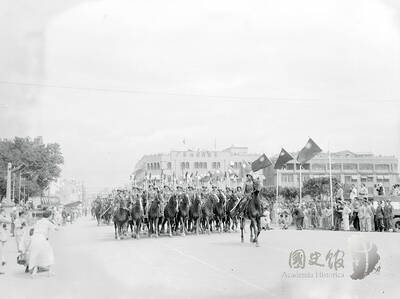
March 9 to March 15 “This land produced no horses,” Qing Dynasty envoy Yu Yung-ho (郁永河) observed when he visited Taiwan in 1697. He didn’t mean that there were no horses at all; it was just difficult to transport them across the sea and raise them in the hot and humid climate. “Although 10,000 soldiers were stationed here, the camps had fewer than 1,000 horses,” Yu added. Starting from the Dutch in the 1600s, each foreign regime brought horses to Taiwan. But they remained rare animals, typically only owned by the government or

It starts out as a heartwarming clip. A young girl, clearly delighted to be in Tokyo, beams as she makes a peace sign to the camera. Seconds later, she is shoved to the ground from behind by a woman wearing a surgical mask. The assailant doesn’t skip a beat, striding out of shot of the clip filmed by the girl’s mother. This was no accidental clash of shoulders in a crowded place, but one of the most visible examples of a spate of butsukari otoko — “bumping man” — shoving incidents in Japan that experts attribute to a combination of gender
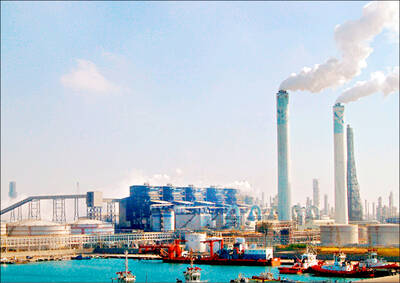
Last month, media outlets including the BBC World Service and Bloomberg reported that China’s greenhouse gas emissions are currently flat or falling, and that the economic giant appears to be on course to comfortably meet Beijing’s stated goal that total emissions will peak no later than 2030. China is by far and away the world’s biggest emitter of greenhouse gases, generating more carbon dioxide than the US and the EU combined. As the BBC pointed out in their Feb. 12 report, “what happens in China literally could change the world’s weather.” Any drop in total emissions is good news, of course. By


 RSS
RSS