


I would have liked to have enjoyed this book but, try as I might, I just couldn't manage it.
Perhaps I'm wrong and there are people out there eager for an experimental work that combines the traditions of Japanese kabuki and shinto with those of the North American Anishinaabe people. One critic has already said Vizenor is doing for Native Americans what James Joyce did for the Irish. So, who knows? Maybe we have a masterpiece comparable to Ulysses on our hands.
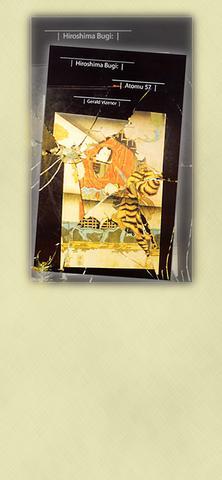
Unfortunately, it's hard to think so. I struggled with this novel, if novel it is. Maybe I failed to understand it, missed its essential point, or was simply blinded by the lightning flash of the new. But I don't believe that many readers will fare very much better.
I wish I could tell you what the book is all about. A few things are clear. Among people and things making an appearance are a dog called Curry, the 19th century Greek-born writer and
Japanophile Lafcadio Hearn (and the Japanese city he settled in, Matsue), the American Faubion Bowers (said to have "saved" kabuki during the post-World War II occupation), pachinko, Roy Orbison, Mahalia Jackson, Herbert Bix's relatively recent book Hirohito and the Making of Modern Japan, the building of Tokyo's Imperial Hotel in 1922, the Yasukuni Shrine, the Meiji Restoration, Anishinaabe tricksters, shinto, the Ainu people of Hokkaido, the 17th century Japanese poet Basho, Tokyo's imperial ravens, sushi, the novelist Yukio Mishima, Alain Renais' 1959 film Hiroshima Mon Amour, chrysanthemums, leprosy, cats and Yankee Doodle. Surely with all these things, you'd think, this ought to be a fascinating book. But it isn't. Sad to say, it lacks bounce, it lacks life.
Try it. You'll certainly hit on many a clear and even enjoyable passage, but you'll also be perplexed, confused, and finally irritated by the absence of any willingness to tell a story.
Is there a plot? Apparently there is, though I found it impossible to unravel it unaided. The author will no doubt claim that it's there for all to see, and quote sentences to prove it. Nevertheless, such sentences are separated by other material such as, for example, direct quotes from other books (lots of these). Clearly someone is hanging out in the Hiroshima Peace Park musing on the horrors and paradoxes of nuclear weapons. But in all probability you'll have to resort to the summary on the dust cover, as I did, to find the key to the story.
There we read that the main character, Roni, is the orphan son of an Anishinaabe man who acted as interpreter for General MacArthur after 1945, and a Japanese boogie dancer from the same period. I swear that I couldn't perceive this from the text itself. And the fact that a reviewer dutifully struggling to understand a book wasn't able to follow the plot doesn't hold out much hope for readers free to fling the book to one side as simply not worth the effort.
To call this a " kabuki novel," as the blurb does, must lead you to expect both the non-realistic and the unexpected. And it is clear that the voices of a variety of ghosts -- of those killed by the Hiroshima bomb, and perhaps others as well -- intersperse such narrative as there is. But kabuki gives pleasure, and I'm sorry to say that this novel doesn't.
This is not to condemn all experimental writing. But the best things in that idiom, though hard to understand initially, gradually become clear as you get onto their wavelength. I never got onto the wavelength of Hiroshima Bugi, if indeed it has one (rather than, as I believe, many).
Nor do I want to be a snob about publishing houses. Someone who was might surmise that if a writer has a novel, as opposed to a scholarly work, published by an academic publisher he must have failed to find a commercial outlet for his labors. But Vladimir Nabokov's Lolita was first published by an obscure Paris
specialist in erotica, and Ulysses itself first issued by one of Joyce's friends through her bookshop, again in Paris. Both books went on to become international classics. And just last month Duke University Press came up with a stunning history of New York's 1970s disco culture, Tim Lawrence's Love Saves The Day. Can it be, then, that the University of Nebraska has a winner hidden away in its stable?
Personally, I doubt it. In 1926, Ezra Pound wrote to Joyce, after receiving a section of his famously obscure Finnegans Wake, "Doubtless there are patient souls who will wade through anything for the sake of the possible joke." Will readers be willing to wade through Hisoshima Bugi? And is there a joke to reward them at the end of their labors? If there is, I didn't manage to find it.
The book does get more lucid toward the end, but only in the sense that it contains increasingly more frequent pieces of potted history, so that the pleasure it affords is like the dubious one of reading through an encyclopedia. Computers make this sort of work attractive to write as material can be keyed in as it comes to hand and then sorted out into sections closer to publication. But it isn't the way compelling imaginative masterpieces are constructed.
Gerald Vizenor is a professor of American Studies at the University of California, Berkley, and the author of 20 books, so one doesn't want to put him down as not being up to the mark. Instead, what this book suffers from is probably a misconceived original scheme.
Something more plot-driven, less formally organized, would, you feel, have stood a better chance of catching fire imaginatively. As it is, it's impossible to relax with it. You keep worrying that there's some grand scheme you haven't managed to grasp, some overwhelming question you can't quite get into focus. But, should you attempt this book and find this is your reaction, don't worry. At least you have this reviewer for company.

In late October of 1873 the government of Japan decided against sending a military expedition to Korea to force that nation to open trade relations. Across the government supporters of the expedition resigned immediately. The spectacle of revolt by disaffected samurai began to loom over Japanese politics. In January of 1874 disaffected samurai attacked a senior minister in Tokyo. A month later, a group of pro-Korea expedition and anti-foreign elements from Saga prefecture in Kyushu revolted, driven in part by high food prices stemming from poor harvests. Their leader, according to Edward Drea’s classic Japan’s Imperial Army, was a samurai

The following three paragraphs are just some of what the local Chinese-language press is reporting on breathlessly and following every twist and turn with the eagerness of a soap opera fan. For many English-language readers, it probably comes across as incomprehensibly opaque, so bear with me briefly dear reader: To the surprise of many, former pop singer and Democratic Progressive Party (DPP) ex-lawmaker Yu Tien (余天) of the Taiwan Normal Country Promotion Association (TNCPA) at the last minute dropped out of the running for committee chair of the DPP’s New Taipei City chapter, paving the way for DPP legislator Su
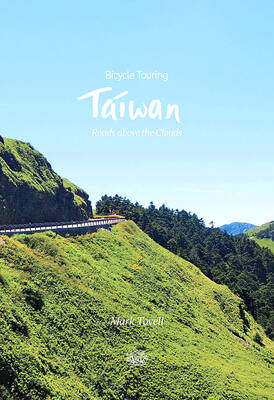
It’s hard to know where to begin with Mark Tovell’s Taiwan: Roads Above the Clouds. Having published a travelogue myself, as well as having contributed to several guidebooks, at first glance Tovell’s book appears to inhabit a middle ground — the kind of hard-to-sell nowheresville publishers detest. Leaf through the pages and you’ll find them suffuse with the purple prose best associated with travel literature: “When the sun is low on a warm, clear morning, and with the heat already rising, we stand at the riverside bike path leading south from Sanxia’s old cobble streets.” Hardly the stuff of your
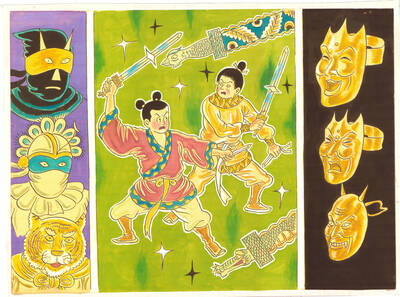
April 22 to April 28 The true identity of the mastermind behind the Demon Gang (魔鬼黨) was undoubtedly on the minds of countless schoolchildren in late 1958. In the days leading up to the big reveal, more than 10,000 guesses were sent to Ta Hwa Publishing Co (大華文化社) for a chance to win prizes. The smash success of the comic series Great Battle Against the Demon Gang (大戰魔鬼黨) came as a surprise to author Yeh Hung-chia (葉宏甲), who had long given up on his dream after being jailed for 10 months in 1947 over political cartoons. Protagonist


 RSS
RSS