


The robot spacecraft rover named Spirit landed safely on Mars yesterday, Taiwan time, after a perfectly programmed descent by parachute and a final programmed adjustment of its position to place it precisely on its target near the center of a Martian crater that may once have been a brimming lake billions of years ago.
It was America's fourth successful landing on the Red Planet and marked the beginning of a new mission to learn whether Mars was once a habitable place where water flowed abundantly in lakes, rivers, creeks and canyons -- and life, perhaps, may once have flourished.
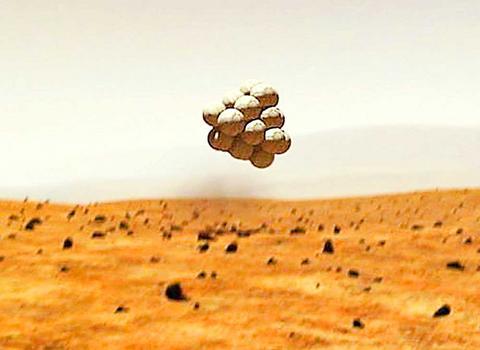
PHOTO: AP
As applause and cheers erupted and tension eased among Mission Controllers here at NASA's Jet Propulsion Laboratory, scientists began sending computer commands across 160 million kilometers of space to prepare the spacecraft for its travels across the Martian terrain and its search for evidence of ancient sediments in Martian rocks that will start within the next nine days.

PHOTO: AP
Spirit, the size of a golf cart and weighing a ton, landed in the Gusev crater on Mars almost precisely at its programmed time of 8:35pm, California time, bouncing again and again for more than 10 minutes inside its protective cluster of Kevlar until it finally rolled to a stop hundreds of yards from where it first hit the Martian surface.
The computers at Mission Control timed the landing at precisely 8:35pm, Ed Theisinger, the project director, said. "Within a second or two at most," said Rob Manning, the engineer who directed the spacecraft's entry into the Martian atmosphere, its descent by parachute and retro-rocket, and its final landing.

PHOTO: AFP
And the position of the landing was precisely as it was designed, said the engineers -- with the base of the spacecraft safely down rather than canted -- a sign that before many days Spirit will be ready to roll off the three petal-shaped runways that had enfolded the spacecraft all the way from Earth and begin to work.
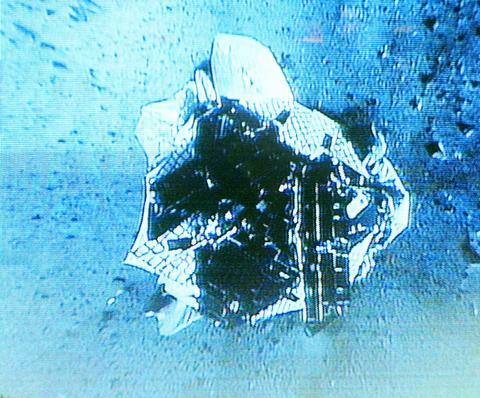
PHOTO: AFP
Engineers and scientists had been biting their nails throughout the day, but the spacecraft's course was set on Friday without chance of change by Spirit's mission controllers here at the Jet Propulsion Laboratory.
The giant antennae of NASA's Deep Space Network in Australia and California's Owens Valley picked up the faintest signals from Spirit's final arrival, and Mission Control strained to decipher faint humming tones from the lander itself, but minute after minute passed before the engineers were satisfied that the landing had indeed been successful.

PHOTO: AFP
Aside from the incredible technical challenges posed by this unprecedented effort to land a vehicle the size of a golf cart on a precise spot in the precise center of a giant Martian crater, mission controllers had warned of fresh dangers as the landing moment neared.
A sandstorm on the surface many kilometers away was changing the density of the atmosphere over the landing site, according to Rob Manning, who runs the team overseeing the entry and parachute landing of the Spirit. Winds up to 32kph may have been blowing at the site as the landing moment approached, Manning said.
That would make things tougher than ever, although a camera on the base of the spacecraft can detect any dangerous swaying of its parachute above, and tiny rockets are programmed to detect the swaying and correct Spirit's downward course only seconds from the surface.
After a curving journey of 480 million kilometers to a planet 170.2 million kilometers from Earth, one might think the hardest part of the trip was over. But now the airbags must be removed, the rover must raise its mast and train its stereoscopic cameras around its environment to hunt for promising rocks, and Spirit's solar-powered batteries must operate flawlessly.
As landing time neared, Louis D'Amario, chief space navigator for the mission, said: "It's been like teeing off in Paris for a golf game and hitting a hole in Tokyo with a breeze and a little water hole the size of an ocean in between.
"But as Spirit's course looks right now, it's been perfect navigation."
The spacecraft's landing site, Gusev, is a giant crater just north of the Martian equator. Images from space show it may have been a huge lakebed billions of years ago, filled with water from streams flowing in torrents down from the southern highlands of Mars.
Spirit had been scheduled to wait nine days or so after its scheduled landing while its high-resolution stereo camera surveys nearby rocks to pick out the most likely ones that show signs of holding sediments from Gusev's possibly ancient flowing water.
The craft's spectrometers are designed to detect evidence of ancient sediments from within the lake and its grinding tool will scrape away the surfaces of sedimentary rocks.
In another 21 days, Spirit's counterpart, the spacecraft named Opportunity, will land on a site called Meridiani Planum, halfway on the other side of the planet from the Gusev crater. And if water were ever there, it could have created rocks called grey hematite, an iron oxide frequently formed within iron-rich water. The rover's instruments are specially equipped to identify that glittering silvery rock.
Said Ed Weiler, NASA's director of space science: "This mission is not about rocks, it's not about pictures; it's part of our first steps in answering a great human question: Are we alone?"
Two Viking spacecraft landed there in 1976 seeking organic chemicals and possible micro-organisms beneath the surface but found only exotic chemistry.
The mission called Pathfinder carried a tiny rover called Sojourner that analyzed a variety of Martian rocks in 1997 and found no conclusive evidence of ancient water. Another effort to land on a Martian polar ice cap in search of liquid water crashed four years ago.
Updated NASA information on the Mars Rover Exploration is on the Web at http://marsrover.jpl.nasa.gov/home/index/html.

Sept.16 to Sept. 22 The “anti-communist train” with then-president Chiang Kai-shek’s (蔣介石) face plastered on the engine puffed along the “sugar railway” (糖業鐵路) in May 1955, drawing enthusiastic crowds at 103 stops covering nearly 1,200km. An estimated 1.58 million spectators were treated to propaganda films, plays and received free sugar products. By this time, the state-run Taiwan Sugar Corporation (台糖, Taisugar) had managed to connect the previously separate east-west lines established by Japanese-era sugar factories, allowing the anti-communist train to travel easily from Taichung to Pingtung’s Donggang Township (東港). Last Sunday’s feature (Taiwan in Time: The sugar express) covered the inauguration of the

The corruption cases surrounding former Taipei Mayor and Taiwan People’s Party (TPP) head Ko Wen-je (柯文哲) are just one item in the endless cycle of noise and fuss obscuring Taiwan’s deep and urgent structural and social problems. Even the case itself, as James Baron observed in an excellent piece at the Diplomat last week, is only one manifestation of the greater problem of deep-rooted corruption in land development. Last week the government announced a program to permit 25,000 foreign university students, primarily from the Philippines, Indonesia and Malaysia, to work in Taiwan after graduation for 2-4 years. That number is a

In a stark demonstration of how award-winning breakthroughs can come from the most unlikely directions, researchers have won an Ig Nobel prize for discovering that mammals can breathe through their anuses. After a series of tests on mice, rats and pigs, Japanese scientists found the animals absorb oxygen delivered through the rectum, work that underpins a clinical trial to see whether the procedure can treat respiratory failure. The team is among 10 recognized in this year’s Ig Nobel awards (see below for more), the irreverent accolades given for achievements that “first make people laugh, and then make them think.” They are not

This Qing Dynasty trail takes hikers from renowned hot springs in the East Rift Valley, up to the top of the Coastal Mountain Range, and down to the Pacific Short vacations to eastern Taiwan often require choosing between the Rift Valley with its pineapple fields, rice paddies and broader range of amenities, or the less populated coastal route for its ocean scenery. For those who can’t decide, why not try both? The Antong Traversing Trail (安通越嶺道) provides just such an opportunity. Built 149 years ago, the trail linked up these two formerly isolated parts of the island by crossing over the Coastal Mountain Range. After decades of serving as a convenient path for local Amis, Han settlers, missionaries and smugglers, the trail fell into disuse once modern roadways were built


 RSS
RSS