


When Milo Thornberry and Judith Thomas arrived in Taiwan on Dec. 30, 1965, the unassuming couple had no idea that they would be caught up in a series of events that read like a plot for a Len Deighton novel.
Initially posted to Taiwan by the United Methodist Church to take up an appointment as chaplain at Taipei's Soochow University, Thornberry later went to the Presbyterian Church of Formosa and was appointed associate professor of church history at Taiwan Theological College.
In preparation for their trip the pair spent a year reading all the English-language literature they could find about the history and people of Taiwan.
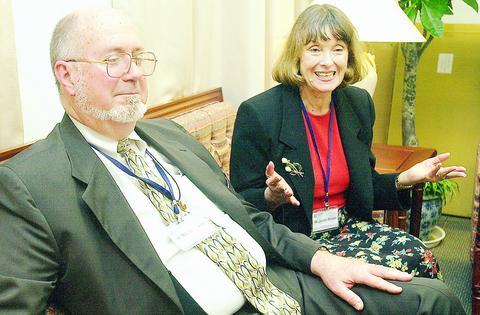
PHOTO: TAIPEI TIMES
But within a year of their arrival the couple was introduced to one-time political prisoner Peng Ming-min (
Peng was arrested in late 1964 while preparing the Declaration of Formosa (台灣自救宣言) -- a document in which he called for a new constitution and independence for Taiwan. Charged with sedition, he was sentenced to eight years
imprisonment.
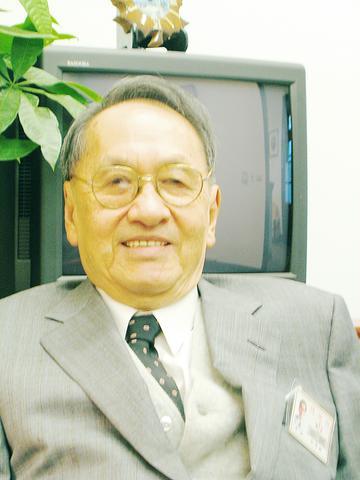
PHOTO: GAVIN PHIPPS, TAIPEI TIMES
"I was well known and I don't think they really knew what to do with me," Peng, now adviser to President Chen Shui-bian (陳水扁) admitted. "Eight years was a light sentence. Looking back at it today I was pretty fortunate. I should have been shot."
Pardoned after 14 months, Peng was placed under house arrest by the Taiwan Garrison Command. By the time the Thornberrys were first introduced to him Peng had mastered the art of slipping in and out of his house after midnight without alerting his jailers.
"We'd been asked to contact Professor Peng by a missionary friend who had returned to the US and had lost contact with him. He told us about his calling for a national debate, his imprisonment and his house arrest," Thomas said.
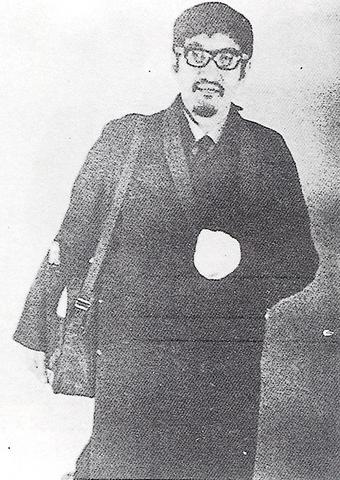
PHOTO COURTESY OF PENG MING-MIN
According to Thomas "something clicked" between them and they instantly became good friends. The evening took an alarming turn, however, when the couple discovered that befriending Peng meant making enemies of his jailers.
"The evening was our first experience with the Garrison Command. We got into a car and there was a jeep on our tail," explained Thornberry. "We went to Ximending and sat in a coffee shop for hours before going home. I don't like to speculate as to the purpose of the jeep, but I think it was just harassment."
By the fall of 1968 the couple had built up a strong relationship with other members of Taiwan's underground movement. This regular exposure to a side of Taiwan few foreigners were aware of gave the couple the incentive they needed.
During the day the pair assumed the personas of a typical mild-
mannered expat US couple. In their off time, though, the pair continued clandestinely to meet with Peng and other Free Formosa activists such as Hsieh Tsung-min (
With the help of a group of people known as "Institutional Guerrillas," who were US government employees disenchanted with US policy, the couple was able to obtain a mimeograph from a US military part-exchange store. Instead of simply meeting with dissidents, the Thornberrys were soon able to print and circulate anonymously penned papers about political repression in Taiwan to scholastic and journalistic circles within the US.
Through these papers word spread of the Thornberrys' relationship with leading activists and their house became a hot-bed of information, where visitors could learn about "the other Taiwan."
"It was a reality that most Americans didn't know anything about so we arranged for people who really wanted to understand Taiwan to meet with Peng and other activists and hear their stories," Thornberry said. "We set meetings with visiting church and government dignitaries as well as journalists. We even came close to setting up a meeting with [Edward] Kennedy, who was a young senator at the time."
In late 1969, Peng told the Thornberrys of a series of interviews that he'd had with the security forces and said that threats had been made to end his life.
"We'd heard the reports and were very worried. It was an incident shortly after this that tipped the balance and made us realize that he had to leave," Thornberry said. "There were between 35 to 40 `gray suits' just waiting near our house. We thought it was all over and that they'd discovered that Peng had been clandestinely meeting people. Peng insisted on leaving, but we didn't think he'd get out."
Wrapped in a winter coat and hat Peng slipped past the security forces and arrived home without incident. Though it later transpired that the gray suits were not looking for Peng that night, the Thornberrys had already decided enough was enough and that they needed to formulate a plan of escape.
"We were total rank amateurs and didn't have a clue how to get someone out of the country. I'd heard of fishing boats, but that would mean depending on people for monetary purposes. Such people could easily betray you," said Thomas. "We finally got the idea from a weekly news magazine after reading an article about eastern European dissidents escaping as tourists."
After six months of preparation the Thornberrys had formulated an audacious plan in which Peng would disguise himself and leave Taiwan right under the noses of his jailers on a scheduled flight from Taipei's Songshan Airport, which then served as Taiwan's international
airport.
A Japanese passport was obtained via a friend of Peng's who come to Taiwan as a tourist, Peng's photograph replaced the original and in June 1970 he was ready to leave.
"We had a date and a ticket for a flight, but we wanted to know what the situation at the airport was like. So a couple of friends went the week before to scout it out," Thornberry said. "It was the last flight on a Saturday night and the airport was empty. When they came back to report what they'd seen the whole idea seemed crazy."
However crazy the Thornberrys believed the plan was, Peng was happy with it. Keeping his departure a secret, even from his immediate family, the independence activist spent the 24 hours prior to his departure at the Thornberrys'
residence.
When the time came, Peng went to the airport and under the watchful eye of two more of the Thornberrys' friends he passed through immigration with his forged Japanese passport.
"I was aware that if they caught me they'd kill me and throw me in the sea and deny everything," Peng said. "I finally got away but there were a couple of moments when I [nearly] died during the escape. There was customs official who asked me to come back because he'd forgotten to stamp my boarding pass and the plane had mechanical problems. When I realized I'd done it, relief was an understatement."
Peng wasn't the only nervous person that evening. At home the Thornberrys were also suffering from shattered nerves waiting for news of Peng's departure.
"Our house was relatively near the airport and we could hear the planes, we were waiting to outside our house to hear Peng's flight leave," Thomas said. "When the scheduled time passed and nothing happened we thought it was all over. Then to our relief and an hour later than expected we heard the plane take off."
The Thornberrys were arrested in March 1971 and accused of "unfriendly activities and attitudes against the ROC." After being labeled CIA operatives and agitators, the couple was deported from Taiwan in March 1971.
"We never worked for the CIA. They [the CIA] wouldn't have had us, as we were fairly competent," said Thornberry. "We were simply two people who believed that it made no sense that somebody so special should be going through what he was."

In late October of 1873 the government of Japan decided against sending a military expedition to Korea to force that nation to open trade relations. Across the government supporters of the expedition resigned immediately. The spectacle of revolt by disaffected samurai began to loom over Japanese politics. In January of 1874 disaffected samurai attacked a senior minister in Tokyo. A month later, a group of pro-Korea expedition and anti-foreign elements from Saga prefecture in Kyushu revolted, driven in part by high food prices stemming from poor harvests. Their leader, according to Edward Drea’s classic Japan’s Imperial Army, was a samurai

The following three paragraphs are just some of what the local Chinese-language press is reporting on breathlessly and following every twist and turn with the eagerness of a soap opera fan. For many English-language readers, it probably comes across as incomprehensibly opaque, so bear with me briefly dear reader: To the surprise of many, former pop singer and Democratic Progressive Party (DPP) ex-lawmaker Yu Tien (余天) of the Taiwan Normal Country Promotion Association (TNCPA) at the last minute dropped out of the running for committee chair of the DPP’s New Taipei City chapter, paving the way for DPP legislator Su
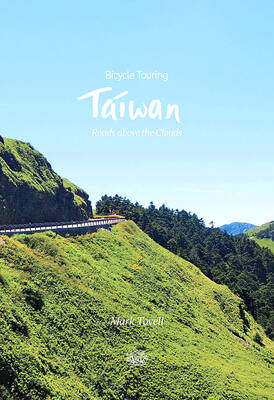
It’s hard to know where to begin with Mark Tovell’s Taiwan: Roads Above the Clouds. Having published a travelogue myself, as well as having contributed to several guidebooks, at first glance Tovell’s book appears to inhabit a middle ground — the kind of hard-to-sell nowheresville publishers detest. Leaf through the pages and you’ll find them suffuse with the purple prose best associated with travel literature: “When the sun is low on a warm, clear morning, and with the heat already rising, we stand at the riverside bike path leading south from Sanxia’s old cobble streets.” Hardly the stuff of your
April 22 to April 28 The true identity of the mastermind behind the Demon Gang (魔鬼黨) was undoubtedly on the minds of countless schoolchildren in late 1958. In the days leading up to the big reveal, more than 10,000 guesses were sent to Ta Hwa Publishing Co (大華文化社) for a chance to win prizes. The smash success of the comic series Great Battle Against the Demon Gang (大戰魔鬼黨) came as a surprise to author Yeh Hung-chia (葉宏甲), who had long given up on his dream after being jailed for 10 months in 1947 over political cartoons. Protagonist


 RSS
RSS