


Fate seems to be playing a trick with Yang Kuei-mei's (楊貴媚) acting career. In the past 10 years she has been the favorite leading actress of many leading Taiwanese directors, such as Tsai Ming-liang (蔡明亮), Ang Lee (李安), Chen Kuo-fu (陳國富) and Lin Cheng-sheng (林正盛). She has been nominated for various film awards, locally and overseas, but has always lucked out.
However, for a small role she acted in the latest Tsai Ming-liang movie, Good-bye Dragon Inn (不散), she won Best Supporting Actress at the 48th Asia Pacific Film Festival, which took place last weekend.
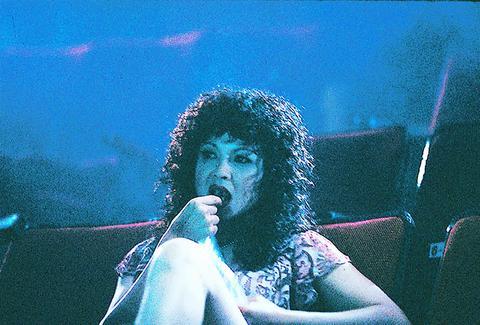
All she did in the less than five minute scene was crack seeds in an empty movie theater, which makes quite a noise, put her high heels into the front row of seats and bent down to pick them up.
"Don't you think cracking seeds is an easy job! To shoot that scene, I broke one piece of my front tooth, right here," Yang said, having just came back from her trip to Shiraz, Iran, the venue for this year's Asia Pacific Film Festival.
For the trip, Yang had her designer make three Muslim-style dresses with long sleeves, headscarf and just a few trimmings. When she went on stage to accept the award, Yang first said thank you in Chinese. The audience was silent. Then, she said, "Salon Behame! [Hello in Iranian], I love Shiraz!"
The two lines immediately won her thunder-like applause and cheers. Yang suddenly became the most popular star at the festival.
"I think all my roles in Taiwanese movies are independent career women with their own emotions and love lives. I did not expect these movies to be shown in Iran or even liked by its audiences," Yang said.
She was wrong.
Many Iranian filmmakers and producers, she said, told her they were big fans of Yang especially in Eat, Drink, Man, Woman (飲食男女), Vive l'Amour (愛情萬歲) and The Hole (洞).
Having spent 20 years in the business, Yang's screen image is usually down-to-earth, practical, independent yet strong in surviving difficulties and has been perfect for Taiwanese film directors who make films in a realistic style, showing what people really look like, instead of an ideal version.
In Eat Drink Man Woman, she was the conservative high school teacher who represses her desires. Even so, she still won the hottest guy in school, a sports teacher, and converted him into a Christian. In Vive l'Amour by Tsai Ming-liang, Yang plays a housing saleswoman who sometimes makes use of the apartments she helps sell, to sleep with men she picks up.
In The Hole, another Tsai film, Yang suffers from an infectious disease. But in an imagined scene in the movie, she dresses up like a peacock, dancing around to old fashioned music. In the movie Double Vision, Yang becomes a forensic doctor, examining a strange, deadly fungus that is related to a serial murder cause.
"Starting with TV dramas, I knew very little about acting and performance. Acting in films is less exaggerated, more controlled and more introverted. I didn't get the knack until I began working with these Taiwanese filmmakers," Yang said.
"I remember when I first worked with Tsai Ming-liang in Vive l'Amour. I didn't know what he wanted. I felt insecure. But when I told him I didn't know what I was doing on the set, he said, `This is it! This is the feeling you should have.'
The last scene in Vive l'Amour, where Yang performed a 10-minute crying scene -- from a sad, devastated look, to sobbing and then to full crying -- made her name.
"I feel very lucky. After Hill of No Return (1993), I began taking roles non-stop from different Taiwanese directors, from Ang Lee, Tsai Ming-liang, Chen Kuo-fu and now Lin Cheng-sheng. During the 10 years I have made good friends with all of them," she said.
When Eat, Drink, Men, Women was nominated for the Golden Horse Awards, and Yang was not nominated, "Ang Lee was the first one to comfort me, telling me not to care too much," Yang said.
Yang said she learned long ago to have a long-term vision for Taiwanese movies and not just "think of making money."
"You have to realize that the industry is not in a good shape and you're probably not going to make money. But you will leave something for the record," she said.
"As a Taiwanese actress, I have to support Taiwan cinema and our own directors, even with just a few shots or a very short screen time. I usually won't reject [an offer]," Yang said. "If I say no to them, Taiwan cinema will have no actress."
So, Yang will stay as the public speaker for Taiwan cinema. Her next projects are Tsai Ming-liang's Wayward Wind (天邊一朵雲) and Lin Cheng-sheng's new movie, tentatively titled Under the Moonlight.
What Yang's fans are getting more concerned about how long the 40-something actress will stay single. To which Yang replied, "Do you think there is a real man in Taiwan? I mean real man!"

Most heroes are remembered for the battles they fought. Taiwan’s Black Bat Squadron is remembered for flying into Chinese airspace 838 times between 1953 and 1967, and for the 148 men whose sacrifice bought the intelligence that kept Taiwan secure. Two-thirds of the squadron died carrying out missions most people wouldn’t learn about for another 40 years. The squadron lost 15 aircraft and 148 crew members over those 14 years, making it the deadliest unit in Taiwan’s military history by casualty rate. They flew at night, often at low altitudes, straight into some of the most heavily defended airspace in Asia.
Many people in Taiwan first learned about universal basic income (UBI) — the idea that the government should provide regular, no-strings-attached payments to each citizen — in 2019. While seeking the Democratic nomination for the 2020 US presidential election, Andrew Yang, a politician of Taiwanese descent, said that, if elected, he’d institute a UBI of US$1,000 per month to “get the economic boot off of people’s throats, allowing them to lift their heads up, breathe, and get excited for the future.” His campaign petered out, but the concept of UBI hasn’t gone away. Throughout the industrialized world, there are fears that

Taiwan’s democracy is at risk. Be very alarmed. This is not a drill. The current constitutional crisis progressed slowly, then suddenly. Political tensions, partisan hostility and emotions are all running high right when cool heads and calm negotiation are most needed. Oxford defines brinkmanship as: “The art or practice of pursuing a dangerous policy to the limits of safety before stopping, especially in politics.” It says the term comes from a quote from a 1956 Cold War interview with then-American Secretary of State John Foster Dulles, when he said: ‘The ability to get to the verge without getting into the war is
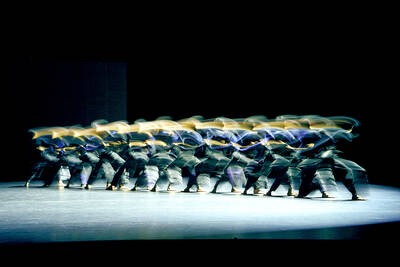
Like much in the world today, theater has experienced major disruptions over the six years since COVID-19. The pandemic, the war in Ukraine and social media have created a new normal of geopolitical and information uncertainty, and the performing arts are not immune to these effects. “Ten years ago people wanted to come to the theater to engage with important issues, but now the Internet allows them to engage with those issues powerfully and immediately,” said Faith Tan, programming director of the Esplanade in Singapore, speaking last week in Japan. “One reaction to unpredictability has been a renewed emphasis on


 RSS
RSS