


With its relentless bloodshed and scrambled, inconclusive narrative, Quentin Tarantino's long-awaited fourth feature, Kill Bill: Vol. 1, is certain to provoke both awe and revulsion. The film's detractors and its fans are likely to agree, however, that the movie, a densely referential pastiche of B-movie attitudes and situations, is above all an exercise in style.
In parts of Pulp Fiction (1994) and in his last picture, Jackie Brown (1997), Tarantino seemed to be using the action-exploitation formulas of which he is so enamored as stepping stones toward an exploration of plausible characters and authentic emotions. Now, it seems, his interests have swung in the opposite direction, and he has immersed himself, his characters and his audience in a highly artificial world, a looking-glass universe that reflects nothing beyond his own cinematic
obsessions.
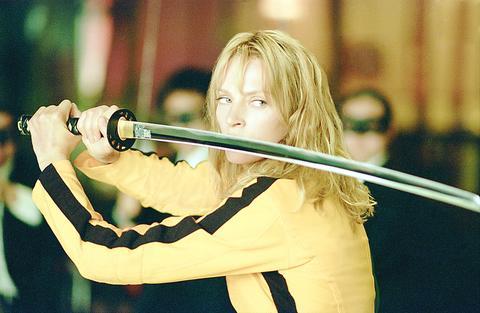
PHOTOS COURTESY OF PANDASIA
How much you like Kill Bill, a two-part revenge epic, the first volume of which opens today, will probably depend on the extent to which you share those obsessions, on how much of a taste you have for the synthetic fusion cuisine that the director has cooked up. There are some strong and diverse flavors, as well as vivid colors in the mix, all of them deftly reflected in the hip-hop artist RZA's clever, eclectic score.
Tarantino samples the lurid hues of spaghetti westerns, the deep-fried funk of 1970s blaxploitation, and above all the graceful and kinetic mayhem of Asian action movies, from Hong Kong-style martial arts to samurai swordplay to hard-boiled gangster anime.
I should probably confess here that Tarantino's knowledge of these genres, to say nothing of his appetite for them, far surpasses my own (and I'd guess, just about everybody else's as well). But while being so relentlessly exposed to a filmmaker's idiosyncratic turn-ons can be tedious and off-putting, the undeniable passion that drives Kill Bill is fascinating, even, strange to say it, endearing.
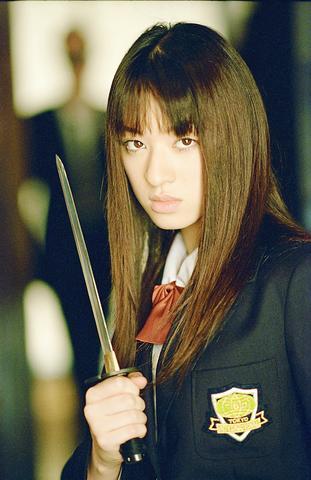
PHOTO COURTESY OF PANDASIA
Tarantino is an irrepressible showoff, recklessly flaunting his formal skills as a choreographer of high-concept violence, but he is also an unabashed cinephile, and the sincerity of his enthusiasm gives this messy, uneven spectacle an odd, feverish integrity.
Old movies are not the sole focus of his obsession. The most vivid emotional connection in Kill Bill does not take place between any of the characters, but between the director and his star, Uma Thurman. Tarantino has referred to Thurman as "my actress," and as Marlene Dietrich to his Josef von Sternberg. Accordingly, much of the perverse energy of Kill Bill arises from his near-maniacal fascination with her. She is at once his idol, his alter-ego, his dream lover and his muse, the way Anna Karina was for Jean-Luc Godard in the early 1960s.
Tarantino shoots the elliptical curves of Thurman's face in extreme close-up, his wide shots emphasize her tall, willowy frame, and at one point the camera lingers on her long, strangely shaped toes for what seems like an entire reel. A title at the end informs us that the movie is "based on The Bride, a character created by Q and U" -- as in Quentin and Uma. In the movie, the two of them, one in front of the camera and one behind it, seem as inseparable as those two codependant letters.
It must be said that this infatuation takes some disturbing guises. The opening shot, in black-and-white, lingers on Thurman's bloody, beaten face. Her character, known by various aliases (her real name, for reasons that may become clear in Volume 2, is bleeped out whenever it is uttered), is attacked on her wedding day and left for dead by a team of assassins called the Deadly Viper Assassination Squad (or DiVAS). They have been hired by Bill (David Carradine, whose face is never shown), who was once The Bride's lover and whose child she may be carrying. After four years in a coma, she wakes up and sets out to take revenge on her assailants, writing a "to kill" list with their names on it.
Bill's name is last, and since this is only the first episode, the title's imperative, which sounds like Dr. Seuss gone haywire, remains unfulfilled. Not that there is any shortage of killing. As is his habit, Tarantino presents the action out of sequence, so that the first person (Copperhead, played by Vivica Fox) to be dispatched is the second one on the list. This may be a tongue-in-cheek nod to a venerable Hollywood convention: the black character dies first. Copperhead lives in a tidy suburban house, which she and the Bride proceed to demolish in a frenzy of hand-to-hand combat interrupted by the arrival of a school bus carrying Copperhead's young daughter.
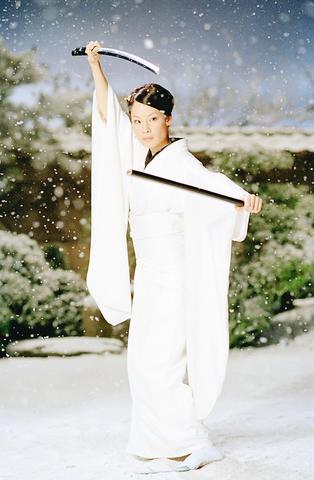
Later -- that is, earlier -- our heroine will force an elaborate showdown with Cottonmouth (Lucy Liu), who has ascended from assassin-for-hire to Tokyo gangland leader. Liu once again demonstrates her agility; she also shows off her linguistic ability and her brains (literally). Michael Madsen and Daryl Hannah, the remaining DiVAS members, will be dealt with in Volume 2.
It will inevitably be said, in Tarantino's defense, that his violence is fundamentally cartoonish. (The actual cartoon inserted in the middle of the picture, to provide background on one of the Bride's would-be assassins, may be bloodier than anything else in it, which is saying a lot.) But he undermines this argument with sequences that cross the line between jolting and sickening. While the Bride is in the hospital, a cretinous orderly named Buck rents out her unconscious body for sex; when she wakes up, she kills Buck's latest customer by chewing off part of his face, and then takes care of Buck by slamming his head in a metal door.
Compared with this, the long, intricate climax, during which the Bride takes on 88 yakuza fighters and litters a Tokyo nightclub with their severed limbs and writhing trunks, feels as insouciant and elegant as a show-stopping musical number. Which, in essence, it is, staged with the assistance of the martial-arts maestro Yuen Wo-ping.
The sordid creepiness that occasionally seeps into Kill Bill makes you wonder what Tarantino is trying to do, and whether he is entirely in control of his own imagination. Other parts of the movie are notable for their dullness, especially an interminable chapter during which the Bride purchases a sword from a reluctant craftsman played by the Japanese action legend Sonny Chiba. The point, aside from allowing an excursion into mystical Shaolin mumbo jumbo and displaying Thurman in a cute American tourist jeans-and-T-shirt ensemble, seems to be to revel in the sheer presence of Chiba. Check it out, Tarantino seems to be saying, Sonny Chiba's in my movie. How cool is that?
Way too cool? Not cool enough? As I said, it depends. The movie-geek in-jokes are sometimes amusing and sometimes annoying. The English dialogue is purposely stilted, often sounding like badly translated
subtitles ("I have no wish to kill you before the eyes of your daughter," the Bride says to Copperhead, before doing just that). When the characters speak Japanese, the English subtitles show a similar awkwardness ("Whom in Okinawa made you this steel?").
The hurtling incoherence of the story may also be, at least partly, a tribute to its sources, in which sense was more often than not trumped by sensation. Will the loose ends and cliffhangers that proliferate in Volume 1 be satisfactorily resolved in Volume 2?
Will anyone outside the hard core of Tarantino's fans really care? Whom knows?

Ajay Verma, a consultant gastroenterologist at Kettering general hospital in Northamptonshire, says our gut is a “complex machine.” “It is constantly providing us with the nutrition we need, initially to grow and develop, and then for us to survive, thrive and repair from injury and illness.” How can we keep it functioning well? Put simply: “Make sure what you put into it is balanced, and that you clear out its waste products adequately,” Verma says. “In a general gastroenterology clinic, the most common conditions we see are irritable bowel syndrome (IBS), gastroesophageal reflux disease, inflammatory bowel disease and constipation,” says Nisha

And so, in the wake of US President Donald Trump’s trip to the People’s Republic of China (PRC), all the experts on the Strait of Hormuz suddenly became experts on US-China-Taiwan relations. The Internet has certainly expanded human knowledge. Lots of these sudden experts made noise this week about Trump’s words after the meeting with PRC dictator Xi Jin-ping (習近平). Trump is going to sell out Taiwan! Longtime Taiwan commentator J. Michael Cole summed the situation up neatly in the Guardian: “We need to keep in mind that he has a tendency to say many things — sometimes contradicting himself within
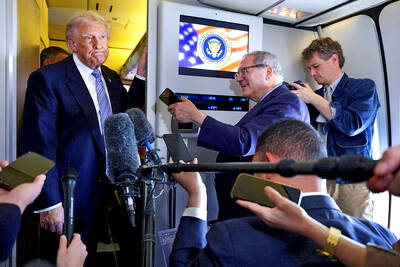
Last week US President Donald Trump was asked by a reporter whether he would speak on the phone to the President of Taiwan. “l’ll speak to him. I speak to everybody. We have that situation very well in hand,” Trump said. This marked the second time in a couple of weeks he had said he would talk to the President of Taiwan. In 2016 he famously took a call from then-president Tsai Ing-wen (蔡英文), when he was president-elect. Despite warnings that the apocalypse was nigh because of a phone call, the world quickly forgot about the conversation between two democratically-elected presidents.
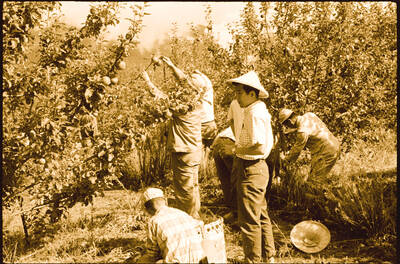
May 25 to May 31 Few believed that apples could be cultivated on a commercial scale in Taiwan’s high mountains. When horticulturalist Cheng Chao-hsiung (程兆熊) first proposed the idea in 1955, both American and Taiwanese colleagues dismissed it as implausible, arguing that temperate fruit could not be reliably grown on a subtropical island, especially on rugged terrain. However, it was this terrain in the Central Mountain Range where many Chinese Civil War veterans were resettled in the late 1950s. With limited job prospects and no family in Taiwan, they were placed on cooperative farms aimed toward self-sufficiency. Some say the conditions


 RSS
RSS