


Barry Levinson's first novel, Sixty-Six, is a wordier, more pretentious version of his wonderful 1982 movie, Diner.
Like Diner, Sixty-Six is set in Levinson's hometown, Baltimore, and like Diner, it chronicles the lives of half a dozen young men on the fence between the dalliances of youth and the more sobering realities of grown-up life. As in Diner, the action focuses on a neighborhood diner where the characters spend most of their free time, hanging out. And as in Diner, Levinson uses a breezily episodic approach to storytelling, capturing his characters' struggles with love and sex and work through a series of memory-vignettes.
Although Diner was set in 1959 and Sixty-Six takes place largely in 1966, many of the people in this novel are reminiscent of those in the film. There's the troubled, erratic young man whose angst takes the form of odd, absurdist gestures; there's the one with woman problems; the one trying to figure out what to do about his career; the one who married early and who already finds his marriage on the rocks.

Levinson is at his best memorializing the small, everyday events of everyday life; as he puts it, "frivolous moments, stand-alone moments that have no beginning, middle or end." While there are many such finely observed moments in Sixty-Six -- some uproariously funny, some haunting and sad -- the novel as a whole is considerably more turgid and long-winded than the author's finest films.
For some reason, Levinson has chosen to take a much more sociological approach to his material in these pages than he did in Diner. While the impact of Vietnam and the draft are worked persuasively into the story line, other issues are clumsily shoehorned in. One character's romance with a hippie girl is meant to dramatize changing sexual mores, while a confrontation between this character and another woman's boyfriend supposedly serves as the spark for a riot that presages a host of racial conflicts in the city.
Levinson has also used the commodious form of the novel to embroider his story heavily with philosophical asides that feel like unnecessary voice-overs, commenting on events that really require no commentary at all. Remembering a statue of George Washington at the scene of the riot, the narrator, Bobby Shine, thinks that "the father of our country" must have been "wondering what had become of his children."
Bobby can be equally sententious when it comes to developments in his own life. Of his relationship with his girlfriend, Annie, he observes, "We both understood that we were traveling through rough waters, but we didn't want to continue to burden ourselves with all the complications." Of his fledgling career in television, he muses, "There had been highs and lows, depression and euphoria. But I was beginning to understand that this was life. The one truism seemed to be that nothing remained the same."
Sixty-Six, like Diner and Levinson's film Avalon, has a distinctly autobiographical feel to it and Bobby Shine has more than a little in common with his creator: both abandoned plans to become lawyers to go to work in television, both had early jobs operating hand puppets for a children's television show, and both share a passion for storytelling and the magical possibilities of film.
The characters in Sixty-Six talk much the way the characters in Diner do -- and much like Levinson's real-life friends, who appeared in his 1999 documentary, Original Diner Guys. In addition, some of the anecdotes in this novel -- most notably, one character's riff about the song Puff the Magic Dragon -- will be familiar to viewers of that glorified home movie.
Yet however familiar these Baltimore guys may be, the cast of Sixty-Six remains an engaging lot, depicted by Levinson with wit and wry affection. While Bobby Shine is clearly the lucky, ambitious one -- the one who will eventually leave Baltimore to seek his fortune, as Levinson did, in California -- the other diner habitues seem headed toward disappointment.
Neil, always given to enigmatic actions, perversely destroys a letter that might have given him a reprieve from the draft and heads off, reluctantly, to boot camp. Ben, once known as the "King of the Teenagers," finds his marriage spiraling into disaster and his expectations of life hurtling even lower. Turko and Eggy, "the Abbott and Costello" of the group, seem caught in a kind of perpetual adolescence, trying to decode the mysteries of love and sex. These characters' lives have been defined by their late-night bull sessions at the diner and when the restaurant is sold, they understand that a chapter of their lives has closed.
Like Levinson's Baltimore movies (Diner, Tin Men,Avalon and Liberty Heights), Sixty-Six is, in retrospect, an elegy: it is not only a story about a group of guys trying to (or trying not to) grow up, but also a story about change and flux and goodbyes.

In late October of 1873 the government of Japan decided against sending a military expedition to Korea to force that nation to open trade relations. Across the government supporters of the expedition resigned immediately. The spectacle of revolt by disaffected samurai began to loom over Japanese politics. In January of 1874 disaffected samurai attacked a senior minister in Tokyo. A month later, a group of pro-Korea expedition and anti-foreign elements from Saga prefecture in Kyushu revolted, driven in part by high food prices stemming from poor harvests. Their leader, according to Edward Drea’s classic Japan’s Imperial Army, was a samurai

The following three paragraphs are just some of what the local Chinese-language press is reporting on breathlessly and following every twist and turn with the eagerness of a soap opera fan. For many English-language readers, it probably comes across as incomprehensibly opaque, so bear with me briefly dear reader: To the surprise of many, former pop singer and Democratic Progressive Party (DPP) ex-lawmaker Yu Tien (余天) of the Taiwan Normal Country Promotion Association (TNCPA) at the last minute dropped out of the running for committee chair of the DPP’s New Taipei City chapter, paving the way for DPP legislator Su
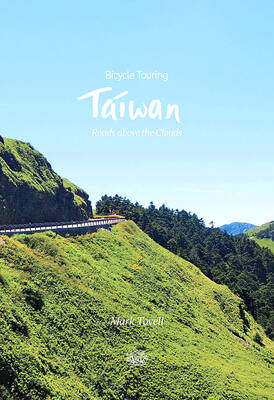
It’s hard to know where to begin with Mark Tovell’s Taiwan: Roads Above the Clouds. Having published a travelogue myself, as well as having contributed to several guidebooks, at first glance Tovell’s book appears to inhabit a middle ground — the kind of hard-to-sell nowheresville publishers detest. Leaf through the pages and you’ll find them suffuse with the purple prose best associated with travel literature: “When the sun is low on a warm, clear morning, and with the heat already rising, we stand at the riverside bike path leading south from Sanxia’s old cobble streets.” Hardly the stuff of your
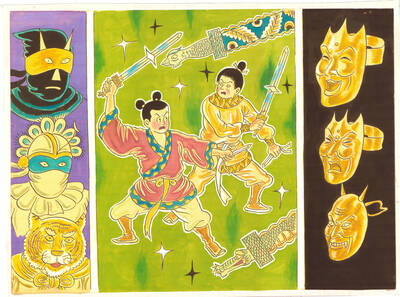
April 22 to April 28 The true identity of the mastermind behind the Demon Gang (魔鬼黨) was undoubtedly on the minds of countless schoolchildren in late 1958. In the days leading up to the big reveal, more than 10,000 guesses were sent to Ta Hwa Publishing Co (大華文化社) for a chance to win prizes. The smash success of the comic series Great Battle Against the Demon Gang (大戰魔鬼黨) came as a surprise to author Yeh Hung-chia (葉宏甲), who had long given up on his dream after being jailed for 10 months in 1947 over political cartoons. Protagonist


 RSS
RSS