


Jagdish Prasad Sharma's day begins with a prayer and a large breakfast washed down with a glass of warm milk. He cleans his truck till it gleams and drives off to work at a stone quarry, returning by 7pm to his favorite TV show and a little quiet time with his wife.
Sharma's life may seem ordinary but it's remarkable because he lives in a prison where he is serving the last of a 14-year sentence for murder.
Nondescript Sanganer town -- about 25km from Jaipur, the capital of the northwestern state of Rajasthan -- is famous for its block-printed fabrics and a unique open jail where life convicts stay with their families.
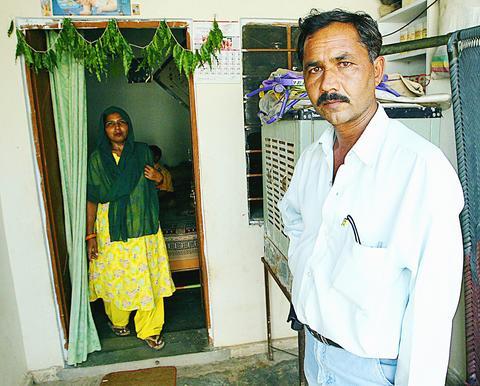
PHOTO: DPA
The handmade Sanganeri print is now a dying art, replaced by sophisticated machines that churn out hundreds of meters of fabric every day, but the prison is a vibrant, thriving community.
The Rajasthan government started the Sri Sampoornanand Khula Bandi Shivir as an experiment in 1963. Till the 1980s, prisoners were taken out of Jaipur jail and allowed to farm during the day. A decade later the government made it compulsory for convicts to live there with their families, as an important step towards their rehabilitation.
Sanganer was such a success that a committee on prison reforms recommended that it be replicated in other states, as it prepares convicts for a life outside, instils a sense of responsibility, reduces overcrowding in jails and costs far less for the state.
The open prison currently has 124 convicts, including 10 women, all of whom have been convicted for murder and are serving life terms -- ranging from 14 to 20 years.
It isn't easy to get to Sanganer: the convict must have served at least one-third of his life sentence, demonstrated good behavior and file an application saying he will live there with his family. The screening committee does not consider habitual offenders or those convicted for offences against the state, rape and robbery.
The Sanganer jail spreads across 4 hectares dotted with orderly rows of about 150 cement houses, tin sheds and thatched cottages. Some have white picket fences, potted plants and a motorcycle parked outside. Others are nothing more than rickety aluminium sheets tied together with a frayed rope.
A majority of the homes have been built by the prisoners, who also pay for electricity and water. Their children attend nearby schools. At least one-third own television sets. Many have cows and sell milk in the local market.
There are few restrictions on the convicts, who can dress as they like. Guests can stay over. The camp has two sleepy guards and a low boundary wall. "It's a relationship of trust, but it's also very disciplined," said police constable Bajrang Lal Meena.
After the 6am roll call the prisoners can work outside within a 10km radius from the camp. Most have found employment as drivers, tailors, vegetable vendors or security guards. More importantly, they have found acceptance from the local community. They must return by 7pm for the evening roll call, after which they are not allowed to leave the camp.
Jagdish Prasad Sharma, who is also elected head of the Sanganer prison community, said the camp has taught him responsibility.
"I killed someone in the heat of the moment over a land dispute in my village. In Sanganer, I started to live a normal life, to take responsibility for my family," Sharma said. "I pay taxes and have a lot of respect in the community. No one calls me a prisoner."
Rajasthan's Jail Minister Chandra Shekhar said, "Everyone is anxious to get rid of the prisoner -- police to the courts, courts to prison. Somebody has to rehabilitate him and the open camp in Rajasthan is one way of doing this."
The sign outside Dr. A.K. Sharma's home says, "Happiness is the every day sunshine of your life." His two children play inside the house, its walls a soothing white, as a large chess board waits with an unfinished game.
Sharma, a homeopath, was convicted for murder and stayed behind bars for nearly seven years. Today, he has a modest practice in Sanganer town and earns about 10,000 rupees (US$220) a month.
"In prison you don't have any worries or responsibilities. You don't have to pay for food, rent or worry about your family. That is why Sanganer is so special, because we do everything ourselves," Sharma said. With three years of his sentence left, Sharma is confident he will save enough to buy a plot of land.
Prisoners have to leave the camp once their term is over. Superintendent of Jails V.K. Mathur said, "Sanganer is between the jail and society. Here they are given the strength and encouragement to go back to the community."
The camp is not without its problems and Mathur admits two prisoners did try and run away. But such cases are rare. Any indiscipline sends the convict back behind bars, with no chance of returning to the freedom of Sanganer.
Anita Wadia, convicted for killing her husband, said, "Prisons damage you completely, you lose your looks, self-respect and dignity. Sanganer is unique because it gives you a second chance at life."

In late October of 1873 the government of Japan decided against sending a military expedition to Korea to force that nation to open trade relations. Across the government supporters of the expedition resigned immediately. The spectacle of revolt by disaffected samurai began to loom over Japanese politics. In January of 1874 disaffected samurai attacked a senior minister in Tokyo. A month later, a group of pro-Korea expedition and anti-foreign elements from Saga prefecture in Kyushu revolted, driven in part by high food prices stemming from poor harvests. Their leader, according to Edward Drea’s classic Japan’s Imperial Army, was a samurai

The following three paragraphs are just some of what the local Chinese-language press is reporting on breathlessly and following every twist and turn with the eagerness of a soap opera fan. For many English-language readers, it probably comes across as incomprehensibly opaque, so bear with me briefly dear reader: To the surprise of many, former pop singer and Democratic Progressive Party (DPP) ex-lawmaker Yu Tien (余天) of the Taiwan Normal Country Promotion Association (TNCPA) at the last minute dropped out of the running for committee chair of the DPP’s New Taipei City chapter, paving the way for DPP legislator Su

It’s hard to know where to begin with Mark Tovell’s Taiwan: Roads Above the Clouds. Having published a travelogue myself, as well as having contributed to several guidebooks, at first glance Tovell’s book appears to inhabit a middle ground — the kind of hard-to-sell nowheresville publishers detest. Leaf through the pages and you’ll find them suffuse with the purple prose best associated with travel literature: “When the sun is low on a warm, clear morning, and with the heat already rising, we stand at the riverside bike path leading south from Sanxia’s old cobble streets.” Hardly the stuff of your

April 22 to April 28 The true identity of the mastermind behind the Demon Gang (魔鬼黨) was undoubtedly on the minds of countless schoolchildren in late 1958. In the days leading up to the big reveal, more than 10,000 guesses were sent to Ta Hwa Publishing Co (大華文化社) for a chance to win prizes. The smash success of the comic series Great Battle Against the Demon Gang (大戰魔鬼黨) came as a surprise to author Yeh Hung-chia (葉宏甲), who had long given up on his dream after being jailed for 10 months in 1947 over political cartoons. Protagonist


 RSS
RSS