


In her lustrous novel The Foreign Student, Susan Choi wrote of the birth pains of a Korean student attempting a life in a Southern college town.
Choi, a Korean-American, did something larger and more original than ingeniously devising a foreigner experiencing America. She devised America through the experience of the foreigner -- an America seemingly strange, largely because our own eyes hadn't known where to look. It was revelation under black light; not replacing daylight's vision but extending it to show crags we took for hills and torrents we knew as streams.
American Woman continues this feat of black-light discovery. Here the setting is not the intimate small carnages and hilarities of a college town -- with grimly illuminating flashbacks to wartime Korea -- but the radical youth activism of the late 1960s and early 1970s.

The time is 1974. The protagonist is Jenny, a Japanese-American woman come east to hide from the authorities after participating in a California bombing. A skilled decorative painter, she finds refuge under an assumed name in Rhinebeck, a Hudson River town, where she earns room and board refurbishing her dotty landlady's gingerbread mansion.
It is an uneasily dreamlike interregnum. Revolutionary ardor -- inextricable from the exhilaration of youth and of sex in the commune with her cell leader -- has faded. Jenny is left with nothing to replace it but a tormented loyalty to her jailed lover and empty time to try to figure out the meaning of what she's been through -- and what meaning it can still hold for her.
One of Choi's foundation themes, dazzlingly developed in the jolts of the story that follows, is that of young activists borne up on America's brief insurrectional tide, then beached like ungainly gilled creatures when the tide receded.
A second theme, specific to the author, is the irony condensed within the title American Woman. As part of her activist cohort, Jenny was estranged from the American majority. As a Japanese-American she was estranged from her country; her father and grandparents were interned in World War II. And then she is estranged from her fellow radicals once the tide drops, camaraderie wanes and they fumble their way back into the separated compartments of American life.
This final, climactic estrangement is held in reserve until after the dramatic events that break in on Jenny's uneasy solitude; events narrated with desolate historical sweep and startling particular shrewdness.
Choi's writing can be difficult until we realize the difficulty is a function of its virtuosity. She gets us to share the disarray of events as Jenny experiences them. Her scenes jump from ambush, only then letting us know what they are up to. They jolt, skip and swerve; triple-stomached they stop for ruminating even as the reader, no more than single-stomached, may grow restless. Gradually a
luminous portrait takes shape of a time and of the indelibly questing figure of Jenny.
Atop a stepladder in Rhinebeck, she strips an attic rafter and listens to the radio -- her only remedy for the loneliness of the clandestine, one of the novel's themes, yet managing only to sharpen it.
A news report breaks in: the police have bloodily assaulted the hideout of the gang that kidnapped and then enlisted the daughter of a rich and powerful San Francisco family -- a close approximation of the Patty Hearst case.
No survivors, the radio reports. Jenny, who like much of the left deplored the kidnapping, is in anguish, nonetheless. She doesn't know that three have survived, among them the Patty Hearst figure (here named Pauline); and are on their way through the old underground network to seek her help hiding out.
Rob, a kind of underground middleman -- part wheeler-dealer, part saint -- fetches Jenny and drops her at a rented farmhouse where the three have shut themselves in a bedroom, emerging at first only to strut, glower and gulp wine.
Jenny is to act as den mother to a litter that resembles fetal blue sharks (who eat each other inside the womb) more than wolf cubs.
The first part of American Woman tells of Jenny's strained efforts to help. Juan, the truculent gun-brandishing leader, imposes Maoist thought control on Yvonne, his lover, and Pauline. The three do regimented jogs and calisthenics (Jenny thinks of Japanese schoolchildren exercising in lockstep), followed by military drill.
Choi has written a fascinating portrait of dangerous fragility. To galvanize his cohort -- and himself -- Juan organizes a harebrained robbery. It goes lethally wrong. They flee; Juan and Yvonne disappearing via the network (years later they are living ordinary lives); and Jenny, who had furiously opposed the venture, rescuing the hapless Pauline and driving west.
The shootout and flight are done as a pulsing jump-cut. They are followed by the hallucinatory randomness of Jenny's drive, with Pauline didactic, tearfully panicked and oozily affectionate. They describe discursive circles through the Great Plains. It suggests the last half-inch of bathwater eddying sluggishly down the drain. It's Choi's image, as well, for the final soapy gurgle of the armed illusions of the 1970s.
The final section is a different irony and the book's grave heart. First we go to Jenny's father, a gardener, and his wartime internment. This lays ground for what follows. Arrested, Pauline falsely implicates Jenny as a fellow terrorist.
Pauline gets a harsh sentence but in two years is paroled back to her family privileges. Jenny, sentenced lightly, is out sooner. But her meditation is a heavy conclusion about America's pervading class and ethnic rigidity.
Pauline's sentence would seem to amount to equal justice for all "but she would still emerge somehow restored, made more interesting by her adventure, a reinforcer, in the end, of the privilege she'd once seemed to spurn." Jenny, with her light sentence, "would feel, perhaps indelibly, a new shame ... as if she were the lucky recipient of some benign power's unusually good graces."

In late October of 1873 the government of Japan decided against sending a military expedition to Korea to force that nation to open trade relations. Across the government supporters of the expedition resigned immediately. The spectacle of revolt by disaffected samurai began to loom over Japanese politics. In January of 1874 disaffected samurai attacked a senior minister in Tokyo. A month later, a group of pro-Korea expedition and anti-foreign elements from Saga prefecture in Kyushu revolted, driven in part by high food prices stemming from poor harvests. Their leader, according to Edward Drea’s classic Japan’s Imperial Army, was a samurai

The following three paragraphs are just some of what the local Chinese-language press is reporting on breathlessly and following every twist and turn with the eagerness of a soap opera fan. For many English-language readers, it probably comes across as incomprehensibly opaque, so bear with me briefly dear reader: To the surprise of many, former pop singer and Democratic Progressive Party (DPP) ex-lawmaker Yu Tien (余天) of the Taiwan Normal Country Promotion Association (TNCPA) at the last minute dropped out of the running for committee chair of the DPP’s New Taipei City chapter, paving the way for DPP legislator Su
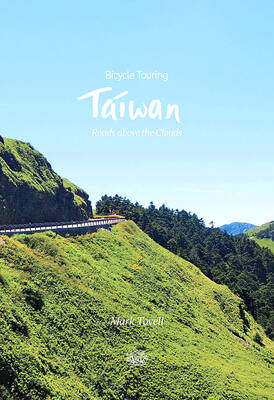
It’s hard to know where to begin with Mark Tovell’s Taiwan: Roads Above the Clouds. Having published a travelogue myself, as well as having contributed to several guidebooks, at first glance Tovell’s book appears to inhabit a middle ground — the kind of hard-to-sell nowheresville publishers detest. Leaf through the pages and you’ll find them suffuse with the purple prose best associated with travel literature: “When the sun is low on a warm, clear morning, and with the heat already rising, we stand at the riverside bike path leading south from Sanxia’s old cobble streets.” Hardly the stuff of your
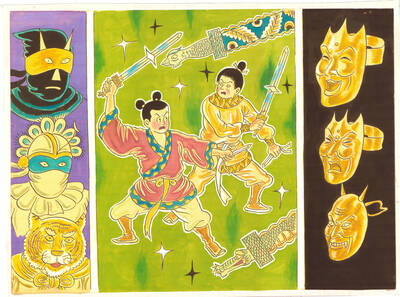
April 22 to April 28 The true identity of the mastermind behind the Demon Gang (魔鬼黨) was undoubtedly on the minds of countless schoolchildren in late 1958. In the days leading up to the big reveal, more than 10,000 guesses were sent to Ta Hwa Publishing Co (大華文化社) for a chance to win prizes. The smash success of the comic series Great Battle Against the Demon Gang (大戰魔鬼黨) came as a surprise to author Yeh Hung-chia (葉宏甲), who had long given up on his dream after being jailed for 10 months in 1947 over political cartoons. Protagonist


 RSS
RSS