


When the flowers had wilted, the sympathy cards had slowed, and their mother had been memorialized in a lakeside service, Carie and Danielle Lemack sat in their mom's Framingham, Massachusetts home and pondered how to channel their shock and grief into action. Their mother, Judy Larocque, was en route to a business meeting in Los Angeles when she died aboard American Airlines Flight 11 on Sept. 11, 2001. She was 50 years old.
Two weeks after the terrorist attacks, the FBI held a meeting for the victims' families. The Lemack sisters circulated a sign-up sheet to obtain participants' contact information, not quite sure what they'd do with it.
"It was all these horrified people standing around," says Carie, who was 26 when her mother died. "At first, we didn't want to be around others in the same situation. But then we realized we are those people. No one else could quite understand what had happened. And there was so much going on, we realized we needed to reach out to other families."
PHOTO: NY TIMES
A month after their loved ones were killed, "Families of Sept. 11" was born. A handful of shell-shocked relatives met at a Marriott hotel in Newton, Massachusetts. They elected a board and came up with a mission: to promote the interests of the victims' families and to advocate for stronger antiterrorism policies. Two years later, some 1,500 people have joined the organization. They come from different generations, different backgrounds, and different places, but they share an unspeakable tragedy -- and the need to do something.
For Carie Lemack, the group has offered a way to regain some control over the uncontrollable.
"Being informed and being involved in the political process and doing the advocacy work we've been doing helps us regain very small bits of control in that we're less surprised by things," she says. "Now, we generally know about things ahead of the media, and that has been extremely helpful and empowering."
In the past two years, the family group has taken up such issues as airport security, a ground zero memorial, compensation for victims' families, and obtaining their loved ones' remains and personal property. They've lobbied Congress. They've met with Kenneth Feinberg, special master of the Sept. 11 victims' compensation fund, with Governor George Pataki and Mayor Michael Bloomberg. They've spent countless hours with reporters. They've responded to charges from talk show hosts and others that they're greedy. ("You wouldn't believe the e-mails we get. `You're worse than Osama bin Laden!' `You deserve what happened to you!'" says Lemack wryly).
The group fought United Way and the Federal Emergency Management Agency, which at first were going to give emergency aid only to the New York and New Jersey families. In June 2002, they rallied in Washington, demanding an independent commission to investigate the attacks. "President Bush was adamantly opposed to it," Lemack says. "It took us 14 months to get it."
And they continue to keep tabs on airline safety. "Only 2 percent of the cargo is checked," she says. "I can't live in fear; I do fly." She pauses and adds, "When I have kids, I may not be able to do it. I don't want them stuck in the same situation my sister and I were stuck in."
The organization has two paid staffers working out of New York and a Web site (www.familiesofseptember11.org). They raise money through grants and donations. Carie Lemack stepped aside as president this year; she is now vice president, her sister Danielle secretary. Thomas Roger, whose daughter Jean was a flight attendant on Flight 11, is the president. Jean Roger was off that day but got called in that morning to substitute for an ill colleague.
For Roger, a vice president of Gilbane Building Company, becoming involved in the aftermath of tragedy has been both a blessing and a curse.
"By becoming actively involved, you're continually reminded of the situation, and in effect you're postponing dealing with some of the personal issues," says Roger, who lives in Longmeadow. "But on the other side, I felt I had to do something other than just sit and grieve. I'm a Type A personality, and I've come to understand that becoming involved is a form of grieving. And you feel you make a difference on behalf of Jean and the others who can't be here."
Roger's primary interest is ground zero, both the memorial and the rebuilding. He is a member of the Families Advisory Council of the Lower Manhattan Development Corp and attends all their meetings in New York. He has also been drawn into the controversy over victims' remains and personal property, finding himself in the position of having to explain to families why their loved ones' articles have not been returned. "A frustrating middle-man job," he calls it.
Though his family did get his daughter's remains back, no personal property has been returned. Unlike some other families, who are angry that they've gotten nothing back, Roger understands.
"It's just so beyond the scale of anything that has ever happened. You had the personal effects of everybody and everything in that building, all mixed together with all the terrible destruction. How do you pair people up with things? It just seems like an impossible task."
Not all family members choose to get involved in a group. Some lack the interest, others the time. Dr. Stephen Holland's wife, Cora, was also on Flight 11, en route to Los Angeles to see her disabled mother. The couple had been empty nesters for a week, having just taken their youngest, a son, to Fordham University, where he was a freshman. After his mother died, the son returned home to Sudbury, to stay with his father for the year. Two older daughters live in the New York area.
With his son and one daughter, Holland attended that first meeting of Families of Sept. 11. "I remember the thing that struck me most was there was a woman there from a national organization for airline disasters. She had lost a son on a flight years ago. And I realized, `Oh my God, she's 10 years out and she has dedicated her life to airline safety.'"
As medical director of a start-up longterm health care company, Holland could take only two weeks off.
"There is no one else but me," he says. "I had to go back to work." Still, he stayed active in the group for several months until he ran out of steam, trying to work 60 hours and be both mother and father to his kids.
"I was just being overwhelmed by my job and my children," he says. He still supports the group, and regularly writes his congressman, senator, and the president Bush on myriad issues.
Holland sees political activism as a means to heal, and to vent. "It's a way to do something. I mean, my wife vaporized. I put her on an airplane and she was gone from my life," he says. "We didn't get to hold a hand or see a body. I think it's a way to do something positive after a devastating loss. I think it's a way to be angry, and to try to prevent it from happening again."

In late October of 1873 the government of Japan decided against sending a military expedition to Korea to force that nation to open trade relations. Across the government supporters of the expedition resigned immediately. The spectacle of revolt by disaffected samurai began to loom over Japanese politics. In January of 1874 disaffected samurai attacked a senior minister in Tokyo. A month later, a group of pro-Korea expedition and anti-foreign elements from Saga prefecture in Kyushu revolted, driven in part by high food prices stemming from poor harvests. Their leader, according to Edward Drea’s classic Japan’s Imperial Army, was a samurai

The following three paragraphs are just some of what the local Chinese-language press is reporting on breathlessly and following every twist and turn with the eagerness of a soap opera fan. For many English-language readers, it probably comes across as incomprehensibly opaque, so bear with me briefly dear reader: To the surprise of many, former pop singer and Democratic Progressive Party (DPP) ex-lawmaker Yu Tien (余天) of the Taiwan Normal Country Promotion Association (TNCPA) at the last minute dropped out of the running for committee chair of the DPP’s New Taipei City chapter, paving the way for DPP legislator Su

It’s hard to know where to begin with Mark Tovell’s Taiwan: Roads Above the Clouds. Having published a travelogue myself, as well as having contributed to several guidebooks, at first glance Tovell’s book appears to inhabit a middle ground — the kind of hard-to-sell nowheresville publishers detest. Leaf through the pages and you’ll find them suffuse with the purple prose best associated with travel literature: “When the sun is low on a warm, clear morning, and with the heat already rising, we stand at the riverside bike path leading south from Sanxia’s old cobble streets.” Hardly the stuff of your
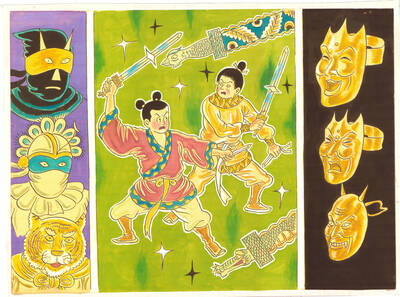
April 22 to April 28 The true identity of the mastermind behind the Demon Gang (魔鬼黨) was undoubtedly on the minds of countless schoolchildren in late 1958. In the days leading up to the big reveal, more than 10,000 guesses were sent to Ta Hwa Publishing Co (大華文化社) for a chance to win prizes. The smash success of the comic series Great Battle Against the Demon Gang (大戰魔鬼黨) came as a surprise to author Yeh Hung-chia (葉宏甲), who had long given up on his dream after being jailed for 10 months in 1947 over political cartoons. Protagonist


 RSS
RSS