


After nine days of walking, Pani Bai, widow and laborer, had little patience for questions. She stopped only long enough to say through tears that her arms and legs were aching, but that her daughter was ailing and she had to keep moving.
What was in her mind's eye, and only a few kilometers away, was the temple built over the gravesite of Ramdev, a 15th-century Rajput warrior and social reformer who has become a saint, even a god, to the rural masses of western India. In flip-flops, Pani Bai had walked, step by painful step, almost 483km from her home in southern Rajasthan to pray for her daughter's recovery.
Each summer, two million people make a similar pilgrimage to this town in the Thar Desert, not far from where India conducted its 1998 nuclear tests, to pray to Ramdev, who is revered by Hindus and Muslims alike.
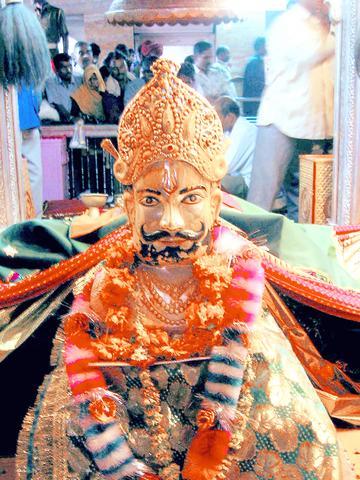
PHOTO: NY TIMES
Many pilgrims come on foot in temperatures well over 38℃. They walk four, or nine, or seventeen days, stretching a sheet on the ground to bed down at night. Others come by bike, motorbike, train, tractor and, less often, car.
The long strings of pilgrims trekking along roadsides throughout Rajasthan, waving colorful martial flags, is a remarkable display of faith. So is the final devotional act some undertake: casting off their shoes, in a show of renunciation, to walk the last miles barefoot on the searing ground. Their shoes -- camel-skin slippers, rubber thongs -- are strewn along the roadside. In town, shoe vendors who perch here just for the pilgrimage period eagerly wait to shod them anew.
This was Pani Bai's third trek here. Yet her 18-year-old daughter's health, she conceded, has not improved; the tumor in her back still swells. Some have suggested she needs to bring her daughter with her -- an impossible feat, she said. Others say she must come five times in five years, and so she will, hoping that enough blisters of devotion will eventually show results.
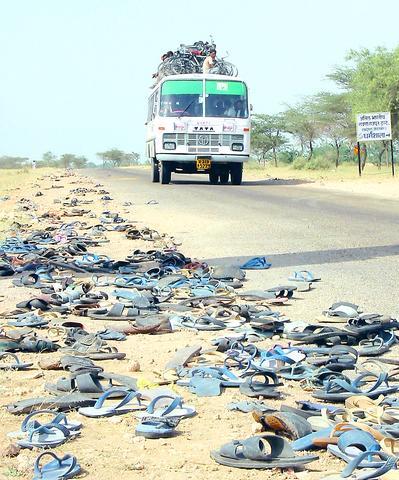
PHOTO: NY TIMES
"I'm not asking any wealth," she said. "Just my daughter's welfare."
Some say their prayers have been answered. Two women held up sons they said had arrived in the world in answer to prayers to "Baba Ramdev."
Ram Kanya, 35, held up two sons who came after five daughters, and her husband's pilgrimage and prayers to Ramdev. "Both my sons were given to me by Baba," she said. When the first was born, they had made an offering of 101 rupees to Ramdev. They had also brought both sons here to be tonsured for the first time, an important Hindu rite.
One could say making tracks to the shrine of a dead man is the resort of the desperate -- people without money for specialists or infertility doctors or other modern mercantilist methods to make their dreams come true. Or one could say it is a tribute to a man whose legacy -- of fighting for the downtrodden, for social equality -- was so strong, and remains so alluring, that it has endured through almost six centuries.
"What a democratically elected government is trying to do now, he tried to do 600 years ago," said Amba Ram, a local official, of Ramdev's efforts at social uplift.
Ramdev's life is recounted through folk songs and tales, making it as well known to Indians as Santa Claus is to Americans. "The whole country knows," said Yakub Khan, 23, a Muslim who sells stickers of Hindu gods for a living. "Baba fulfills the wishes of everybody."
Though Hindus and Muslims have battled, sometimes murderously, for control of religious sites, the two religions mingle easily here. Hindus believe that Ramdev, who died around 1459, was the incarnation of Lord Krishna, and that his birth to a sonless king was an answer to his father's prayers.
Another legend, though, holds that five Muslim holy men skeptical of Ramdev's miraculous power came from Mecca to see him and left convinced. Thus Muslims, following Sufi tradition, worship him too, under the name Ramdevpir, Ramapir or Ramshahpir.
On busy days, the wait to pay homage inside the temple can be five hours. In the shrine, the tombs of Ramdev's parents, sons and relatives -- family members still live in the area -- are cloaked in Islamic green. Behind glass, there are life-size statues, made from cloth and in one case silver, representing his horse. There is tinsel, the noise of a clanging bell, the shriek of a whistle, songs, and the press of crowds. A man falls to his knees and crawls to the image of Ramdev.
In town, which has the festive and commercial feel of a fair, vendors sell bangles and roasted rice for offering in worship, as well as T-shirts and necklaces with Ramdev's picture. He is depicted as a man of deep, dark eyes and lively facial hair, with a mustache twirling up at both ends. A pair of feet, the crescent moon of Islam and the horse, replicated in miniature for sale in colorful paper and tinsel, are representations of his worship.
The real horses are long gone. Nearby, men and bicycles are being piled on top of buses. This is the sweet coda to sacrifice: After their days of walking or bicycling here, the pilgrims get to ride home.

In late October of 1873 the government of Japan decided against sending a military expedition to Korea to force that nation to open trade relations. Across the government supporters of the expedition resigned immediately. The spectacle of revolt by disaffected samurai began to loom over Japanese politics. In January of 1874 disaffected samurai attacked a senior minister in Tokyo. A month later, a group of pro-Korea expedition and anti-foreign elements from Saga prefecture in Kyushu revolted, driven in part by high food prices stemming from poor harvests. Their leader, according to Edward Drea’s classic Japan’s Imperial Army, was a samurai

The following three paragraphs are just some of what the local Chinese-language press is reporting on breathlessly and following every twist and turn with the eagerness of a soap opera fan. For many English-language readers, it probably comes across as incomprehensibly opaque, so bear with me briefly dear reader: To the surprise of many, former pop singer and Democratic Progressive Party (DPP) ex-lawmaker Yu Tien (余天) of the Taiwan Normal Country Promotion Association (TNCPA) at the last minute dropped out of the running for committee chair of the DPP’s New Taipei City chapter, paving the way for DPP legislator Su
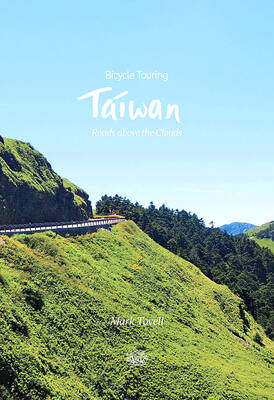
It’s hard to know where to begin with Mark Tovell’s Taiwan: Roads Above the Clouds. Having published a travelogue myself, as well as having contributed to several guidebooks, at first glance Tovell’s book appears to inhabit a middle ground — the kind of hard-to-sell nowheresville publishers detest. Leaf through the pages and you’ll find them suffuse with the purple prose best associated with travel literature: “When the sun is low on a warm, clear morning, and with the heat already rising, we stand at the riverside bike path leading south from Sanxia’s old cobble streets.” Hardly the stuff of your
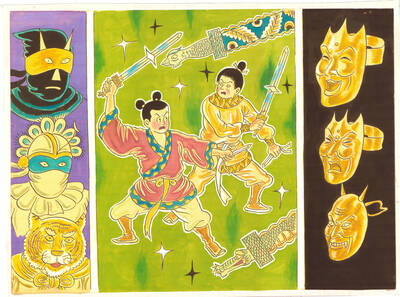
April 22 to April 28 The true identity of the mastermind behind the Demon Gang (魔鬼黨) was undoubtedly on the minds of countless schoolchildren in late 1958. In the days leading up to the big reveal, more than 10,000 guesses were sent to Ta Hwa Publishing Co (大華文化社) for a chance to win prizes. The smash success of the comic series Great Battle Against the Demon Gang (大戰魔鬼黨) came as a surprise to author Yeh Hung-chia (葉宏甲), who had long given up on his dream after being jailed for 10 months in 1947 over political cartoons. Protagonist


 RSS
RSS