


Twenty-year-old Jason Harvey bought his mother her favorite meal for dinner on Mother's Day two years ago -- pork chops, sweet potatoes, collard greens, corn bread and macaroni and cheese.
That was the last meal they ate together.
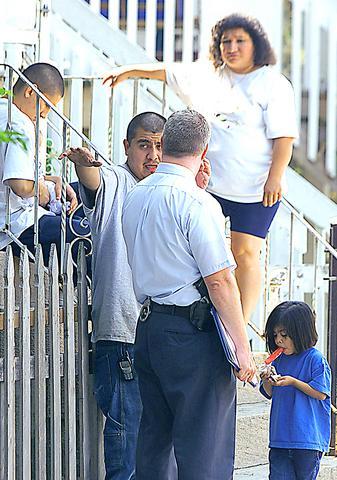
PHOTO: REUTERS
The next morning, Jason Harvey was shot four times in broad daylight by a 16-year-old boy presumed to be a gang member.
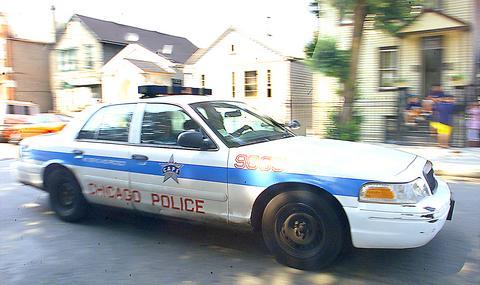
PHOTO: REUTERS
Harvey is just another number in the statistics that make Chicago's murder rate the highest per capita among all US cities with populations of over 1 million.
Chicago, with a population of 2.9 million, recorded 646 murders last year and 666 in 2001. There have been 384 murders from Jan. 1 to Aug. 22 this year. New York, with two-and-a-half times the population, had fewer murders in each of the last two years, excluding the Sept. 11, 2001, attacks.
The number of murders in the US rose slightly last year, according to FBI figures. The US homicide rate is one of the highest among major industrial countries. The US has almost five times the population of Britain but nearly 10 times the homicides.
Just about everyone agrees on the reason for Chicago's high murder rate -- a mixture of gangs, guns and drugs. Gangs control the drug trade throughout the city.
"The biggest challenge Chicago faces is gangs," said police officer Tom Garritty as he patrolled one of Chicago's most crime-ridden neighborhoods in a police car.
More than 60,000 people in Chicago have admitted to being gang members, and more than 60 percent of the homicides are gang-related, according to the gangs unit at the state attorney's office.
Less than 5km from the shimmering Sears Tower in downtown Chicago is Pilsen, a neighborhood where gang members stroll past dilapidated buildings. A seven-year-old girl sitting on a porch was killed there in a drive-by shooting recently.
The letter "A" sprayed in bright green and circled on a pillar at South Blue Island Avenue and 16th Street means the area belongs to Ambrose, one of the two largest Hispanic gangs in the city. Anyone not a member of Ambrose who tries to sell drugs in the area is risking his or her life.
"The most common cause of homicide among gangs is turf," said Garritty.
He waved at two teenagers dressed in red, white and green, hanging out on a street corner. "They are Larazia members. Those are Larazia colors they are wearing," said officer Chris Kantor, also riding in the car. The situation is similar in some predominantly black neighborhoods where gangs called the Vice Lords and the Gangster Disciples guard their turf.
Jason Harvey, who had been arrested three times before he was murdered, and the boy who shot him fit the typical profile of murder victim and offender in Chicago -- young and black or Hispanic, with prior arrests.
In Chicago, 72 percent of homicide offenders and 74 percent of victims are black, and 20 percent of offenders and 18.1 percent of victims are Hispanic, according to police data for the first six months of this year.
Chicago's high murder rate has people apportioning blame and calling for action.
Police officers said the city needs more cops on the streets and tougher laws to apprehend loitering gang members. Also, the city should not have disbanded a special intelligence unit on gangs within the police department, said Brian Sexton of the gang prosecution unit in the state attorney's office.
Matt Crowl, an adviser on gangs to Chicago Mayor Richard Daley, said the main problem is the number of handguns on the streets. While it is illegal in Chicago to own or sell a handgun, the law does not apply to the rest of the state or surrounding areas and guns are smuggled in.
The gang wars are being fought in pockets on the west and south sides of the city, making them virtually invisible to the mostly white and affluent neighborhoods along Lake Michigan and the suburbs to the north.
When Daley tried to move police from low-crime areas of the north side to high-crime areas of the South and West, city council members from low-crime areas objected.
To Vera Evans, mother of murder victim Jason Harvey, the problems appear intractable. Police seldom show up to stop drug-dealing youths who appear on her South Side street every night, and the allure of big money from selling drugs is too great for many youth to resist the trade, she said.
Jason Harvey had a two-year-old son at the time of his death, and Evans dreams of a better future for her grandson. "When he is 15, I hope life will not be so cheap on the streets of Chicago."

In late October of 1873 the government of Japan decided against sending a military expedition to Korea to force that nation to open trade relations. Across the government supporters of the expedition resigned immediately. The spectacle of revolt by disaffected samurai began to loom over Japanese politics. In January of 1874 disaffected samurai attacked a senior minister in Tokyo. A month later, a group of pro-Korea expedition and anti-foreign elements from Saga prefecture in Kyushu revolted, driven in part by high food prices stemming from poor harvests. Their leader, according to Edward Drea’s classic Japan’s Imperial Army, was a samurai

The following three paragraphs are just some of what the local Chinese-language press is reporting on breathlessly and following every twist and turn with the eagerness of a soap opera fan. For many English-language readers, it probably comes across as incomprehensibly opaque, so bear with me briefly dear reader: To the surprise of many, former pop singer and Democratic Progressive Party (DPP) ex-lawmaker Yu Tien (余天) of the Taiwan Normal Country Promotion Association (TNCPA) at the last minute dropped out of the running for committee chair of the DPP’s New Taipei City chapter, paving the way for DPP legislator Su
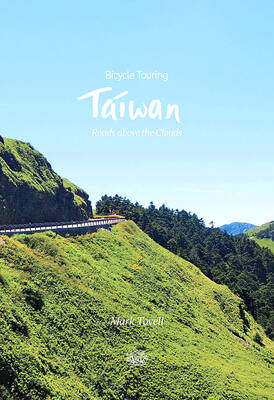
It’s hard to know where to begin with Mark Tovell’s Taiwan: Roads Above the Clouds. Having published a travelogue myself, as well as having contributed to several guidebooks, at first glance Tovell’s book appears to inhabit a middle ground — the kind of hard-to-sell nowheresville publishers detest. Leaf through the pages and you’ll find them suffuse with the purple prose best associated with travel literature: “When the sun is low on a warm, clear morning, and with the heat already rising, we stand at the riverside bike path leading south from Sanxia’s old cobble streets.” Hardly the stuff of your
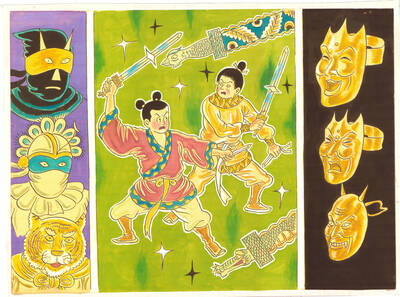
April 22 to April 28 The true identity of the mastermind behind the Demon Gang (魔鬼黨) was undoubtedly on the minds of countless schoolchildren in late 1958. In the days leading up to the big reveal, more than 10,000 guesses were sent to Ta Hwa Publishing Co (大華文化社) for a chance to win prizes. The smash success of the comic series Great Battle Against the Demon Gang (大戰魔鬼黨) came as a surprise to author Yeh Hung-chia (葉宏甲), who had long given up on his dream after being jailed for 10 months in 1947 over political cartoons. Protagonist


 RSS
RSS