


Only the French would be crazy enough to invent a pursuit in which participants were encouraged to leap off of cliff faces with nothing but a 2m square piece of nylon strapped to their backs.
Dubbed parapente -- translated into English as paraglide -- by the early pioneers, the first paragliders to take to the air were French mountaineers in the mid-1980s. Too lazy to hike down after completing an ascent, the reckless Europeans would unfurl the chutes they had carried with them and casually glide down to the valley floor from the freshly conquered summit.

PHOTO COURTESY OF LES SHARP
Since then the pastime has taken off on a global scale. On any given weekend, be it in Texas or Keelung, people crazy enough to leap off precipices into thin air can be spotted enjoying this somewhat dangerous pastime.
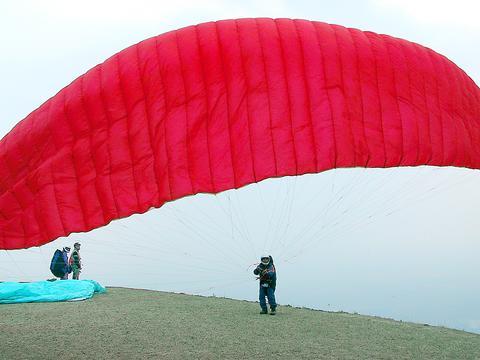
Once boasting over 1,000 active pilots, paragliding has lost momentum in Taiwan over the past eight years. While the nation boasts 12 clubs, the number of people now active is currently at an all-time low of 200.
Because of this, paragliding clubs, local town councils and the Tourism Bureau have been actively trying to increase this number in recent months. A series of regattas in Taitung and Pingtung attracted hundreds of onlookers and were considered huge successes by organizers.
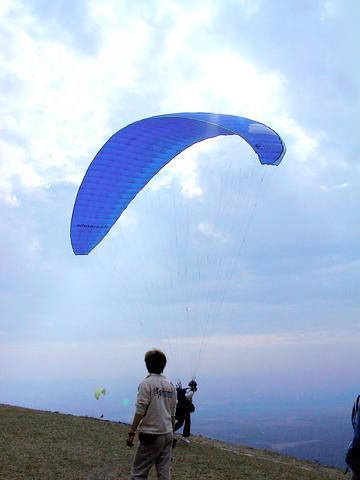
In conjunction with the recent flurry of airborne activity, Taiwan has also seen an increase in the number of paragliding venues. Along with well-established spots such as Pingtung's Saijia and Taitung's Luyeh, paragliders can now soar with the birds in Hualian, Keelung, Nantou, Ilan and Hsinchu.
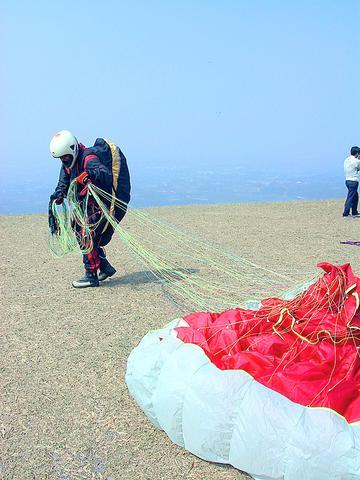
Rabid promotion and more venues have meant that clubs such as the Taipei Aerosport Association (
"The numbers of students are increasing all the time. And as the number of places that allow paragliding increase, I'm sure the number of people wanting to learn will increase also," Hsieh said.
Luo Gu-sheng (
Due to this sudden upsurge in the number of those wishing to take to the sky, tuition rates have leveled off. While there is no standardized fee, nearly all of Taiwan's clubs charge around NT$10,000 for a month-long course.
Although the equipment is far from cheap, with prices for a full kit starting at around NT$80,000, the number of would-be paragliders willing to purchase equipment is also on the increase. While the economy stews, it appears that would-be paragliders are more than happy to spend their cash.
"It's certainly not a cheap pastime, but you'd be surprised at the number of people willing to pay for the gear," said Hsieh. "They see it as an investment and a way in which they can get a little adventure in their lives."
While the number of those seeking adventure is on the increase, many serious questions remain relating to the quality of tuition and the overall safety aspects surrounding paragliding in Taiwan.
A decade ago, all paragliders in Taiwan held credentials that were issued by the ROC Aerosports Association. The association had close ties to World Aerospace and certification was globally recognized. The ROC's association ceased to exist some years ago, however, shortly after the man in charge absconded with all the funds.
Needless to say, this left Taiwan with no central paragliding governing body. Today many of the guys who ply the skies have no credentials other than those issued to them by their fellow paragliders.
British national Les Sharp, a former paragliding instructor, who has called Taiwan home for the past decade, believes that a centralized and globally recognized governing body is necessary for the genuine development of paragliding in Taiwan.
The lack of such a body means that a large number of cowboys, or "taxi drivers" as Sharp labels them, can call themselves instructors and operate without proper credentials. All of which should have alarm bells ringing according to Sharp.
"These guys take you're money and if you're still alive after six flights you're awarded with a piece of paper," said the British paraglider. "This is certainly not the way it should be done."
Sharp believes that a minimum of 25 to 30 radio-controlled flights, eight hours of groundwork and the same in theory should be the basis for any club that wishes to teach paragliding. Also, according to Sharp, instructors should either have been trained by someone with internationally recognized certification, or, better still, trained abroad.
Paragliding instruction in Taiwan is, more often than not, as much groundwork and as many theory lessons as the instructor sees fit, one or two tandem flights and six solo fights.
Despite what clubs or instructors might say, the certification gained from local flight schools is not recognized anywhere else in the world. This is not due to Taiwan's perilous political situation, but simply because of the lack of a centralized paragliding body.
Along with the dubious, and some might say dodgy, training given in Taiwan, several people who should know better, namely the instructors, seem to take rather a blase attitude towards the dangers involved in paragliding.
One rather nonchalant Taipei-based paraglider simply asserted that "any sport is dangerous" when quizzed by Taipei Times over the dangers. Suffice to say Taiwan loses a paraglider every couple of years.
While the number might seem small, it remains a pretty frightening statistic, with the number of accidents roughly the same as in France, where there is a hardcore of 20,000 to 30,000 paragliders as opposed to Taiwan's 200 active fliers.
Recent tragedies include a chap who leapt off a cliff face without first ensuring his safety harness was correctly fastened, only to plummet 200m to his death. Another paraglider took off in some rather inclement weather conditions and was blown out of the sky by strong winds. The most shocking accident, however, involved a man who was sucked into a huge thundercloud. He was, needless to say, never seen alive again.
If you do decide to forego rationality and trust your life to one of the nation's instructors, then Taiwan does offer some reasonably good sites at which to enjoy some interesting low level paragliding.
"It's OK, but not world-class," explained Sharp. "As the cloud-base is low in Taiwan you can reach only heights of about 2,000m as opposed to places in the US, where you fly at heights of 3,500m to 4,000m."
Some of the nation's busiest sites at which contact with clubs can be made are at Luyeh in Taitung County and at Saijia in Pingtung County, both of which attract large numbers of onlookers, novice paragliders as well as more seasoned veterans during the weekends.
Other spots, where lessons and tandem rides can be found include Green Bay in Keelung and Tiger Head Mountain, near Puli in Nantou County. The going rate for tandem runs -- a form of paragliding at which the uninitiated are strapped to a more experienced pilot and no experience is necessary -- cost roughly NT$1,000 for between 20 and 30 minutes depending on the weather.
On a passing note, whether you choose to fly tandem or alone, it's probably wise to heed Sharp's words of warning before taking to the skies. "It [paragliding] is a lot different to being pulled along by a rope in Mexico after one too many Mai Tais."
Information
Ilan Aerosports Association (
Keelung Aerosports Association (
Taipei Aerosports Association (
Huelian Paragliding Association (
For Saijia and other southern locations call Pingtung County Government at (08) 738-5401
In late October of 1873 the government of Japan decided against sending a military expedition to Korea to force that nation to open trade relations. Across the government supporters of the expedition resigned immediately. The spectacle of revolt by disaffected samurai began to loom over Japanese politics. In January of 1874 disaffected samurai attacked a senior minister in Tokyo. A month later, a group of pro-Korea expedition and anti-foreign elements from Saga prefecture in Kyushu revolted, driven in part by high food prices stemming from poor harvests. Their leader, according to Edward Drea’s classic Japan’s Imperial Army, was a samurai

The following three paragraphs are just some of what the local Chinese-language press is reporting on breathlessly and following every twist and turn with the eagerness of a soap opera fan. For many English-language readers, it probably comes across as incomprehensibly opaque, so bear with me briefly dear reader: To the surprise of many, former pop singer and Democratic Progressive Party (DPP) ex-lawmaker Yu Tien (余天) of the Taiwan Normal Country Promotion Association (TNCPA) at the last minute dropped out of the running for committee chair of the DPP’s New Taipei City chapter, paving the way for DPP legislator Su

It’s hard to know where to begin with Mark Tovell’s Taiwan: Roads Above the Clouds. Having published a travelogue myself, as well as having contributed to several guidebooks, at first glance Tovell’s book appears to inhabit a middle ground — the kind of hard-to-sell nowheresville publishers detest. Leaf through the pages and you’ll find them suffuse with the purple prose best associated with travel literature: “When the sun is low on a warm, clear morning, and with the heat already rising, we stand at the riverside bike path leading south from Sanxia’s old cobble streets.” Hardly the stuff of your

April 22 to April 28 The true identity of the mastermind behind the Demon Gang (魔鬼黨) was undoubtedly on the minds of countless schoolchildren in late 1958. In the days leading up to the big reveal, more than 10,000 guesses were sent to Ta Hwa Publishing Co (大華文化社) for a chance to win prizes. The smash success of the comic series Great Battle Against the Demon Gang (大戰魔鬼黨) came as a surprise to author Yeh Hung-chia (葉宏甲), who had long given up on his dream after being jailed for 10 months in 1947 over political cartoons. Protagonist


 RSS
RSS