


W.G. Sebald's unforgettable and extraordinary The Rings of Saturn concluded with an astonishing and unforgettable meditation on the art of silk-making in ancient China. For page after page he expatiated on the miraculous evolution of the craft, going on to consider its meaning, its inner symbolism, its effects on Europe once the secret of the silkworms and their diet of mulberry leaves had finally been smuggled out to the West, and much more.
At the book's center was a walking tour round the English country of Suffolk, but gradually his concerns widened to encompass the Low Countries, then Europe in general, and finally China and the Far East. Much of the wealth of the often derelict country houses he viewed in Suffolk had come from trade with Asia, and the narrative ended, appropriately, on an Asian crescendo.

Sebald was born in Germany but lived in England from the mid-1960s, latterly as a Professor of European Literature at the University of East Anglia. He wrote his six books in German, but during the late 1990s rose to fame in the English-speaking world as, essentially, a stylist in the English language (Austerlitz is superbly rendered into English by Anthea Bell). He died in a road accident in December 2001 at the age of 57.
Austerlitz was Sebald's last book and, according to those who've read them all, his masterpiece. By any standards it's a remarkable performance.
It isn't hard to read, but it's very unconventional. The first thing that will strike most readers is that the entire book, though 415 pages long, consists of one single, enormous paragraph. There's also one sentence two-thirds of the way through that goes on for a total of 11 pages.
Style is the essence of Sebald's attraction, as it was almost certainly central to his interest. The form of his books, too, is highly original.
Austerlitz is made up of a sequence of meditations, some lasting a few pages, others maybe for 50. These are almost invariably linked by only a single sentence, giving the effect of a gigantic literary patchwork quilt. It doesn't smother you exactly, but the way the tone of voice continues without change, and without stumbling, from one subject to another is so extraordinary it seems at times almost comic.
The tone itself must first and foremost be described as lofty. It's also somber, ruminative, and building to magnificent set-pieces that nonetheless manage to avoid grandiloquence. To anyone familiar with the symphonies of Anton Bruckner, these will provide a close parallel. Bruckner's symphonies have been brilliantly described as "boa constrictor" works. Like the great snake, they slowly and almost imperceptibly slide round you, and then proceed to crush you with a series of devastating and laughingly triumphant climaxes.
There's nothing laughing about Sebald, though there are undoubtedly some quiet and all-but hidden jokes for those on the look out for them. But the parallel of an insidious progression leading to some grand and marvelous effects is otherwise valid. Sebald, like Bruckner, appears to meander while in fact having his end clearly in view.
What is also striking is the oddity of Sebald's formal structures. In Austerlitz there appears at first to be a single narrator, but soon he gets into conversation with a stranger, a Czech called Austerlitz, in the Central Station in Antwerp, Belgium. Austerlitz then proceeds to tell his tale, and this ends up constituting nine-tenths of the book. (Some of Joseph Conrad's narratives come to mind here). As a result "said Austerlitz" recurs hundreds of times in the book's pages, so much so that you find yourself tensing as you anticipate the phrase's reappearance, and sometimes chuckling at the strange place Sebald chooses to place it -- phrases like "`said Vera,' said Austerlitz," are not uncommon. This, combined with the endless paragraph and the often very long sentences, produces a hallucinatory effect, and also one of unstoppability. The narrative rolls on like a huge snowball, with you, the reader, rolled up, legs flailing in vain, inside it.
Is there a story? In this book, yes. The Rings of Saturn was in the nature of a travel diary, but Austerlitz is in essence the story of a young Jewish boy sent from Prague to London to escape persecution by the occupying Nazis. He is cared for by a strict evangelical family in North Wales, and his identity is concealed from him. His attempts to uncover that identity, and to find out what happened to his parents, constitute the book's central preoccupation.
But, in a sense, this story, terrible though it is when it focuses on the details of the hounding out of the Jews from Prague and Paris, with their property being seized by the occupying German authorities and carefully catalogued in huge warehouses before being expropriated, isn't really at the heart of the book. Rather, its essence seems to lie in its description of buildings.
Sebald is profoundly interested in large and ambitious building projects -- railway stations, palaces, one particular concentration camp disguised as a charming holiday resort, and fortresses. The way these grand projects represent human aspirations, yet at the same time are doomed to crumble and become overgrown with weeds, is probably the author's most abiding preoccupation.
Another unusual feature of the book is that it contains many black and white photographs, all placed in the text at precisely the point in the story they illustrate. For hundreds of years now illustrations have been held to be very inferior adjuncts to any serious literary text, with only a few artists, such as the English poet, Blake, bucking the trend. Now W.G.Sebald has placed them back as authorially authenticated elements of his grand composition.
Once you've finished this wonderful book you're haunted by the melancholy tone of this solitary, meditative figure. If there's a literary precursor, it's the English 17th century essayist Sir Thomas Browne. It's no accident that places associated with Browne open The Rings of Saturn. He too was concerned above all with death and mutability. And it's in his company that W.G. Sebald, despite writing in German, will probably enter the pantheon of English Literature.

In late October of 1873 the government of Japan decided against sending a military expedition to Korea to force that nation to open trade relations. Across the government supporters of the expedition resigned immediately. The spectacle of revolt by disaffected samurai began to loom over Japanese politics. In January of 1874 disaffected samurai attacked a senior minister in Tokyo. A month later, a group of pro-Korea expedition and anti-foreign elements from Saga prefecture in Kyushu revolted, driven in part by high food prices stemming from poor harvests. Their leader, according to Edward Drea’s classic Japan’s Imperial Army, was a samurai

The following three paragraphs are just some of what the local Chinese-language press is reporting on breathlessly and following every twist and turn with the eagerness of a soap opera fan. For many English-language readers, it probably comes across as incomprehensibly opaque, so bear with me briefly dear reader: To the surprise of many, former pop singer and Democratic Progressive Party (DPP) ex-lawmaker Yu Tien (余天) of the Taiwan Normal Country Promotion Association (TNCPA) at the last minute dropped out of the running for committee chair of the DPP’s New Taipei City chapter, paving the way for DPP legislator Su

It’s hard to know where to begin with Mark Tovell’s Taiwan: Roads Above the Clouds. Having published a travelogue myself, as well as having contributed to several guidebooks, at first glance Tovell’s book appears to inhabit a middle ground — the kind of hard-to-sell nowheresville publishers detest. Leaf through the pages and you’ll find them suffuse with the purple prose best associated with travel literature: “When the sun is low on a warm, clear morning, and with the heat already rising, we stand at the riverside bike path leading south from Sanxia’s old cobble streets.” Hardly the stuff of your
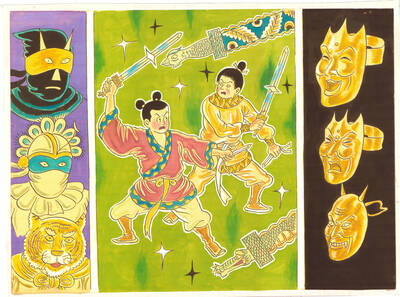
April 22 to April 28 The true identity of the mastermind behind the Demon Gang (魔鬼黨) was undoubtedly on the minds of countless schoolchildren in late 1958. In the days leading up to the big reveal, more than 10,000 guesses were sent to Ta Hwa Publishing Co (大華文化社) for a chance to win prizes. The smash success of the comic series Great Battle Against the Demon Gang (大戰魔鬼黨) came as a surprise to author Yeh Hung-chia (葉宏甲), who had long given up on his dream after being jailed for 10 months in 1947 over political cartoons. Protagonist


 RSS
RSS