


China has long prided itself on its eight great regional cuisines, but in the eyes of the imperial court, they were just that, regional. "In the imperial court, the best chefs from around the country were brought together to create dishes specifically to meet the tastes of the empress dowager," said Li Li (厲莉), owner of Li's Cuisine Beijing (厲家菜) and currently a guest chef at the Far Eastern Plaza Hotel.
Her narrow frame hunched under heavy Manchu robes during a press presentation last week, she looked very much like a typical courtier of late Ching dynasty prints. This is not surprising, as her family belonged to the Pure White Banner, one of the most senior branches of the Manchu social hierarchy and her great-grandfather served as the Minister of the Household Affairs in charge of the imperial kitchens.

PHOTO COURTESY OF FAR EASTERN PLAZA HOTEL
It is from here that Li Li's story begins, which has taken her from a restaurant with just a single round table to seat 12 to being in demand internationally by some of the mostly highly regarded hotels in the world. Part of the appeal is that Li Zhijia (厲子嘉), her great-grandfather, was a kind of personal butler to the Empress dowager Cixi (慈禧太后), and many of the dishes that he passed down to children where personal favorites of the Old Buddha herself.
This historical link to a lost tradition is appeal enough in itself -- it helps also that the food that Li will be presenting over the next four nights at the Far Eastern Plaza Hotel's Shang Palace restaurant is also very delicious, focusing on steamed and boiled dishes at the expense of the more conventional stir-fry techniques that people often associate with Chinese food.
While many local chefs complain Chinese food in Taiwan has lost all its regional distinctions and can make little claim to authenticity, Li is blissfully secure in her own tradition. "It is a tradition of cooking that has come down through our family," she said, and apart from her husband Chung Chun-sheng (叢春生), "who counts as family," she does not intend to let anyone else in on the secrets of her cooking.
"Much of the food is very labor intensive," said Chung, "with preparation times of up to six months in some cases." Such long periods of preparation are required for dishes like shark's fin, for which Li's Cuisine does all the preliminary processing. "We do not use ingredients that have been processed by others," he added.
Li Li first came to prominence after winning a cooking competition in 1984. With China opening up at that time, the "discovery" of a living tradition of the imperial kitchens was made into a media event. For all that, Li's Cuisine remained a very small operation, although bookings often needed to be made as much as six months in advance, according to Li.
The restaurant continues to be an item on the schedules of many heads of state and other visiting dignitaries to Beijing. In 1991, Li opened another restaurant in Melbourne Australia, which has also proved very popular. Li's current visit to Taiwan is taking place under the guise of a cultural exchange with the Yu Chang Technical and Commercial College (豫章工商), which is associated with the Far Eastern Group. For more information about tasting this imperial cuisine, contact tel (02) 2378-8888 ext. 5888. See also Li's Cuisine Web site at http://www.lilis.net.au/.
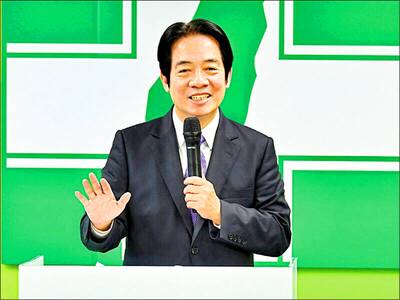
Ahead of incoming president William Lai’s (賴清德) inauguration on May 20 there appear to be signs that he is signaling to the Chinese Communist Party (CCP) and that the Chinese side is also signaling to the Taiwan side. This raises a lot of questions, including what is the CCP up to, who are they signaling to, what are they signaling, how with the various actors in Taiwan respond and where this could ultimately go. In the last column, published on May 2, we examined the curious case of Democratic Progressive Party (DPP) heavyweight Cheng Wen-tsan (鄭文燦) — currently vice premier
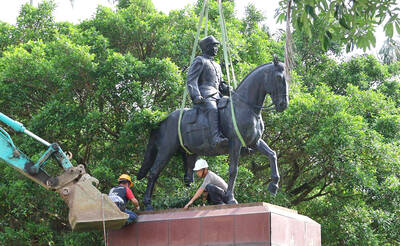
The last time Mrs Hsieh came to Cihu Park in Taoyuan was almost 50 years ago, on a school trip to the grave of Taiwan’s recently deceased dictator. Busloads of children were brought in to pay their respects to Chiang Kai-shek (蔣中正), known as Generalissimo, who had died at 87, after decades ruling Taiwan under brutal martial law. “There were a lot of buses, and there was a long queue,” Hsieh recalled. “It was a school rule. We had to bow, and then we went home.” Chiang’s body is still there, under guard in a mausoleum at the end of a path
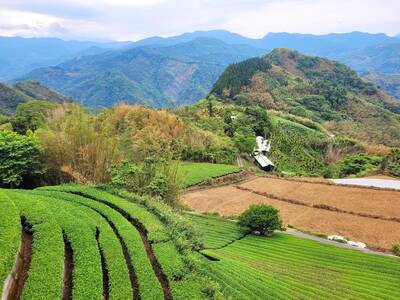
Few scenes are more representative of rural Taiwan than a mountain slope covered in row upon row of carefully manicured tea plants. Like staring at the raked sand in a Zen garden, seeing these natural features in an unnaturally perfect arrangement of parallel lines has a certain calming effect. Snapping photos of the tea plantations blanketing Taiwan’s mountain is a favorite activity among tourists but, unfortunately, the experience is often rather superficial. As these tea fields are part of working farms, it’s not usually possible to walk amongst them or sample the teas they are producing, much less understand how the
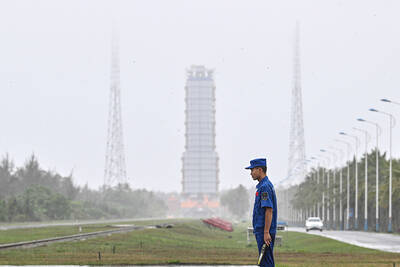
The worsening rivalry between the world’s two most powerful countries that has in recent years spread across the world, has now extended beyond the terrestrial, into the realms of the celestial. As China has become deeply enmeshed in strategic competition with the US — while edging towards outright hostilities with other regional neighbors — Washington’s alarm at the pace of its advancement in space is growing ever-louder. Beijing has made no secret over its ambitions and a spate of recent successful space missions has shown that the government’s rhetoric is backed by technological advances. On Friday, China launched a robotic spacecraft on a


 RSS
RSS