


Yang Kwei-ying (
"To be honest, when I heard the news I could not really feel immediately happy, because throughout the years of protest I felt too much. My feelings became so complicated," she said.
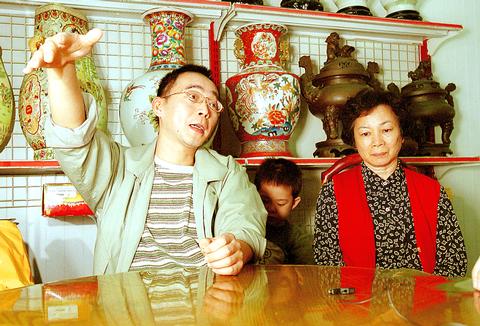
PHOTO: CHIANG YING-YING, TAIPEI TIMES
"It has become a part of my life. Before we really succeeded, [the nuclear plant] was like a shadow in my head that haunted me everyday and I could not take it out," she said.

PHOTO: CHIANG YING-YING, TAIPEI TIMES
In the eyes of Yang's companions from the Yenliao Anti-Nuclear Self-Help Organization (
In the eyes of her neighbors in Fulung village, however, Yang and her husband are strange. Since their involvement in the anti-nuclear energy movement, they have neglected their shop, just a short walk form the Fulung train station, which originally sold clothes and groceries.
TAIPEI TIMES FILE PHOTO
Two or three days in a week, Yang had to attend meetings concerning the power plant so she would close the store. "Little by little people stopped coming to the store. So I changed to selling fishing and water sports goods, you know, things that don't go out of fashion quickly," Yang said.
The family, which includes four children, now mostly depends on her husband's wage as a ticket clerk at the Fulung train station. Her husband has been reluctant to aggressively join the campaign, fearing that it might impact his government job. "So I just act out his beliefs," said Yang.
The couple has been rigid about adhering to their opposition to the plant. They were one of the first households to reject all preferential treatment from Taipower. Since the passage of the budget for the Fourth Nuclear Power Plant, Kungliao residents have been given various benefits, including discounted electricity. Kungliao township government is also given NT$200 million each year to conduct other preferential measures.
"We don't accept the cable fee discount. Our children don't join the free lunch provided by the school that is supported by Taipower. My children don't take the scholarship and tuition fee reduction, either" she said.
To give up those benefits Yang had to go to through a string of application processes, which made Yang "a difficult person" in the neighborhood. "The administration staff thought we were weird. And school teachers thought I was giving them a hard time. Relatives and friends blamed us for blocking their way to save money," she said. "But I thought since we are against the plant we should show it from our actions."
But her devotion has caused rifts not only between her and neighbors, but also among her and her children. "When ? my children complain that I am not being a dutiful mother, I really have no position to argue back. I just become silent," she said. "These are the enormous pressures you have no place to release."
Thirteen years ago, Yang was inspired to join the movement by a speech made by environmental scholar Chang Kuo-lung (
But the gains from the movement are also countless, she said. Not only did she gain a community consciousness but also political bargaining skills. Most importantly, she said she gained more knowledge of her environment and of the importance of ecological balance. "If you go against nature, nature will bite you back much more strongly," she said.
Warrior spirit
For many anti nuclear activists in Kungliao township, the long battle against the Fourth Nuclear Power Plant sapped much of their mental and physical energy, especially during the early, most difficult years of the movement -- the years just after martial law ended.
Chiang Chun-ho (
Chiang had led the group from 1989 to 1991, the time when activists engaged in numerous confrontations with riot police. Chiang's family and fellow activists believe that it was his persistent devotion to the anti-nuclear movement that caused him to fall ill.
"I remember in those days I could hardly see my father at home," said Chiang Chih-en (
Chiang proved himself a tough, experienced leader, perhaps a natural extension of his career as a fishing boat captain. He retired from being a fisherman at the age of 50 and began a new career in fish farming and pottery. But his involvement in the anti-nuclear energy movement eventually monopolized his time.
During the course of his leadership, Chiang's most unforgettable setback was the so-called 1003 incident, which took place on Oct. 3, 1991. During a tense confrontation between activists and hundreds of riot police, a policeman was killed in a car accident. This resulted in the prosecution of Chiang and 16 other activists, including the car-driver Lin Shun-yuan (
Chiang's widow, Yang Sho-chih (
Chiang felt guilty that a movement intended for safety and life had resulted in such a deadly incident. "My father felt very depressed for a few years. His business was affected. And the movement faced a setback. Fewer people supported the movement. He felt nothing was going right," said Chiang Chih-en.
Things did not get better for the Chiang family. In 1998 Chiang Chun-ho was diagnosed with liver cancer. "But he was still deeply concerned about the movement. It's like his unfulfilled duty," Chiang Chih-en said.
When Yang heard the news about the cancellation, she began to cry. "The movement has given me mainly losses and few gains -- I lost a husband. I just hope he can rest in peace with his wish achieved," Yang said.
Soon she will go to the grave containing his ashes and burn newspapers reporting the news so that he will be able to read them and know that his wish has come true.
Speaking out
Wu Wen-tung (吳文通) is hardly a quiet, meek man.
As spokesman for the Yenliao Anti-Nuclear Self-Help Organization, Wu is usually in the middle of the fracas. He makes his point, and then again. These days he is just as vociferous as ever, defending the actions of the activists and swatting away any accusations that their activities have threatened the well-being of the nation.
"It's so unfair to blame our movement for shaking public confidence for the economy. How can we have the ability to ruin Taiwan's economy?" asked Wu.
Wu has been a member of the movement for more than a decade. In that time, he has been transformed from the uninformed owner of a household appliance store to one of the key leaders of the group.
During the early 1990s, Wu was one of the activists jailed after a clash with riot police resulted in a car accident in which one policeman was killed.
Wu spent a month in jail for organizing the demonstration. Since then, Wu has faced dozens of lawsuits for sporadic clashes with the police.
The 45-year-old activist has lived in Kungliao for more than 20 years. He said he would not have paid such a price for a movement if he had chosen not to attend an anti-nuclear energy speech 12 years ago in front of Jenho Temple, the town's religious center.
"Maybe it was because my uncle was killed in the 228 incident. My relatives had warned me not to touch politics." But he did. And despite credit paid to him by other activists, he has remained modest about his devotion. "There are no heros in the movement. As I'm not a fisherman working out at sea all day, I just happened to have more time," he said.

In late October of 1873 the government of Japan decided against sending a military expedition to Korea to force that nation to open trade relations. Across the government supporters of the expedition resigned immediately. The spectacle of revolt by disaffected samurai began to loom over Japanese politics. In January of 1874 disaffected samurai attacked a senior minister in Tokyo. A month later, a group of pro-Korea expedition and anti-foreign elements from Saga prefecture in Kyushu revolted, driven in part by high food prices stemming from poor harvests. Their leader, according to Edward Drea’s classic Japan’s Imperial Army, was a samurai

The following three paragraphs are just some of what the local Chinese-language press is reporting on breathlessly and following every twist and turn with the eagerness of a soap opera fan. For many English-language readers, it probably comes across as incomprehensibly opaque, so bear with me briefly dear reader: To the surprise of many, former pop singer and Democratic Progressive Party (DPP) ex-lawmaker Yu Tien (余天) of the Taiwan Normal Country Promotion Association (TNCPA) at the last minute dropped out of the running for committee chair of the DPP’s New Taipei City chapter, paving the way for DPP legislator Su
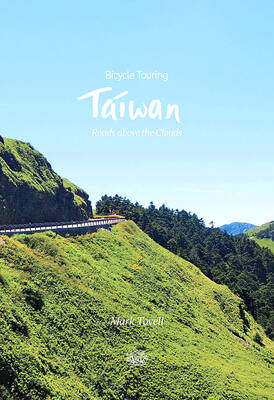
It’s hard to know where to begin with Mark Tovell’s Taiwan: Roads Above the Clouds. Having published a travelogue myself, as well as having contributed to several guidebooks, at first glance Tovell’s book appears to inhabit a middle ground — the kind of hard-to-sell nowheresville publishers detest. Leaf through the pages and you’ll find them suffuse with the purple prose best associated with travel literature: “When the sun is low on a warm, clear morning, and with the heat already rising, we stand at the riverside bike path leading south from Sanxia’s old cobble streets.” Hardly the stuff of your
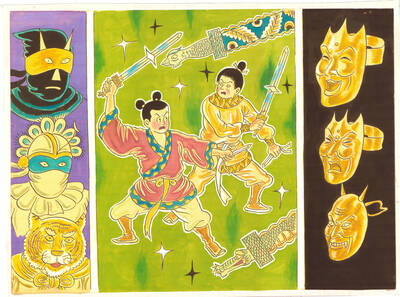
April 22 to April 28 The true identity of the mastermind behind the Demon Gang (魔鬼黨) was undoubtedly on the minds of countless schoolchildren in late 1958. In the days leading up to the big reveal, more than 10,000 guesses were sent to Ta Hwa Publishing Co (大華文化社) for a chance to win prizes. The smash success of the comic series Great Battle Against the Demon Gang (大戰魔鬼黨) came as a surprise to author Yeh Hung-chia (葉宏甲), who had long given up on his dream after being jailed for 10 months in 1947 over political cartoons. Protagonist


 RSS
RSS