


From the streets of Santiago and Quito to the ballot boxes of Buenos Aires, many South Americans have strongly rejected in recent weeks their leaders’ free market agendas, amid outcry that they are fueling inequality across the region.
With economic growth slowing sharply, job security fraying and holes in social safety nets widening, a wave of protest has arisen, spanning millions of people across the continent.
The end of the “pink tide” of leftist leaders that swept Latin America in the 2000s gave way in recent years to a series of more broadly conservative governments.
While each country has its own issues, there has been a common backlash against the “market-friendly” policies pursued by some of those governments — such as the privatizing of state assets, reduction of public subsidies and exposure of more aspects of society to market forces.
In Chile, which introduced market reforms long before the rest of the region and is seen by many as a posterchild of neoliberalism, some 1 million people marched on Friday to protest the conservative economic agenda of billionaire President Sebastian Pinera, the largest protest since the country’s return to democracy in 1990.
That followed a week of riots in which at least 18 people were killed. The unrest began after the government raised the price of metro fares, but reflected long-simmering anger at its failure to alter Chile’s economic course despite growing inequality.
“There are two Chiles here. The Chile of people with money, and the Chile of the poor,” said Nathaly Melendez, 28, a manicurist in Santiago. “If you don’t have money, you have to wait in long lines for healthcare, education is terrible, students are all in debt.”
The protests in Chile came hot on the heels of violent demonstrations in Ecuador sparked by a proposed cut to decades-old fuel subsidies, which forced the government to temporarily relocate the capital to Guayaquil.
In perhaps the most emphatic rejection of austerity and business friendly reforms, Argentine voters on Sunday removed conservative President Mauricio Macri in favor of Peronist Alberto Fernandez — a landslide backing for a decidedly more protectionist agenda.
Branko Milanovic, visiting professor at The City University of New York and an expert on inequality, said the uneven effects of globalization had sown discontent in Latin America.
Globalization in recent decades brought a surge in low-cost products from emerging countries like China and expanded the export markets for Latin America’s commodities, helping to fuel economic growth, but many across the region feel the rewards have accrued mostly to the wealthy.
By some measures, Chile is one of the most unequal countries in Latin America, though it also has the highest average income.
The combined wealth of Chilean billionaires in 2015 was equal to a quarter of gross domestic product — the highest in the world, excluding tax havens like Cyprus, and around double the level of Mexico and Peru, Milanovic said.
“If there is no social justice and minimum of social cohesion, the effects of growth will dissolve in grief, demonstrations, and yes, in the shooting of people,” he added.
Leftist leaders have been galvanized by the backlash. Bolivian President Evo Morales, a socialist leader now facing widespread protests after a disputed election win this month, has looked to rally his supporters with warnings about the return of neoliberalism should he lose power.
Creomar De Souza, founder of Brasilia-based consultancy Dharma Political Risk And Strategy, said the longer-term policy impact of the upheavals was not yet clear.
“But in some of these countries, Argentina and maybe Bolivia, the economy will take a more heterodox turn, with a greater role for the state. Pinera will try to endorse some social reforms in Chile, but the legitimacy of that generation of politicians is under threat,” De Souza said.
The unrest coincides with a slide in Latin American economic growth in the wake of a long commodities-driven boom. The IMF this month slashed its growth forecasts for the region this year to a dismal 0.2 percent — the second-slowest rate in the world, behind the Middle East and North Africa’s 0.1 percent.
While many people around the world feel poorer as the world economy slows, in Latin America it is actually true, according to World Bank figures.
The Bank uses a variety of measures to track GDP per capita, depending on exchange rate fluctuations, and most of them suggest it is lower in the region today than it was five years ago.
According to its measure using current US dollars, GDP per capita in Latin America last year was US$9,023, down 13 percent from the peak of US$10,405 in 2014.
The process is not helped by government’s efforts in countries like Argentina, Chile and Brazil to reduce budget deficits.
Ana Lia Agullo, a 69-year-old retiree in Buenos Aires, said Argentina’s new government needed to refocus on employment, health and education — “the pillars of every society.”
“It’s totally different from Macri’s supposed model, which is obviously not a model at all but rather a big-business trick typical of people belonging to his class,” she said.
Moody’s warned that social pressure would likely also force Pinera to ease efforts to reduce the deficit and stop Chile’s debt from growing.
Opposition to Chile’s direction might be of particular interest for Brazil watchers, given that Economy Minister Paulo Guedes is a devotee of its economic model.
An orthodox economist trained at the University of Chicago, Guedes failed in his attempt to introduce a pension system in Brazil based on the Chilean model of private savings accounts.
However, his reform, passed this month, would save the public purse 800 billion reais (US$200 billion) over the next decade by raising the minimum retirement age and increasing workers’ contributions.
The remainder of his reform agenda, which includes labor market deregulation and ramping up privatization, might face increased political resistance.
Memories linger of Brazil’s brutal recession in 2015-2016 as well as last year’s truckers’ strike over diesel price hikes that brought the country to a standstill. So far, there is no sign of people taking to the streets again in Brazil, but the political mood appears to be turning against Guedes’ agenda.
Center-right lawmaker Marcelo Ramos said Brazil needed investment to grow again, but it also needed to tackle inequality.
The inequality “keeps millions of Brazilians from being consumers and demands heavy social spending on unemployed, discouraged and underutilized workers,” he said.
Additional reporting by Miguel Lo Bianco
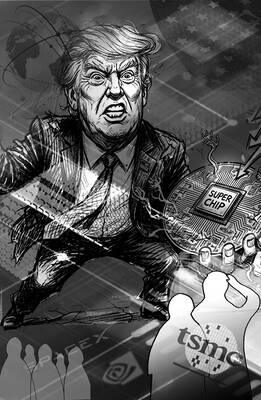
The White House’s decision to take a 9.9 percent stake in Intel Corp is looking like very shrewd business indeed. Since the government bought in at US$20.47 a share last August, the US chipmaker’s surging stock price has delivered the US a US$43 billion return. One of the reasons the investment has so far proved so sound is that the White House has made sure of it. According to The Wall Street Journal, Howard personally pushed deals on Intel’s behalf with some of the most lucrative clients imaginable. They include Nvidia Corp, the company at the heart of the AI
In a Taiwanese university classroom, a lecturer asks in English: “Can anyone give me an example from Taiwan?” Students look down. No one answers. After class, one student writes on the course platform in Mandarin: “I understood the concept, but I didn’t know how to answer in English.” That moment highlights a key issue in Taiwan’s English-medium instruction (EMI) reform: It is not just about more English-taught courses, but whether students can learn, participate and belong. EMI expansion is part of the Bilingual 2030 policy and the Ministry of Education’s BEST Program, aiming to improve English ability, support EMI teaching
The Ministry of the Interior, working with the navy and coast guard, is organizing Taiwan’s first joint exercise simulating escort tankers carrying liquefied natural gas (LNG) and oil through a Chinese blockade. The drills simulate fuel transport along three maritime corridors leading toward Japan, the Philippines and the US. Deputy Minister of the Interior Sawyer Mars (馬士元) said that a blockade of the Taiwan Strait would amount to “almost a 100 percent blockade of the regional energy supply.” Minister of National Defense Wellington Koo said planning to counter a blockade is standard practice in Taipei. While the exercise is limited in
A single photograph can cut through a lot of noise, but it can also be used to misrepresent the truth. At the very least, it can concentrate the mind on something that requires further investigation. On Monday last week, Ma Ying-jeou Foundation CEO Tai Hsia-ling (戴遐齡) and former National Security Council secretary-general King Pu-tsung (金溥聰) held a news conference in which they showed a photograph of former foundation CEO Hsiao Hsu-tsen (蕭旭岑), now Chinese Nationalist Party (KMT) deputy chairman. In the image Hsiao is seated next to Xiamen Taiwan Businessmen Association chairman Han Ying-huan (韓螢煥). The two men were holding


 RSS
RSS