


Zin Mar was a housewife in Bago, Myanmar, when she saw an advertisement for a job at Thai Union Group, a global seafood supplier and the world’s biggest producer of tuna.
The 44-year-old paid a local recruitment agency about 4,300 Thai baht (US$142) — less than half the sum that most migrants from Myanmar pay to win work in neighboring Thailand.
Zin Mar is among the 23,000 Burmese workers Thai Union employed under what the company calls its ethical migrant recruitment policy.
Three in four of its workers are migrants in a company that operates in 13 nations and is considered a leader in efforts to clean up an industry that was rife with worker abuse.
Four years after the Thai seafood industry came under fire for its work practices, the government and private sector have introduced a raft of measures — from worker contracts to tighter laws — to clean up the multibillion-dollar sector.
Thai Union was among the first to react, though campaigners say smaller firms have copied its lead and the pace of reform must continue if the industry is to ward off bad practice.
The industry was badly in need of a cleanup.
It was in 2014 accused of widespread slavery, trafficking, and violence on fishing boats and in processing factories.
Thai Union in 2016 was among the first in the $6.6 billion industry to adopt an ethical recruitment policy, with help from the Migrant Worker Rights Network (MWRN), a Thai non-profit assisting migrant workers, to reduce worker debt.
Debt bondage is one of the world’s most prevalent forms of modern slavery, affecting 610,000 people in Thailand, according to the Global Slavery Index by rights group Walk Free Foundation.
Under debt bondage, workers are tricked into paying to get a job, then end up trapped in a never-ending cycle of repayments that effectively means they work for free and are enslaved.
Under the more ethical Thai Union policy, it pays the recruitment fees, while workers pay about 4,300 baht for permits, health checks, visas and other services.
One of the first collaborations between the private sector and civil society, it spawned a host of copies, such as the Seafood Task Force, a coalition of businesses and charities that regularly audits fishing vessels to prevent human rights abuses.
Charoen Pokphand Foods, Thailand’s largest agriculture conglomerate, has worked for two years with a campaign group that helps migrant workers lodge complaints about their company.
Another firm, Seafresh Industry, has joined with the anti-trafficking Issara Institute to set up a migrant helpline.
“There’s an increasing dialogue taking place between industry and civil society,” said Darian McBain, who joined Thai Union in 2015 as global director of corporate affairs and sustainability.
Thailand officially has 3 million migrant workers and the UN estimates there are at least 2 million more working illegally across the nation.
Many are mired in debt or were trafficked into Thailand against their will, rights activists say.
About 55 percent of seafood processing workers paid a recruitment fee in Thailand averaging 11,000 baht, according to a report last year by the International Labour Organization.
“The first thing we did was give the MWRN access to our facility so they could talk to workers and what they found was that migrant workers were arriving from Myanmar in large debts that had built up as they journeyed to Thailand,” McBain said.
The company stopped employing migrants who had already got to Thailand and began recruiting directly from Myanmar through International Focus, an agent trained on the new policy.
The MWRN then ensures the recruits do not pay any extra fees.
“We have found cases of brokers charging workers up to 500,000 [Burmese] kyat [US$327] to find work with Thai Union, and when this happens we investigate what money they paid and who they paid it to, and if necessary we’d pay it back,” MWRN secretary-general Sein Htay said.
About 500,000 baht of fees have been returned to Thai Union workers, he said.
Now the challenge is to ensure workers pay no fees.
Oxfam policy and campaign manager Jacques-chai Chomthongdi said that workers could pay up to four times the legal limit of 150,000 kyat at home to get work abroad.
“Workers still have to bear these costs and those in debt are at risk of forced labor,” Chomthongdi said.
He spoke on behalf of a coalition of civil society organizations that advise the Thai seafood industry.
Thai Union was a trailblazer in fighting modern slavery, he said, but smaller firms are now adopting similar policies in a bid to stamp out exploitation during the recruitment process.
“Other companies, some with a much smaller scale, are starting to catch up,” Chomthongdi said. “This is a welcome development. However, if they [Thai Union] don’t adapt and ensure that the implementation of existing good policies are maintained rigorously, they might eventually become a follower.”
The EU in 2015 gave Thailand a “yellow card” warning for failing to prevent illegal and unregulated fish from entering the supply chain and ending up in Europe. It required Thailand to clean up in six months or face a trade ban.
The EU in January removed the yellow card in light of efforts by Thailand to combat human trafficking and improve conditions for workers, but fisheries associations — emboldened by a change in government — are now pushing for a relaxation to the rules.
Among the demands: dropping age restrictions so that 16-year-olds can work on fishing boats; scrapping vessel inspections; and letting vessels swap out crew and catch at sea, far from any oversight.
“One of the main challenges Thailand is facing at the moment is ensuring that the reforms that have been painstakingly introduced over the past five years are not swiftly removed and replaced with policies that would return the industry to ‘business as usual,’” said Steve Trent, executive director of the Environmental Justice Foundation, an advocacy group that investigates environmental and human rights abuses.
Industry experts are also urging Thailand to grant migrant workers the same rights in terms of freedom to organize and collective bargaining as Thai workers.
At Thai Union, employees can e-mail their concerns, post suggestions to post boxes or call a third-party hotline.
“Collaboration and engagement is key to solving the world’s big challenges like ending modern slavery,” McBain said.
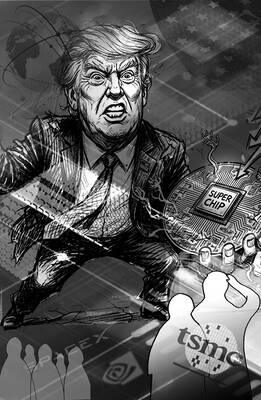
The White House’s decision to take a 9.9 percent stake in Intel Corp is looking like very shrewd business indeed. Since the government bought in at US$20.47 a share last August, the US chipmaker’s surging stock price has delivered the US a US$43 billion return. One of the reasons the investment has so far proved so sound is that the White House has made sure of it. According to The Wall Street Journal, Howard personally pushed deals on Intel’s behalf with some of the most lucrative clients imaginable. They include Nvidia Corp, the company at the heart of the AI
A single photograph can cut through a lot of noise, but it can also be used to misrepresent the truth. At the very least, it can concentrate the mind on something that requires further investigation. On Monday last week, Ma Ying-jeou Foundation CEO Tai Hsia-ling (戴遐齡) and former National Security Council secretary-general King Pu-tsung (金溥聰) held a news conference in which they showed a photograph of former foundation CEO Hsiao Hsu-tsen (蕭旭岑), now Chinese Nationalist Party (KMT) deputy chairman. In the image Hsiao is seated next to Xiamen Taiwan Businessmen Association chairman Han Ying-huan (韓螢煥). The two men were holding
I first met Professor Ray Jiing (井迎瑞) as a film and documentary student at Shih Hsin University’s (SHU) Department of Radio Television and Film in 1988. The following year, he went on to become the director of the Chinese Taipei Film Archive — forerunner of the Taiwan Film and Audiovisual Institute (TFAI). Over his eight-year tenure, Jiing rescued and restored over 200 classic Taiwanese films. In 1997, he established the Graduate Institute of Studies in Documentary and Film Archiving at Tainan National University of the Arts (TNNUA), and I joined the program in his third cohort of students. Beyond a
President William Lai Ching-te’s (賴清德) May 20 second-anniversary address was not just a routine policy review; it was damage control. US President Donald Trump’s remarks — that he did not want to see anyone move toward independence and that the delivery of a major Taiwan arms package could depend on the progress of US-China relations — unsettled Taiwan’s public and created an opening for opposition parties to question whether Taiwan was being treated as a bargaining chip in Washington’s dealings with Beijing. Lai’s speech was designed to close that opening. The address covered the expected ground: sovereignty, cross-strait relations, defense spending,


 RSS
RSS