


As the Democratic Progressive Party (DPP) and Chinese Nationalist Party (KMT) primaries progress in the run-up to the presidential and legislative elections on Jan. 11 next year, one trend seems to be that voters are responding more to the aesthetics and emotive appeal of the candidates than their record in office.
For the DPP, the challenge to President Tsai Ing-wen (蔡英文) from former premier William Lai (賴清德) is an illustration of not only the party’s three-decade internal power struggle between the Formosa and New Tide factions, but also a reflection of two competing visions of leadership: technocratic pragmatism versus aspirational nationalism.
There is no doubt that Tsai and Lai are unswayable advocates of Taiwan and the nation’s sovereignty and democracy, but at the same time they differ markedly in style and experience.
As the incumbent president who won by a landslide, Tsai has an automatic advantage over Lai. She has served at the legislative and national government level for most of her career, whereas Lai was drafted, by Tsai, from Tainan mayor into the premiership only recently.
Tsai is supported by big party hitters, such as Premier Su Tseng-chang (蘇貞昌) and Presidential Office Secretary-General Chen Chu (陳菊), both very popular politicians with the grassroots and party elite.
Lai’s popularity in his own city suffered toward the end of his last term and members of his own local party revolted in the city council speaker vote. Lai simply does not command the same level of respect and support across the party as Tsai, regardless of Lai’s legitimate complaints of an uneven playing field.
Despite the seeming inevitability of Tsai winning the primary, by whatever method is finally chosen, a potential looming paradox is that Tsai might still not be able to retain the presidency for two related reasons. First, she lacks Lai’s charisma, and second, Tsai’s public appeal could be severely tested if her KMT opponent is either Kaohsiung Mayor Han Kuo-yu (韓國瑜) or Hon Hai Precision Industry Co chairman Terry Gou (郭台銘).
Tsai won in 2016 largely because of a meltdown within the KMT that saw it replace its presidential candidate — then-KMT chairwoman Hung Hsiu-chu (洪秀柱) — with then-New Taipei City mayor Eric Chu (朱立倫) within weeks of the vote, when it became apparent that Hung’s strident pro-China reactionary nationalism was toxic for the party with voters, especially among young people after the 2014 Sunflower movement protests.
The KMT’s disarray and Chu’s weak appeal outside of New Taipei City translated into Tsai winning on a record swing of 25 percent. The KMT was also eviscerated in the Legislative Yuan.
This time around the context is reversed. Instead of going to the national polls two years after their resounding success in local elections, Tsai and the DPP are going in on the back of a dreadful set of results last year that saw Kaohsiung fall to the KMT for the first time since 1998.
Han’s improbable, but not entirely unexpected victory has the KMT believing it could win back the presidency, if not with Han, then on the back of a “Han wave.”
Sensing his chance to capitalize on this almost entirely media-fabricated and sustained phenomenon, and seeing the lack of appeal of party heavyweights such as Chairman Wu Den-yih (吳敦義), former legislative speaker Wang Jin-pyng (王金平) and Chu, Gou has thrown his MAGA-style Republic of China (ROC) flag hat into the ring as a dark horse candidate.
While it seems obvious that Tsai’s record in office — three-and-a-half years of relatively stable governance, modest, but solid economic growth, and a principled and dignified defense and promotion of the nation on the international stage — is not threatened by anything Gou or Han could offer either in experience or policy, Tsai, her party and their supporters are nevertheless extremely nervous, and they are right to be.
Han’s victory in Kaohsiung has been carefully curated into an astroturfed moment that has unleashed the kind of soap box backlash in Taiwan that saw US President Donald Trump win.
So far, it has not been about Han the person, or Han’s policies, but about a kind of “yes we can!” visceral reaction to a perception of economic and political stagnation infecting the ruling class and the leadership of the nation. In many ways, it is similar to the widespread grumbling discontent seen in the UK before the shock result of the Brexit referendum. Tsai and her government’s mishandling of a number of domestic issues, riling the public, and offering a ready target for her opponents, is much to blame.
The greatest threat to Tsai and the DPP is a voting public that decides “anyone but them” because “they’re all the same.” It is instructive to note that just as rational choice theory can be quickly “debunked” by simply asking why, so it is too with elections where shock results can happen when voters “unexpectedly” choose the false or impossible promises of a charlatan over the dry statistical mantras of a competent, but uncharismatic bureaucrat.
Of course, later, when the full realization of the political and economic firestorm that has been spawned hits the public, it will be too late to reverse it.
When businesses close and Taiwanese see their sovereignty sold for “unification” painted as a peace treaty, the media will breathlessly report on the ensuing and escalating misery and anger with the same glee that promoted Han non-stop or suggested that Gou could have widespread public appeal.
Mainstream and social media might be vulnerable to Chinese “united front” attempts to push Han or Gou as a panacea for Taiwan’s stubborn insistence on not annexing itself into an expansionist authoritarian empire, but it can also just as quickly deliver the reverse. A case in hand presented itself recently.
At a question-and-answer session at the city council, New Power Party Kaohsiung City Councilor Huang Jie (黃捷) demanded detailed answers from Han about his proposed “free economic pilot zones” plan. Han’s inability to articulate a coherent description or defense of his pilot zones, in stark contrast to Huang’s incisive line of questioning, clinically exposed a weakness at the core of the “Han wave” that the DPP had been unable to puncture since the local elections in November last year. The video of Huang’s demolition of Han went instantly viral across Taiwanese social media.
For the first time since his election, the mythos of Han was punctured by the obvious reality that always lay beneath it, hidden by the culpability of mainstream media in treating Han as an infotainment reality show star rather than holding him to account as a politician.
Huang exposed Han as the obscure and unexceptional KMT journeyman he has always been: weak, inconsistent and lacking content or depth when demanded.
Perhaps one reason why Han is demanding, and the KMT is seriously considering, drafting him as its candidate and bypassing its primary rules, is that the longer Han has to actually do the job of being mayor of Taiwan’s second-largest city, the more obvious it will become how unexperienced and unqualified he is for the job and, by logical extension, how unsuitable he would be to lead the nation, and what a gift a weak Han presidency would be for China.
Gou will be pleased to see Han humiliated for it will give his Trump-esque challenge more definition and momentum, and for now he is largely protected by a media that seems slightly terrified of annoying him.
What Tsai and the DPP should note from that Huang-Han exchange is that Huang is a young member of the NPP, which became the third-largest party in the Legislative Yuan in the 2016 elections.
Some have argued that the NPP would be a flash in the pan like the New Party was in the mid-1990s, but in last year’s local elections the NPP nominated 41 councilors and saw 16 elected, double that of James Soong’s (宋楚瑜) much older People First Party, which nominated 26, but only won 8.
If Tsai wants to win next year, she could do worse than ask why the NPP is gaining support despite its apparently “too radical for the Taiwanese mainstream” policy proposals? She should ask herself how she can expect to defeat an irrational populism masking a Han nationalist chauvinism with an un-relatable list of “achievements” delivered in a monotone.
Tsai needs to empathize with the sense of betrayal felt by many voters over her incompetent handling of pension reforms, referendums, the superficiality of her statements and government policies that have in practice abandoned the Aboriginal and LGBTQ people she claimed to care about, and she needs to show that she will end the suffocating lack of imagination or courage at the heart of her Cabinet and party caucus, starting in the Presidential Office.
This will be her election to lose, not the KMT’s to win.
Ben Goren is an essayist, businessman and long-term resident of Taiwan.
In recent weeks, Taiwan has witnessed a surge of public anxiety over the possible introduction of Indian migrant workers. What began as a policy signal from the Ministry of Labor quickly escalated into a broader controversy. Petitions gathered thousands of signatures within days, political figures issued strong warnings, and social media became saturated with concerns about public safety and social stability. At first glance, this appears to be a straightforward policy question: Should Taiwan introduce Indian migrant workers or not? However, this framing is misleading. The current debate is not fundamentally about India. It is about Taiwan’s labor system, its
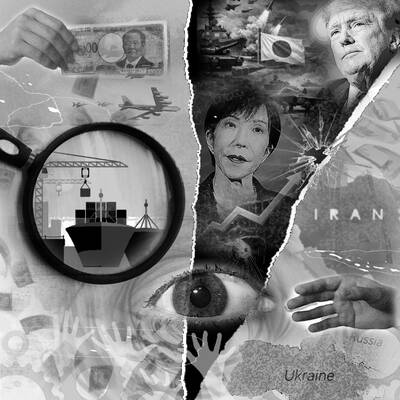
Japan’s imminent easing of arms export rules has sparked strong interest from Warsaw to Manila, Reuters reporting found, as US President Donald Trump wavers on security commitments to allies, and the wars in Iran and Ukraine strain US weapons supplies. Japanese Prime Minister Sanae Takaichi’s ruling party approved the changes this week as she tries to invigorate the pacifist country’s military industrial base. Her government would formally adopt the new rules as soon as this month, three Japanese government officials told Reuters. Despite largely isolating itself from global arms markets since World War II, Japan spends enough on its own
On March 31, the South Korean Ministry of Foreign Affairs released declassified diplomatic records from 1995 that drew wide domestic media attention. One revelation stood out: North Korea had once raised the possibility of diplomatic relations with Taiwan. In a meeting with visiting Chinese officials in May 1995, as then-Chinese president Jiang Zemin (江澤民) prepared for a visit to South Korea, North Korean officials objected to Beijing’s growing ties with Seoul and raised Taiwan directly. According to the newly released records, North Korean officials asked why Pyongyang should refrain from developing relations with Taiwan while China and South Korea were expanding high-level
Minister of Labor Hung Sun-han (洪申翰) on April 9 said that the first group of Indian workers could arrive as early as this year as part of a memorandum of understanding (MOU) between the Taipei Economic and Cultural Center in India and the India Taipei Association. Signed in February 2024, the MOU stipulates that Taipei would decide the number of migrant workers and which industries would employ them, while New Delhi would manage recruitment and training. Employment would be governed by the laws of both countries. Months after its signing, the two sides agreed that 1,000 migrant workers from India would


 RSS
RSS