


Chinese President Xi Jinping (習近平) has just concluded a five-day visit to Italy, Monaco and France. At a time of all-out confrontation in the US-China trade dispute, Beijing is trying to get European nations on its side by tackling them one by one.
However, on Thursday last week, just as Xi arrived in Italy, the Council of the European Union discussed a program of 10 actions that make up a hardline strategy toward China.
A few days earlier, on March 12, the European Commission released a paper that adjusts the EU’s strategy toward China by calling it an “economic competitor” and a “systemic rival promoting alternative models of governance.”
On March 14, the European Parliament approved by an overwhelming majority a resolution that urges the EU and its 28 member states to adopt a sanctions regime similar to that embodied in the US’ Global Magnitsky Human Rights Accountability Act, which calls for sanctions against governments and politicians who violate human rights.
The act is named after Russian tax accountant Sergei Magnitsky, who died in pretrial detention in 2009.
The act and similar laws adopted by other nations impose sanctions on officials of specific countries who are known to be responsible for serious violations of human rights.
Possible sanctions include denying them visas, banning them from entering the legislating country, freezing their assets and prohibiting them from making property transactions.
The US led the way by adopting the act in 2016, after which Estonia, the UK, Canada, Lithuania and Latvia enacted similar legislation, while other countries, such as France and Australia, are working toward that goal.
Reacting to the European Parliament resolution, Democratic Progressive Party (DPP) Legislator Wang Ding-yu (王定宇) said that these laws sanction powerful human rights violators and can strengthen countries’ national security.
He said that if the whole world joins hands to ensure that those guilty of human rights violations and corruption have nowhere to run, and to stop their assets from circulating, it would be helpful in strengthening their national security and human rights.
“This is a great chapter in the history of human civilization,” Wang said.
Meanwhile, DPP Legislator Lin Chun-hsien (林俊憲) said that the US and European nations have seen the Chinese Communist Party (CCP) for what it is and realize that many Chinese officials have hidden large amounts of financial assets in Western countries.
Given this understanding, Lin said that the European Parliament resolution was clearly aimed at China.
In 2017, the government banned three CCP officials known to have been involved in suppressing the Falun Gong spiritual movement from entering Taiwan.
In September of that year, a team of Taiwanese lawyers representing Falun Gong submitted to the US Department of State and the US Congress a list of 40 CCP officials, including former Chinese president Jiang Zemin (江澤民) and Luo Gan (羅幹), former secretary of the CCP’s Central Political and Legal Affairs Commission, who they accused of oppressing Falun Gong.
Taiwan should join this united front alongside some of the world’s main democracies. It should consider drawing up a Magnitsky act, or maybe call it the “Liu Xiaobo (劉曉波) human rights accountability act” in memory of the late Chinese dissident and Nobel Peace Prize winner.
Li Dao-yong is director of the City South Culture and History Studio.
Translated by Julian Clegg
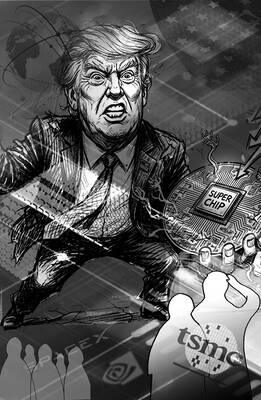
The White House’s decision to take a 9.9 percent stake in Intel Corp is looking like very shrewd business indeed. Since the government bought in at US$20.47 a share last August, the US chipmaker’s surging stock price has delivered the US a US$43 billion return. One of the reasons the investment has so far proved so sound is that the White House has made sure of it. According to The Wall Street Journal, Howard personally pushed deals on Intel’s behalf with some of the most lucrative clients imaginable. They include Nvidia Corp, the company at the heart of the AI
A single photograph can cut through a lot of noise, but it can also be used to misrepresent the truth. At the very least, it can concentrate the mind on something that requires further investigation. On Monday last week, Ma Ying-jeou Foundation CEO Tai Hsia-ling (戴遐齡) and former National Security Council secretary-general King Pu-tsung (金溥聰) held a news conference in which they showed a photograph of former foundation CEO Hsiao Hsu-tsen (蕭旭岑), now Chinese Nationalist Party (KMT) deputy chairman. In the image Hsiao is seated next to Xiamen Taiwan Businessmen Association chairman Han Ying-huan (韓螢煥). The two men were holding
I first met Professor Ray Jiing (井迎瑞) as a film and documentary student at Shih Hsin University’s (SHU) Department of Radio Television and Film in 1988. The following year, he went on to become the director of the Chinese Taipei Film Archive — forerunner of the Taiwan Film and Audiovisual Institute (TFAI). Over his eight-year tenure, Jiing rescued and restored over 200 classic Taiwanese films. In 1997, he established the Graduate Institute of Studies in Documentary and Film Archiving at Tainan National University of the Arts (TNNUA), and I joined the program in his third cohort of students. Beyond a
President William Lai Ching-te’s (賴清德) May 20 second-anniversary address was not just a routine policy review; it was damage control. US President Donald Trump’s remarks — that he did not want to see anyone move toward independence and that the delivery of a major Taiwan arms package could depend on the progress of US-China relations — unsettled Taiwan’s public and created an opening for opposition parties to question whether Taiwan was being treated as a bargaining chip in Washington’s dealings with Beijing. Lai’s speech was designed to close that opening. The address covered the expected ground: sovereignty, cross-strait relations, defense spending,


 RSS
RSS