


After the National Rifle Association of America (NRA) spent more than US$30 million to help US President Donald Trump win the 2016 election, it had high hopes for its gun rights agenda, but Trump’s victory has been a mixed blessing, with the NRA facing a bevy of political, regulatory and financial headaches, gun analysts and senior NRA officials said.
The problems for the 5 million-member association range from an emboldened pro-gun control and Democrat-controlled US House of Representatives to state and federal regulatory fights, and from better financed groups seeking to curb gun deaths to internal criticism of the NRA’s leadership.
Gun issue lobbyists — both proponents and opponents of gun control — and firearms experts said that the group’s legendary clout is being challenged on multiple fronts, and its long-standing image of invulnerability and power is encountering tougher opposition.
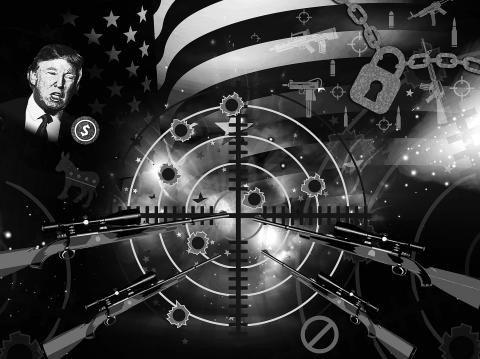
illustration: Louise Ting
“I think it’s a very serious confluence of issues that the NRA is facing,” said Independent Gunowners of America president Richard Feldman, a long-time NRA member. “They’re facing a growing storm.”
“The NRA is facing some pretty hard times these days, with a heavy legal, political and financial cloud over them,” said Robert Spitzer, the author of five books on guns and a politics professor at the State University of New York College at Cortland.
“Their reputation has suffered in the public mind — especially in the outrage cycle following Parkland,” he said, referring to Stoneman Douglas High School in Parkland, Florida, where 17 people died in a mass shooting in February last year.
In the year since Parkland there were almost 350 mass shootings in the US, including one this month at an Illinois factory, where an employee with a criminal record killed five people with an illegal gun.
The death toll from such mass shootings has been rising for almost two decades.
That helps explain why the NRA’s big stable of lobbyists and lawyer is — yet again — battling new gun control measures in the US Congress and at state legislatures, and facing regulatory legal skirmishes.
In one key example, a bipartisan bill to expand background checks to include almost all gun purchases was this week approved by the House Committee on the Judiciary, the first such action since the 1990s. The bill was passed by the full House on Wednesday.
NRA allies predict that with the US Senate remaining in Republican hands, the odds are that gun owners have “little to worry about gun control legislation in the current Congress,” Feldman said, but added that it might not be the end of the story.
“Their eyes need to stay peeled to what happens after the 2020 elections,” if Democrats take back the Senate and the White House, where Trump has not always been as solid an ally as the NRA had hoped, Feldman said.
Many gun rights champions were dismayed when the administration in December last year banned bump stocks, the devices that can modify semiautomatic weapons to make them more lethal and which were used by the Las Vegas shooter who killed 59 people in October 2017.
That ban did not sit well with NRA activists, given the group’s 2016 record spending to help Trump with TV and digital advertisement blitzes, which made the NRA his biggest outside ally and provided badly needed early ad support in the summer of 2016.
Trump did show his gratitude in early 2017, when he became the first sitting US president since Ronald Reagan to attend an NRA convention, where he offered his fulsome support.
“I will never let you down,” he told the NRA faithful in Atlanta, Georgia.
However, on the financial front, the Trump presidency has contributed to leaner times for the NRA than hoped: Revenues have declined over the past two years, contributing to a notable drop in NRA political spending in the run-up to last year’s US midterm elections.
NRA spending on the elections totaled US$9.4 million, about one-third of the US$27 million it poured into the 2014 midterms, the nonpartisan Center for Responsive Politics said.
The NRA was even outspent by pro-gun control groups, a seismic shift that was fueled in part by millions of dollars from billionaire Michael Bloomberg, the former New York mayor and gun control backer behind Everytown for Gun Safety.
NRA loyalists said that when the Republicans control the White House and Congress, fundraising and membership revenues often drop.
NRA revenues from membership dues fell from US$163 million in 2016 to US$128 million last year, the research center said.
“The membership becomes complacent because there’s less a threat to the Second Amendment,” a former NRA employee said, adding that he expects fundraising “will take off” with Democrats pushing for more gun control.
However, Spitzer said that a key lesson of last year was that candidates — including some Republicans — could advocate tougher gun control and “not only not be penalized, but ride those issues to victory.”
The NRA’s other political and regulatory troubles at the federal and state levels also became palpable last year.
In December last year, two watchdog groups filed a complaint with the US Federal Election Commission claiming that the NRA illegally coordinated a US$25 million television advertisement campaign in 2016 with the Trump campaign, enabling it to “advance a unified, coordinated election strategy.”
Election law bars independent political groups such as the NRA from coordinating their ad efforts with candidates’ campaign committees.
The complaint by the Campaign Legal Center and the Giffords Law Center to prevent Gun Violence said that the NRA and the Trump campaign used the same four executives at two firms located at the same address to buy their ads.
The commission permits outside groups and campaigns to use the same vendor, but they must create “Chinese walls” between their clients to prevent coordination.
The NRA has denied that there was any coordination.
“The NRA complies with all election laws and any suggestion to the contrary is false,” NRA spokeswoman Jennifer Baker said.
In May last year, the NRA suffered a different regulatory blow when its fledgling gun insurance program, Carry Guard, was banned by New York state regulators, who ruled it “unlawfully provided liability insurance to gun owners for certain acts of intentional wrongdoing.”
The NRA Web site says that Carry Guard insurance is a way “to avoid and de-escalate conflict situations” and provides “important access to financial resources” if someone is charged with a criminal act.
However, the New York Department of Financial Services ruled that the NRA did not obtain a proper state license.
The insurance brokerage that sold Carry Guard terminated its New York policies and agreed to pay the state US$7 million in penalties.
The New York regulatory action in summer last year prompted the NRA to sue the state, a move that has turned into a costly and lengthy legal battle for the NRA, which argues that if New York succeeds, the NRA might be “unable to exist.”
Likewise, the state of Washington also banned Carry Guard and levied about US$175,000 in fines against two insurers that sold it.
Separately, the NRA has faced some internal criticism from long-time members, who fault the leadership for not pushing hard for less gun control — such as a bill that would have expanded nationwide “concealed carry” gun privileges — before the last elections.
“They squandered a golden opportunity to enact some pro-gun reforms,” Feldman said.
The Comedy Club on Fuxing N Road in Taipei was vandalized with paint bombs mixed with feces on May 29, allegedly because one of its performers had satirized Chinese President Xi Jinping (習近平). The incident has triggered concerns about the growing threat from China’s cross-border repression within Taiwan. On the day of the attack, a comedian surnamed Huang (黃), who is known for mocking Xi, was the headline performer. The Comedy Club founder said the assault was obviously politically motivated. China, which Freedom House said “conducts the most sophisticated, extensive and far-reaching campaign of transnational repression in the world,” has
China’s Taiwan Affairs Office spokesperson Zhu Fenglian (朱鳳蓮) at a press conference last week repeated the same, tired line, claiming that Taiwan’s future should be “decided jointly by the more than 1.4 billion Chinese people, including Taiwan compatriots.” The statement is absurd. Virtually every word is incorrect, with some parts mistaken to an astonishing degree. First, the People’s Republic of China (PRC) has never included Taiwan. When the Republic of China’s (ROC) original five-colored flag was established in 1912, Taiwan was still under Japanese rule. When the PRC was founded in 1949, Taiwan was under the control of president Chiang
Following the outbreak of conflict in Iran, TikTok was flooded with videos targeting Taiwanese users. Many featured artificial intelligence (AI)-generated anchors posing as Taiwanese broadcasters with localized traditional Chinese subtitles. The videos warned of imminent social collapse due to liquefied natural gas shortages, blamed the Democratic Progressive Party and its alleged failed energy policies for a fabricated crisis, and used recycled footage from unrelated events to create the impression Taiwan stood on the edge of systemic breakdown. By saturating the information environment with falsehoods or selectively edited material designed to trigger emotional responses, malign actors can exploit cognitive vulnerabilities and
Taiwan’s leading position in the global semiconductor industry is not, as some claim, based on misconceptions, a result of “stealing.” It was built upon formal, transparent and costly technology transfer agreements between the Taiwanese government and US enterprises half a century ago. According to the oral history of Hu Ding-hua (胡定華), a pioneer in Taiwan’s semiconductor industry, the origin of Taiwan’s integrated circuit (IC) technology dates back to the “IC pilot factory” in the 1970s. The implementation of this project fully complied with international commercial standards and legal procedures. First, the project completed formal contract signing and payment. In 1975,


 RSS
RSS