


Green park space reflects a city’s cultural standards. Newspaper reports have said that only 10 percent of New Taipei City’s green park space has been developed. Of 48 park locations selected by the city, only 15 have been developed, and some are only halfway done.
In the municipality’s Yonghe District (永和), with 200,000 registered residents, parks only cover 1 percent of the land.
The city government has said that development of existing sites has not stopped and that it is installing playgrounds and outdoor workout facilities, greening riverbanks and constructing softball, baseball, basketball and soccer fields, as well as roller-skating rinks.
If these facilities reduce green space or are placed in the riverside parks, they are meaningless. Green spaces are a city’s lungs, so the government should find ways to expropriate land and build parks in densely populated areas, planting flowers and trees. That is more important than building sports fields.
Taipei does no better. At least 17 parks were planned during the Japanese era, but some have shrunk. For instance, Park No. 10 was 1.5 times larger than the current site, the Taipei Botanical Garden, but parts are now used by Taipei Mandarin Experimental Elementary School and the Council of Agriculture.
Several designated parks have been reappropriated for other purposes: Park No. 3 now holds the Lin An Tai Historical House (林安泰古厝); Park No. 5 became the Taipei Arena, Park No. 6 became Sun Yat-sen Memorial Hall, and Park No. 9 now houses the Taipei Water Department.
Park No. 16 in Songshan District (松山) and Park No. 17 to the west of the Martyrs’ Shrine remain undeveloped.
As Taiwan’s population rose sharply after World War II, green park space became scarcer. Green space accounts for less than 10 percent of the land in the greater Taipei region, far behind 47 percent in London, 30 percent in New York, 42 percent in Beijing and 36 percent in Shanghai.
The 1940 edition of Taiwan Affairs (台灣現況) said: “The purpose of city parks is to bring comfort and rest to urban life. In the subtropics, where temperatures are high throughout the year, we are easily physically and spiritually fatigued. Thus, parks must cover a wide area with plants, trees, pavilions and ponds.”
The book also mentioned that Taiwan’s first park was Taipei Yuanshan Park, but this is no longer a decent park. The second park was Keelung’s Takasago Park (高砂公園), a five-minute walk from Keelung Railway Station. That park is now gone — very uncivilized, one might say.
Views that attribute the Taipei area’s lack of parks to the dense population do not hold: There are more people in Beijing and Shanghai. The most densely populated metropolis is probably Tokyo, but bustling districts such as Chiyoda and Shinjuku have several parks covering 50 hectares of land, twice the size of Taipei’s Daan Forest Park.
Many countries boast at least one large urban park, but Taiwan has a long way to go, with Daan Forest Park a rare exception. The site used to be a military camp and a veterans’ village, and it was not until 1992 that the city government built the park, despite protests by residents. The park is only one-twelfth the size of New York City’s Central Park.
The development of New York City’s Central Park began when the government acquired land at US writer Washington Irving’s suggestion. Ambrose Kingsland, who strongly supported the development of a large park, won the 1850 mayoral election.
In Taipei’s ongoing mayoral election campaign, one candidate is proposing a “central park plan,” which shows increased cultural awareness.
It is time that government officials changed their mindset.
Lu Ching-fu is a university professor.
Translated by Chang Ho-ming.
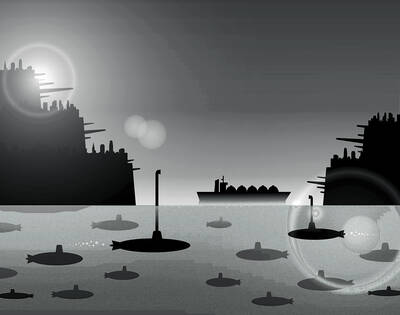
In the event of a war with China, Taiwan has some surprisingly tough defenses that could make it as difficult to tackle as a porcupine: A shoreline dotted with swamps, rocks and concrete barriers; conscription for all adult men; highways and airports that are built to double as hardened combat facilities. This porcupine has a soft underbelly, though, and the war in Iran is exposing it: energy. About 39,000 ships dock at Taiwan’s ports each year, more than the 30,000 that transit the Strait of Hormuz. About one-fifth of their inbound tonnage is coal, oil, refined fuels and liquefied natural gas (LNG),
On Monday, the day before Chinese Nationalist Party (KMT) Chairwoman Cheng Li-wun (鄭麗文) departed on her visit to China, the party released a promotional video titled “Only with peace can we ‘lie flat’” to highlight its desire to have peace across the Taiwan Strait. However, its use of the expression “lie flat” (tang ping, 躺平) drew sarcastic comments, with critics saying it sounded as if the party was “bowing down” to the Chinese Communist Party (CCP). Amid the controversy over the opposition parties blocking proposed defense budgets, Cheng departed for China after receiving an invitation from the CCP, with a meeting with
To counter the CCP’s escalating threats, Taiwan must build a national consensus and demonstrate the capability and the will to fight. The Chinese Communist Party (CCP) often leans on a seductive mantra to soften its threats, such as “Chinese do not kill Chinese.” The slogan is designed to frame territorial conquest (annexation) as a domestic family matter. A look at the historical ledger reveals a different truth. For the CCP, being labeled “family” has never been a guarantee of safety; it has been the primary prerequisite for state-sanctioned slaughter. From the forced starvation of 150,000 civilians at the Siege of Changchun
The two major opposition parties, the Chinese Nationalist Party (KMT) and the Taiwan People’s Party (TPP), jointly announced on Tuesday last week that former TPP lawmaker Chang Chi-kai (張啟楷) would be their joint candidate for Chiayi mayor, following polling conducted earlier this month. It is the first case of blue-white (KMT-TPP) cooperation in selecting a joint candidate under an agreement signed by their chairpersons last month. KMT and TPP supporters have blamed their 2024 presidential election loss on failing to decide on a joint candidate, which ended in a dramatic breakdown with participants pointing fingers, calling polls unfair, sobbing and walking


 RSS
RSS