


Appeal to Tor Books
As readers who follow the news know, last month China sent a threatening letter to a large number of international airlines demanding that they change the country code for Taiwan (TW) on their schedules to China (CN), as dictated by Beijing’s “one China” principle.
However, standing up for Taiwan’s international space and presence, on May 5 US President Donald Trump’s administration issued a statement condemning China’s science fictional “demand” as “Orwellian nonsense” through which China was trying to impose its own political claims on private companies around the world.
It’s like the British novels Nighteen Eighty-four and Animal Farm have come to life in 2018.
Believe it or not, a major sci-fi publishing company in New York, the most prestigious science fiction publisher in the world, Tor Books, whose editors know all about the Nighteen Eighty-four and Animal Farm, also kowtows to Beijing’s “one China” nonsense by asking Taiwanese sci-fi fans who want to sign up at the Tor Web site (tor.com/register) to list their country on the site’s drop-down menu as either “China” or “Taiwan, province of China.”
Yes, the world-famous sci-fi Web site run by Tor Books does not allow Taiwanese sci-fi fans to list their country as “Taiwan.”
Yet as readers know, Taiwan is a free and independent democracy, which abides by international law and has never been a part of the People’s Republic of China (PRC). The Chinese claim that Taiwan is part of the PRC is a silly nationalistic sci-fi illusion, with no basis in international law.
By forcing Taiwanese sci-fi fans to register on the Web site as being from either “China” or “Taiwan, province of China,” Tor’s editors and Web site managers are showing a terrible and naive bias to Taiwanese fans.
Tor’s editors are probably not even aware of this oversight on their registration form, thus this letter, and hopefully a change in the Web site’s current Orwellian nonsense.
I hope that Tor Books, once its editors read this letter, will do the right thing and stand up for Taiwan on its online registration form and show science fiction fans around the world that US sci-fi Web sites do not kowtow to China.
Name withheld
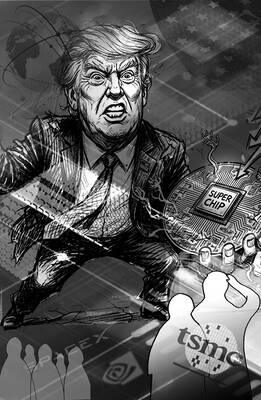
The White House’s decision to take a 9.9 percent stake in Intel Corp is looking like very shrewd business indeed. Since the government bought in at US$20.47 a share last August, the US chipmaker’s surging stock price has delivered the US a US$43 billion return. One of the reasons the investment has so far proved so sound is that the White House has made sure of it. According to The Wall Street Journal, Howard personally pushed deals on Intel’s behalf with some of the most lucrative clients imaginable. They include Nvidia Corp, the company at the heart of the AI
In a Taiwanese university classroom, a lecturer asks in English: “Can anyone give me an example from Taiwan?” Students look down. No one answers. After class, one student writes on the course platform in Mandarin: “I understood the concept, but I didn’t know how to answer in English.” That moment highlights a key issue in Taiwan’s English-medium instruction (EMI) reform: It is not just about more English-taught courses, but whether students can learn, participate and belong. EMI expansion is part of the Bilingual 2030 policy and the Ministry of Education’s BEST Program, aiming to improve English ability, support EMI teaching
A single photograph can cut through a lot of noise, but it can also be used to misrepresent the truth. At the very least, it can concentrate the mind on something that requires further investigation. On Monday last week, Ma Ying-jeou Foundation CEO Tai Hsia-ling (戴遐齡) and former National Security Council secretary-general King Pu-tsung (金溥聰) held a news conference in which they showed a photograph of former foundation CEO Hsiao Hsu-tsen (蕭旭岑), now Chinese Nationalist Party (KMT) deputy chairman. In the image Hsiao is seated next to Xiamen Taiwan Businessmen Association chairman Han Ying-huan (韓螢煥). The two men were holding
The Ministry of the Interior, working with the navy and coast guard, is organizing Taiwan’s first joint exercise simulating escort tankers carrying liquefied natural gas (LNG) and oil through a Chinese blockade. The drills simulate fuel transport along three maritime corridors leading toward Japan, the Philippines and the US. Deputy Minister of the Interior Sawyer Mars (馬士元) said that a blockade of the Taiwan Strait would amount to “almost a 100 percent blockade of the regional energy supply.” Minister of National Defense Wellington Koo said planning to counter a blockade is standard practice in Taipei. While the exercise is limited in


 RSS
RSS