


Jennifer Smith does not like the term “accident.” It implies too much chance and too little culpability.
A “crash” killed her mother in 2008, she insists, when her car was broadsided by another vehicle while on her way to pick up cat food. The other driver, a 20-year-old college student, ran a red light while talking on his mobile phone, a distraction that he immediately admitted and cited as the catalyst of the fatal event.
“He was remorseful,” Smith, 43, said. “He never changed his story.”
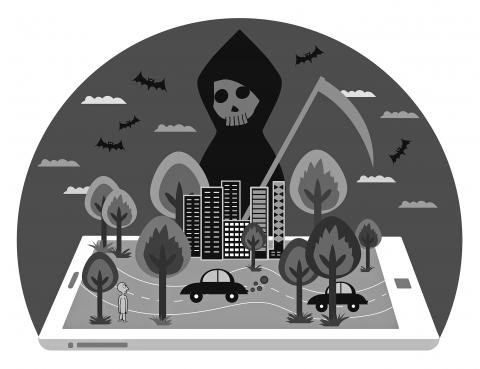
Illustration: Lance Liu
Yet in federal records, the death is not attributed to distraction or mobile-phone use. It is just another line item on the grim annual toll taken by the National Highway Transportation Safety Administration (NHTSA) — one of 37,262 that year.
Three months later, Smith quit her job as a realtor and formed Stopdistractions.org, a nonprofit lobbying and support group. Her intent was to make the tragic loss of her mother an anomaly.
To that end, she has been wildly unsuccessful. Nine years later, the problem of death-by-distraction has gotten much worse.
Over the past two years, after decades of declining deaths on the road, US traffic fatalities surged by 14.4 percent.
Last year alone, more than 100 people died every day in or near vehicles in the US, the first time the nation has passed that grim toll in a decade.
Meanwhile, regulators still have no good idea why crash-related deaths are spiking: People are driving longer distances, but not tremendously so — total kilometers were up just 2.2 percent last year.
Collectively, Americans seemed to be speeding and drinking a little more, but not much more than usual. Together, experts say these upticks do not explain the surge in road deaths.
However, there are three big clues and they do not rest along the highway.
One, as you might have guessed, is the substantial increase in smartphone use by US drivers as they drive. From 2014 to last year, the share of Americans who owned an iPhone, Android phone or something comparable rose from 75 percent to 81 percent.
The second is the changing way in which Americans use their phones while they drive.
These days, we are pretty much done talking. Texting, Twitter, Facebook and Instagram are the order of the day — all activities that require far more attention than simply holding a gadget to your ear or responding to a disembodied voice.
By 2015, almost 70 percent of Americans were using their phones to share photographs and follow news events via social media. In just two additional years, that figure has jumped to 80 percent.
Finally, the increase in fatalities has been largely among bicyclists, motorcyclists and pedestrians — all of whom are easier to miss from the driver’s seat than, say, an SUV — especially if you are glancing up from your phone rather than concentrating on the road.
Last year, 5,987 pedestrians were killed by cars in the US, almost 1,100 more than in 2014 — that is a 22 percent increase in just two years.
Safety regulators and law enforcement officials certainly understand the danger of taking — or making — a phone call while operating a piece of heavy machinery, but they still have no idea just how dangerous it is, because the data just is not easily obtained, and as mobile phone traffic continues to shift away from simple voice calls and texts to encrypted social networks, officials increasingly have less of a clue than ever before.
In the NHTSA’s 2015 data, only 448 deaths were linked to mobile phones — that is just 1.4 percent of all traffic fatalities. By that measure, drunk driving is 23 times more deadly than using a phone while driving, though studies have shown that both activities behind the wheel constitute (on average) a similar level of impairment.
The NHTSA has yet to fully crunch last year’s data, but the agency said deaths tied to distraction actually declined last year.
There are many reasons to believe mobile phones are far deadlier than NHTSA spreadsheets suggest. Some of the biggest indicators are within the data itself.
In more than half of 2015 fatal crashes, motorists were simply going straight down the road — no crossing traffic, rainstorms or blowouts. Meanwhile, drivers involved in accidents increasingly mowed down things smaller than a Honda Accord, such as pedestrians or cyclists, many of whom occupy the side of the road or the sidewalk next to it.
Fatalities increased inordinately among motorcyclists (up 6.2 percent last year) and pedestrians (up 9 percent).
“Honestly, I think the real number of fatalities tied to cell phones is at least three times the federal figure,” Smith said. “We’re all addicted and the scale of this is unheard of.”
In a recent study, the nonprofit National Safety Council found only about half of fatal crashes tied to known mobile-phone use were coded as such in NHTSA data. In other words, according to the council, the NHTSA’s figures for distraction-related death are too low.
Perhaps more telling are the findings of Zendrive Inc, a San Francisco start-up that analyzes smartphone data to help insurers of commercial fleets assess safety risks.
In a study of 3 million people, it found drivers using their mobile phone during 88 percent of trips.
The true number is probably even higher because Zendrive did not capture instances when phones were mounted in a fixed position — so-called hands-free technology, which is also considered dangerous.
“It’s definitely frightening,” Zendrive cofounder and chief executive Jonathan Matus said. “Pretty much everybody is using their phone while driving.”
There are, by now, myriad technological nannies that freeze smartphone activity. Most notably, a version of Apple Inc’s iOS operating system can be configured to keep a phone asleep when its owner is driving and to send an automated text response to incoming messages, but the “Do Not Disturb” function can be overridden by the person trying to get in touch.
More critically, safety advocates note that such systems require an opt-in from the same users who have difficulty ignoring their phones in the first place.
In NHTSA’s defense, its tally of mobile phone-related deaths is only as good as the data it gets from individual states, each of which has its own methods for diagnosing and detailing the cause of a traffic accident. Each state in turn relies on its various municipalities to compile accident metrics — and they often do things differently, too.
The data from each state is compiled from accident reports filed by local police, most of which do not prompt officers to consider mobile-phone distraction as an underlying cause. Only 11 states use reporting forms that contain a field for police to tick mobile-phone distraction, while 27 have a space to note distraction in general as a potential cause of the accident.
The fine print seems to make a difference.
Tennessee, for example, has one of the most thorough accident report forms in the nation, a document that asks police to evaluate both distractions in general and mobile phones in particular.
Of the 448 accidents involving a phone in 2015 as reported by the NHTSA, 84 occurred in Tennessee. That means, a state with 2 percent of the nation’s population accounted for 19 percent of its phone-related driving deaths.
As in polling, it really depends on how you ask the question.
Massachusetts State Police Sergeant Christopher Sanchez, a national expert on distracted driving, said many police departments still focus on drinking or drug use when investigating a crash. Also, figuring out whether a mobile phone was in use at the time of a crash is getting trickier every day — proving that it precipitated the event can be even harder to do.
Prosecutors have a similar bias.
Currently, it is illegal for drivers to use a phone at all in 15 states and texting while driving is specifically barred in 47 states, but getting phone records after a crash typically involves a court order and, even then, the records might not show much activity beyond a call or text.
If police provide solid evidence of speeding, drinking, drugs or some other violation, lawyers will not bother pursuing distraction as a cause.
“Crash investigators are told to catch up with this technology phenomenon — and it’s hard,” Sanchez said. “Every year new apps are developed that make it even more difficult.”
Police officers in Arizona and Montana do not have to bother, since they allow mobile-phone use while you drive, and in Missouri, police only have to monitor drivers under 21 who pick up their phone while driving.
Like Smith, Emily Stein, 36, lost a parent to the streets.
Ever since her father was killed by a distracted driver in 2011, she sometimes finds herself doing unscientific surveys. She will sit in front of her home in the suburbs west of Boston and watch how many passing drivers glance down at their phones.
“I tell my local police department: ‘If you come here, sit on my stoop and hand out tickets, you’d generate a lot of revenue,’” Stein said.
Since forming the Safe Roads Alliance five years ago, Stein talks to the police regularly.
“A lot of them say it surpasses drunk driving at this point,” she said.
Meanwhile, grieving families and safety advocates such as her are still struggling to pass legislation mandating hands-free-only use of phones while driving — Iowa and Texas just got around to banning texting behind the wheel.
“The argument is always that it’s big government,” Governors Highway Safety Association (GHSA) executive director Jonathan Adkins said. “The other issue is that ... it’s hard to ban something that we all do and we know that we want to do.”
Safety advocates such as Smith say lawmakers, investigators and prosecutors will not prioritize the danger of mobile phones in vehicles until they are seen as a sizeable problem — as big as drinking, say. Yet, it will not be measured as such until it is a priority for lawmakers, investigators and prosecutors.
“That’s the catch 22 here,” Smith said. “We all know what’s going on, but we don’t have a Breathalyzer for a phone.”
Perhaps the lawmakers who vote against curbing phone use in cars should watch the heart-wrenching 36-minute documentary filmmaker Werner Herzog made on the subject.
Laudably, the piece, From One Second to the Next, was bankrolled by the nation’s major smartphone companies.
“It’s not just an accident,” Herzog said of the fatalities. “It’s a new form of culture coming at us and it’s coming with great vehemence.”
Adkins has watched smartphone culture overtake much of his work in 10 years at the helm of the GHSA, growing increasingly frustrated with the mounting death toll and what he calls clear under-reporting of mobile-phone related fatalities, but he does not think the numbers will come down until a backlash takes hold, one where it is viewed as shameful to drive while using a phone.
Herzog’s documentary, it appears, has had little effect in its four years on YouTube. At this point, Adkins is simply holding out for gains in autonomous-driving technology.
“I use the cocktail party example,” he said. “If you’re at a cocktail party and say: ‘I was so hammered the other day and I got behind the wheel,’ people will be outraged, but if you say the same thing about using a cell phone, it won’t be a big deal. It is still acceptable and that’s the problem.”
The cancelation this week of President William Lai’s (賴清德) state visit to Eswatini, after the Seychelles, Madagascar and Mauritius revoked overflight permits under Chinese pressure, is one more measure of Taiwan’s shrinking executive diplomatic space. Another channel that deserves attention keeps growing while the first contracts. For several years now, Taipei has been one of Europe’s busiest legislative destinations. Where presidents and foreign ministers cannot land, parliamentarians do — and they do it in rising numbers. The Italian parliament opened the year with its largest bipartisan delegation to Taiwan to date: six Italian deputies and one senator, drawn from six
Recently, Taipei’s streets have been plagued by the bizarre sight of rats running rampant and the city government’s countermeasures have devolved into an anti-intellectual farce. The Taipei Parks and Street Lights Office has attempted to eradicate rats by filling their burrows with polyurethane foam, seeming to believe that rats could not simply dig another path out. Meanwhile, as the nation’s capital slowly deteriorates into a rat hive, the Taipei Department of Environmental Protection has proudly pointed to the increase in the number of poisoned rats reported in February and March as a sign of success. When confronted with public concerns over young
Taiwan and India are important partners, yet this reality is increasingly being overshadowed in current debates. At a time when Taiwan-India relations are at a crossroads, with clear potential for deeper engagement and cooperation, the labor agreement signed in February 2024 has become a source of friction. The proposal to bring in 1,000 migrant workers from India is already facing significant resistance, with a petition calling for its “indefinite suspension” garnering more than 40,000 signatures. What should have been a straightforward and practical step forward has instead become controversial. The agreement had the potential to serve as a milestone in

China has long given assurances that it would not interfere in free access to the global commons. As one Ministry of Defense spokesperson put it in 2024, “the Chinese side always respects the freedom of navigation and overflight entitled to countries under international law.” Although these reassurances have always been disingenuous, China’s recent actions display a blatant disregard for these principles. Countries that care about civilian air safety should take note. In April, President Lai Ching-te (賴清德) canceled a planned trip to Eswatini for the 40th anniversary of King Mswati III’s coronation and the 58th anniversary of bilateral diplomatic


 RSS
RSS