


In the middle of last month, Taiwan celebrated the 30th anniversary of the end of nearly 40 years of martial law. To mark the occasion, President Tsai Ing-wen (蔡英文) said: “Today is the time to salute the great Taiwanese people... Only by believing that people are the driving force to move the nation forward can Taiwan’s democracy continue to move forward.”
The strides that Taiwan and its people have made in developing its democracy as well as free speech and freedom of the press should rightfully be celebrated.
On that momentous day in 1987, a US Department of State spokesman said: “Over the past months, Taiwan has made significant progress toward increased democracy and respect for human rights... We believe that the lifting of martial law is an important event that symbolizes the commitment of the Taiwan authorities to continue this process.”
That process and progress have continued into the present.
Tsai is correct in saying that people are the driving force for change in a nation; as a result, “the people” must never become complacent over their hard-earned rights.
The celebration was truly a holiday of the people, by the people and for the people.
The milestone anniversary should also serve as a stark reminder of what could be, and Taiwanese just need to look across the Taiwan Strait to see what the nation might have looked like today if martial law still existed.
With this view in mind, Taiwan must remember that the fight for free speech is one that never ends, as democracy cannot exist without free speech.
US statesman Benjamin Franklin’s words are still true today: “Freedom of speech is a principal pillar of a free government; when this support is taken away, the constitution of a free society is dissolved.”
A comparison of the two sides of the Strait shows many parallels between China today and Taiwan from 1949 to 1987.
One difference can be seen in how the life and recent death of Chinese democracy activist Liu Xiaobo (劉曉波) mirrored that of the life and death of Deng Nan-jung (鄭南榕).
Liu was imprisoned for drafting and signing Charter 08, a document calling for the end of one-party rule and for the introduction of political reforms in China. He was released under strict medical leave for cancer treatment before dying in the middle of last month.
Deng, facing a life sentence in prison for publishing the “Taiwan Republic constitution,” self-immolated after barricading himself in his office for more than 70 days.
Deng’s constitution, essentially a call for independence, broke Article 100 of the Criminal Code because the document sought “by illegal means [to] change the constitution, or overthrow the government.”
Both Liu and Deng suffered and died for the causes of democracy and free speech.
In addition, thousands in Taiwan were arrested during the martial law era for expressing their views, and thousands died as well.
Publications were heavily regulated, and dangwai (outside the party, 黨外) magazines were banned outright for publishing salacious content. These publications played a critical role in the development of the Democratic Progressive Party’s early identity.
Similarly, the Chinese Communist Party (CCP) greatly censors and blocks the information that people can access within its borders.
Crackdowns on free information are increasing; the CCP has even notified Internet service providers that they must remove customer access to virtual private networks by Feb. 1 next year — thus essentially blocking people permanently from accessing uncensored information.
One can also see similarities between the 228 Massacre and the Tiananmen Square Massacre. Both events initiated widespread crackdowns in regards to politics and free speech and led to the deaths of many activists.
A major difference between the two nations is that Taiwan eventually ended the crackdown, democratized and worked toward reconciliation and memorialization of the victims of the White Terror; whereas, in China, the CCP has strengthened its grip over its people.
Another difference between Taiwan and China involves what the goals of their dissidents. Dissidents in Taiwan strove to introduce democracy and promote a national identity and eventual independence, whereas dissidents in China are currently focusing on introducing political reforms and democracy.
Tsai has promised that within three years a comprehensive report on the White Terror era is to be completed, properly documenting and assessing the Chinese Nationalist Party (KMT) for its role in those atrocious acts.
Tsai’s promise, for which many in Taiwan will hold her accountable, shows a government and society coming to terms with its dark past.
In Taiwan today, the fight goes on. Taiwanese of all ages continue to ensure that their rights to free speech and political participation are never taken away.
Tsai has designated April 7 as “Freedom of Speech Day” in Taiwan, in remembrance of the sacrifice of Deng.
The holiday will serve as a reminder of what previous generations of Taiwanese went through to achieve the vibrant democracy that Taiwan is today.
A final reminder of the difference between Taiwan and China is the recent opening of Reporters Without Borders’ Asia bureau in Taipei, over the originally planned Hong Kong office.
The main reported reason for the switch to Taiwan entailed potential free speech and freedom of the press issues in Hong Kong, a supposedly autonomous territory that faces ever-growing control from China.
The opening of the Taipei office speaks just as much about Taiwan’s free society as it does about the dangers of an encroaching China.
Taiwanese sadly can see plenty of places around the world where free speech and democracy are deteriorating.
As Tsai said, Taiwanese fought for decades to obtain these rights and to move Taiwan forward, but they must not grow complacent, because the fight for free speech never ends.
Thomas Shattuck is assistant editor and research associate at the Foreign Policy Research Institute.
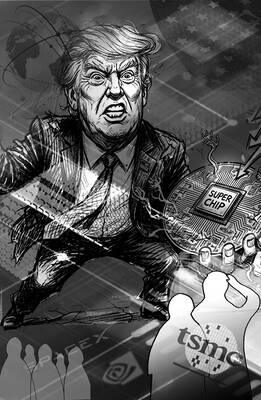
The White House’s decision to take a 9.9 percent stake in Intel Corp is looking like very shrewd business indeed. Since the government bought in at US$20.47 a share last August, the US chipmaker’s surging stock price has delivered the US a US$43 billion return. One of the reasons the investment has so far proved so sound is that the White House has made sure of it. According to The Wall Street Journal, Howard personally pushed deals on Intel’s behalf with some of the most lucrative clients imaginable. They include Nvidia Corp, the company at the heart of the AI
A single photograph can cut through a lot of noise, but it can also be used to misrepresent the truth. At the very least, it can concentrate the mind on something that requires further investigation. On Monday last week, Ma Ying-jeou Foundation CEO Tai Hsia-ling (戴遐齡) and former National Security Council secretary-general King Pu-tsung (金溥聰) held a news conference in which they showed a photograph of former foundation CEO Hsiao Hsu-tsen (蕭旭岑), now Chinese Nationalist Party (KMT) deputy chairman. In the image Hsiao is seated next to Xiamen Taiwan Businessmen Association chairman Han Ying-huan (韓螢煥). The two men were holding
I first met Professor Ray Jiing (井迎瑞) as a film and documentary student at Shih Hsin University’s (SHU) Department of Radio Television and Film in 1988. The following year, he went on to become the director of the Chinese Taipei Film Archive — forerunner of the Taiwan Film and Audiovisual Institute (TFAI). Over his eight-year tenure, Jiing rescued and restored over 200 classic Taiwanese films. In 1997, he established the Graduate Institute of Studies in Documentary and Film Archiving at Tainan National University of the Arts (TNNUA), and I joined the program in his third cohort of students. Beyond a
A recent report concerning a student who is suing his teacher posed the question in its headline: Does failing a student in two subjects constitute bullying? The college student in Chiayi County apparently sought NT$2 million (US$63,603) in state compensation, but a court dismissed the case. The first reaction of many might have been to ask: What has happened to students nowadays? Some say that teachers have lost their authority, while others say students are overindulged. Some even start reminiscing over the days when “whatever the teacher says goes.” However, the real issue might be overlooked if emotional reactions like that are the


 RSS
RSS