


Thirty years ago was a chilling era for Taiwan, full of darkness, fear and terror. It was also a memorable era, full of ideals, enthusiasm and hope. In those years, there were many selfless and brave people who were not afraid of suppression and hardship, who did not know if they would see tomorrow, and yet they continued to strive for a better tomorrow for Taiwanese.
In those years, out of the simple desire for freedom and democracy, we participated in all kinds of social movements, looking forward to a better society.
From the age of 19, due to the circumstances in which I found myself, I devoted myself to the dangwai (黨外, “outside the party”) movement, a political movement in Taiwan in the mid-1970s and early 1980s to oppose the Chinese Nationalist Party (KMT), fighting with many comrades against the oppression of the state apparatus, and was imprisoned for my part in all this.
Then Taiwan lifted the party ban and martial law, and the first direct legislative election was held in 1992, followed by the first direct presidential election in 1996, and then by transfers of political power, turning Taiwan step-by-step into a democratic nation that is mature and that values human rights.
The ideals of my juvenile years have come true one by one, something that makes me feel my life has been worth it after all.
However, when I look back, the scenes of blood and tears in the nation’s painful history are still unforgettable — all the struggle, the sacrifice of many people fighting for democracy — they fought for democratic reform, freedom and human rights, which led to endless years of imprisonment and, in some cases, cost their lives.
How honored and privileged I am to have been able to join them to take part in the nation’s democratization process. None of this could have been achieved without the support of the public — from the Martial Law era to the lifting of martial law, from an absence of any political party except the KMT to instigating the dangwai movement to the establishment of the Democratic Progressive Party (DPP), going from dictatorship to democracy — all these achievements are what I am deeply grateful for, and I will never forget.
I am also delighted to see evidence of political awareness in subsequent generations, from the Wild Lily Student Movement (野百合學運) of February 1990 to the Sunflower movement of March 2014.
The people who were young at the time of the Wild Lily Student Movement now form the backbone of society, while the students of the Sunflower movement have accepted the torch of freedom and democracy that has been passed on to them and held it up at this crucial juncture for society and the government to see.
I can see the future of Taiwan in the new generation. The seeds planted during several decades of pro-democracy movements are finally starting to germinate and grow shoots. These people, born after the lifting of martial law, are clear-headed and sure of purpose. That young people are stepping up, that democracy is being passed down to the next generation, is a source of much reassurance for me.
As we celebrate the 30th anniversary of the lifting of martial law, Taiwan has already experienced three transitions of political power and introduced democracy and the rule of law. The process has not been a smooth one and we must still strive forward.
We have gone from a street movement to a fully fledged political party, and we are honored to have received the public’s trust in moving forward and facing each new challenge that comes our way.
In the past, the struggle was between the ideal of democracy and the autocratic state: it was black and white; right versus wrong. There was no need for us to doubt what we were doing, we were very clear about which side we should be standing on. It was about the masses protesting against unjust state power.
Now that the dictator’s statues have been toppled, the nation must operate within the bounds of a democratic system. The government belongs to the public and some form of balance must be sought in the rights and interests of ordinary people. Each social movement represents the interests of groups and each has its own goals.
As every new civic movement emerges among a multitude of social and economic discourses — the public interest and individual rights, freedom or equality, prosperity and progress, all of which are positive values in and of themselves — often compete with each other in the reality of everyday life.
Those in government have two main duties: to protect Taiwan’s national security and promote social progress. The former is obvious and absolute, and I observe what positive moves President Tsai Ing-wen (蔡英文) is making in this regard.
The latter involves addressing conflicting values and the contradiction between what one would ideally want and what reality imposes.
Nevertheless, I do believe that if we are clear about what our values are and place importance on the actual results of policy, what follows is but a question of making choices and standing by them.
Revolution is sudden; reform is gradual. We have already gone through the revolutionary stage and, now that the dictator has been overthrown, the most important and difficult task is how to realize our ideals and make them succeed.
I do believe that as long as we continue to listen to what the public is saying, and adjust the way we proceed accordingly and continue to take Taiwan in the direction of becoming a civilized nation, ever mindful of why we started off on this path in the first place, then we are sure to succeed.
It is with this thought in mind that we commemorate the 30th anniversary of the lifting of martial law.
Chen Chu is Kaohsiung mayor and a former prisoner for her part in the Kaohsiung Incident.
Translated by Lin Lee-kai and Paul Cooper
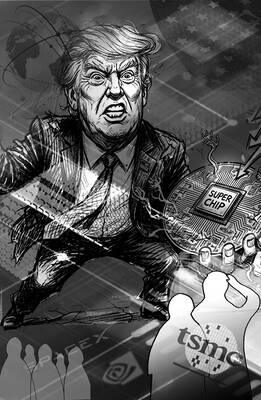
The White House’s decision to take a 9.9 percent stake in Intel Corp is looking like very shrewd business indeed. Since the government bought in at US$20.47 a share last August, the US chipmaker’s surging stock price has delivered the US a US$43 billion return. One of the reasons the investment has so far proved so sound is that the White House has made sure of it. According to The Wall Street Journal, Howard personally pushed deals on Intel’s behalf with some of the most lucrative clients imaginable. They include Nvidia Corp, the company at the heart of the AI
A single photograph can cut through a lot of noise, but it can also be used to misrepresent the truth. At the very least, it can concentrate the mind on something that requires further investigation. On Monday last week, Ma Ying-jeou Foundation CEO Tai Hsia-ling (戴遐齡) and former National Security Council secretary-general King Pu-tsung (金溥聰) held a news conference in which they showed a photograph of former foundation CEO Hsiao Hsu-tsen (蕭旭岑), now Chinese Nationalist Party (KMT) deputy chairman. In the image Hsiao is seated next to Xiamen Taiwan Businessmen Association chairman Han Ying-huan (韓螢煥). The two men were holding
I first met Professor Ray Jiing (井迎瑞) as a film and documentary student at Shih Hsin University’s (SHU) Department of Radio Television and Film in 1988. The following year, he went on to become the director of the Chinese Taipei Film Archive — forerunner of the Taiwan Film and Audiovisual Institute (TFAI). Over his eight-year tenure, Jiing rescued and restored over 200 classic Taiwanese films. In 1997, he established the Graduate Institute of Studies in Documentary and Film Archiving at Tainan National University of the Arts (TNNUA), and I joined the program in his third cohort of students. Beyond a
A recent report concerning a student who is suing his teacher posed the question in its headline: Does failing a student in two subjects constitute bullying? The college student in Chiayi County apparently sought NT$2 million (US$63,603) in state compensation, but a court dismissed the case. The first reaction of many might have been to ask: What has happened to students nowadays? Some say that teachers have lost their authority, while others say students are overindulged. Some even start reminiscing over the days when “whatever the teacher says goes.” However, the real issue might be overlooked if emotional reactions like that are the


 RSS
RSS