


Last year began with the election of President Tsai Ing-wen (蔡英文). Beijing refuses to recognize Taiwan as a nation, but considers it a core interest. While Tsai was certainly not Beijing’s preference for leader, it can at least content itself that she is a known quantity. The year ended with the election of Donald Trump as president of the US, a country core to China’s strategic, economic and hegemonic interests. While Trump might have been Beijing’s preference over former US secretary of state Hillary Rodham Clinton at the time, recent weeks have demonstrated that he is most certainly not a known quantity.
As Taiwan embarks upon a new year, optimism is desirable, even indicated, but caution is advised.
Trump ran roughshod over decades of US “one China” policy acknowledgment by accepting Tsai’s congratulatory call on his victory and referring to her as the Taiwanese president, and subsequently questioning the US’ adherence to the “one China” policy. By talking to Tsai, Trump broke convention, but not international laws.
The US is not bound by the “one China” policy. It is bound by the 1979 Taiwan Relations Act (TRA), which acknowledges Taiwan by name. The TRA is complemented by, but governs, the Three Communiques of 1972, 1978 and 1982 — less law than statements of diplomatic intent — that greased the wheels of normalizing Sino-US relations given the obvious contradictions of the “one China” principle.
Essentially, the TRA established the conditions and mechanisms for continued communication and dealings between the US and Taiwan and assured Taiwan that the US would not abandon it, and would continue to sell it defensive arms.
Former US president Ronald Reagan’s “six assurances” — which, along with the TRA, were once again fully endorsed by the US Republican Party during last year’s party convention — promised that the US would not formally recognize Chinese sovereignty over Taiwan and would not change the terms of the TRA.
The TRA includes a clause saying the US expects the cross-strait situation to be settled peacefully. The maintenance of the cross-strait “status quo” by both sides of the Taiwan Strait is a condition for the US’ continued adherence to the “one China” policy. If Beijing expects the US to continue with its “one China” policy, it might want to reflect about its promulgation of a the “Anti-Secession” Law, which mandates the use of force against Taiwan; the firing of missiles across the Taiwan Strait in 1995 and 1996; and the deployment of almost 2,000 missiles pointed at Taiwan since then. With these acts, Beijing has reneged on its side of the agreement.
If Trump’s straight talking enables him to cut through the suspended delusion and hypocrisy of the “one China” policy, he will have not just US law, but also international law, in his armory. There is no need to question the existence of only “one China.” Let Taiwanese decide.
Article 2 of the UN Charter calls for the self-determination of peoples. Article 21 of the Universal Declaration of Human Rights states that the will of the people is the basis of the authority of government; the International Covenant on Civil and Political Rights and the International Covenant on Economic, Social and Cultural Rights both uphold self-determination as fundamental human rights. The 1933 Montevideo Convention on the Rights and Duties of States, widely accepted as an objective formula for the recognition of states, lists an effective government with control over a defined territory and a permanent population, together with the ability to conduct foreign relations with other states, as conditions of statehood. Taiwan indisputably has all of those.
Trump has ample wiggle room on seeking a new, state-to-state relationship with Taiwan. This year could be interesting. Caution is advised.
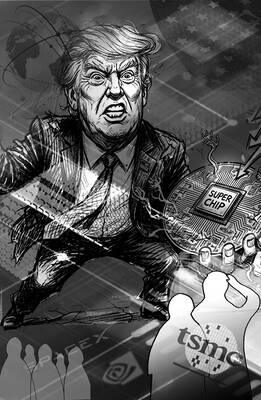
The White House’s decision to take a 9.9 percent stake in Intel Corp is looking like very shrewd business indeed. Since the government bought in at US$20.47 a share last August, the US chipmaker’s surging stock price has delivered the US a US$43 billion return. One of the reasons the investment has so far proved so sound is that the White House has made sure of it. According to The Wall Street Journal, Howard personally pushed deals on Intel’s behalf with some of the most lucrative clients imaginable. They include Nvidia Corp, the company at the heart of the AI
The Ministry of the Interior, working with the navy and coast guard, is organizing Taiwan’s first joint exercise simulating escort tankers carrying liquefied natural gas (LNG) and oil through a Chinese blockade. The drills simulate fuel transport along three maritime corridors leading toward Japan, the Philippines and the US. Deputy Minister of the Interior Sawyer Mars (馬士元) said that a blockade of the Taiwan Strait would amount to “almost a 100 percent blockade of the regional energy supply.” Minister of National Defense Wellington Koo said planning to counter a blockade is standard practice in Taipei. While the exercise is limited in
A single photograph can cut through a lot of noise, but it can also be used to misrepresent the truth. At the very least, it can concentrate the mind on something that requires further investigation. On Monday last week, Ma Ying-jeou Foundation CEO Tai Hsia-ling (戴遐齡) and former National Security Council secretary-general King Pu-tsung (金溥聰) held a news conference in which they showed a photograph of former foundation CEO Hsiao Hsu-tsen (蕭旭岑), now Chinese Nationalist Party (KMT) deputy chairman. In the image Hsiao is seated next to Xiamen Taiwan Businessmen Association chairman Han Ying-huan (韓螢煥). The two men were holding
I first met Professor Ray Jiing (井迎瑞) as a film and documentary student at Shih Hsin University’s (SHU) Department of Radio Television and Film in 1988. The following year, he went on to become the director of the Chinese Taipei Film Archive — forerunner of the Taiwan Film and Audiovisual Institute (TFAI). Over his eight-year tenure, Jiing rescued and restored over 200 classic Taiwanese films. In 1997, he established the Graduate Institute of Studies in Documentary and Film Archiving at Tainan National University of the Arts (TNNUA), and I joined the program in his third cohort of students. Beyond a


 RSS
RSS