


From 100M above Jiancheng Circle in Taipei’s Datong District (大同), one would have a clear view of the Tamsui River — the mother that gave birth to Taipei — as it cuts northwest through to Guandu (關渡) plain in Beitou District (北投) and from there flows into the sea.
A straight line runs from the midpoint of the Tamsui River Bridge through Jiancheng Circle to Taipei Railway Station.
Looking into the distance toward the southwest, one can see where the New Taipei Expressway crosses the Dahan River, which has both eroded and silted up the Taipei Basin, causing it to shift and change over tens of thousands of years.
The Jiancheng Circle similarly bears witness to the historical context in which Taipei was born, grew, flourished and matured. The imprint of different stages of the city’s development can be seen here.
The traffic circle is the first gateway seen when exiting the Taipei Interchange and entering the city. Beyond this gateway — and connected to it — is the heart of present-day Taipei — the area around Taipei Railway Station.
All these attributes make the Jiancheng Circle the most suitable and practical place to build a “Taipei tower.”
The glass-clad building in the middle of the circle is being demolished and the circle is to be made into a green space. After the above-ground structures have been removed, the pond that lies underground — built in 1943 as a reservoir for firefighting and listed by the city government as a historic monument — will see the light of day once more.
The Taipei Parks and Street Lights Office has announced what it calls “two great alternative plans” for the pond. One is to cover it with a glass canopy, the other is to leave it uncovered, but install a railing around it.
This so-called choice may be fun, in the sense that playing with a doll’s house is amusing, but it is really just two versions of a single muddle-headed design that involves setting the space aside without creating anything new.
Some Bureau of Cultural Heritage members have suggested digging down to create a green space so that people can walk around the pond, but this is still a narrow-minded idea.
Urban designers have not been included in the discussion, nor have tourism and leisure professionals. Their absence, combined with the barren vision of the city government, is the real nub of the city’s problems.
The Jiancheng Circle occupies an area of about 1,735m2 in the bustling Dadaocheng (大稻埕) area. Since it was built at a relatively early stage in the city’s development, it is a place where historical traces of Japanese colonial rule, World War II, the immediate postwar years and Taipei’s subsequent growth can all be found.
Numerous towers have been built around the world that contribute to rich and diverse urban landscapes, including the Eiffel Tower in Paris (1889), Shanghai’s Oriental Pearl Tower (1994), Guangzhou’s Canton Tower (2010) and the Tokyo Skytree (2012). This context simply serves to highlight the exceptional dormancy and rigidity of Taiwan’s urban scenery.
Hsu Cheng-wang is an assistant professor at Shu-Te University’s Graduate School of Architecture and Interior Design.
Translated by Julian Clegg
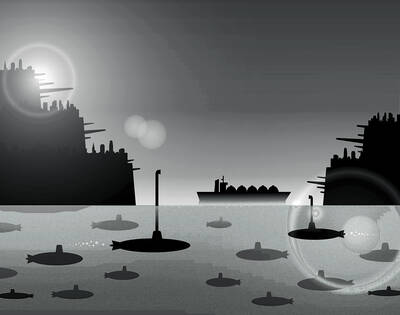
In the event of a war with China, Taiwan has some surprisingly tough defenses that could make it as difficult to tackle as a porcupine: A shoreline dotted with swamps, rocks and concrete barriers; conscription for all adult men; highways and airports that are built to double as hardened combat facilities. This porcupine has a soft underbelly, though, and the war in Iran is exposing it: energy. About 39,000 ships dock at Taiwan’s ports each year, more than the 30,000 that transit the Strait of Hormuz. About one-fifth of their inbound tonnage is coal, oil, refined fuels and liquefied natural gas (LNG),
On Monday, the day before Chinese Nationalist Party (KMT) Chairwoman Cheng Li-wun (鄭麗文) departed on her visit to China, the party released a promotional video titled “Only with peace can we ‘lie flat’” to highlight its desire to have peace across the Taiwan Strait. However, its use of the expression “lie flat” (tang ping, 躺平) drew sarcastic comments, with critics saying it sounded as if the party was “bowing down” to the Chinese Communist Party (CCP). Amid the controversy over the opposition parties blocking proposed defense budgets, Cheng departed for China after receiving an invitation from the CCP, with a meeting with
To counter the CCP’s escalating threats, Taiwan must build a national consensus and demonstrate the capability and the will to fight. The Chinese Communist Party (CCP) often leans on a seductive mantra to soften its threats, such as “Chinese do not kill Chinese.” The slogan is designed to frame territorial conquest (annexation) as a domestic family matter. A look at the historical ledger reveals a different truth. For the CCP, being labeled “family” has never been a guarantee of safety; it has been the primary prerequisite for state-sanctioned slaughter. From the forced starvation of 150,000 civilians at the Siege of Changchun
The two major opposition parties, the Chinese Nationalist Party (KMT) and the Taiwan People’s Party (TPP), jointly announced on Tuesday last week that former TPP lawmaker Chang Chi-kai (張啟楷) would be their joint candidate for Chiayi mayor, following polling conducted earlier this month. It is the first case of blue-white (KMT-TPP) cooperation in selecting a joint candidate under an agreement signed by their chairpersons last month. KMT and TPP supporters have blamed their 2024 presidential election loss on failing to decide on a joint candidate, which ended in a dramatic breakdown with participants pointing fingers, calling polls unfair, sobbing and walking


 RSS
RSS