


Over the past half-century, Taiwan’s eating and drinking habits have evolved. In the past, cooking oil was made from animal fats and many have childhood memories of fried lard and crisp, deep-fried onion rings. Granulated sugar made by Taiwan Sugar Corp is made into syrup and added to cold drinks and sweet soups. In the past, the average Taiwanese was not very heavy, despite a cultural preference for fat children, because it implies good fortune and wealth. A love of fatness is deep and it does not exist only in Han Chinese societies, but also among some Austronesian cultures.
Who would have thought that today, half a century later, obesity and heart disease would become a Taiwanese epidemic?
These eating and drinking habits are part of a global culture and are influenced by the US in particular. Taiwanese today eat little animal fat and avoid cholesterol-rich foods, but instead eat a lot of carbohydrates, and almost every dish contains sugar and is accompanied by sweet drinks and desserts.
These changes are closely related to the US’ Sugar Association. In 1965, the association’s predecessor paid Harvard scientists to write a skewed study making a connection between heart disease and saturated fats, while playing down the relationship between sugar and heart disease. The report was published in the New England Journal of Medicine.
In the early 20th century, few people died from heart disease, but by the middle of the century it had become very common. In 1955, then-US president Dwight Eisenhower had a heart attack and donations to the American Heart Association increased by 40 percent. After recovering, Eisenhower became a board member and honorary chairman of the association.
By the early 1960s, doctors and nutritionists successfully showed a connection between heart disease, saturated fats and cholesterol. They made it onto the cover of Time magazine and dominated the US National Institutes of Health’s food and beverage guide. Animal fats and cholesterol had become the main culprits behind heart disease.
Last week, JAMA Internal Medicine published an article claiming that researchers had cooperated with the sugar industry to distort the facts, citing historical internal sugar industry documents. The article said that, based on today’s research standards, the study was unethical and involved conflicts of interest.
Cholesterol and saturated fats have been wrongly accused for 50 years.
Today, the main suspect behind obesity and heart disease is sugar. It is addictive and akin to a legalized drug. It has been tolerated for half a century in a historical political, scientific, social and medical context.
In the 1970s, the US began to produce corn in large quantities and the excess has been used for animal feed, cheap vegetable oil and promoting the prosperity of fast food chains. The cheap concentrated fructose (corn syrup) refined from corn has been hidden in Taiwanese food and beverages ever since.
Half a century later, the Taiwanese gut has been drawn into the perfect storm of US-style food and beverages, obesity and cardiovascular disease.
New medical evidence has weakened concern over animal fats and raised warnings over sugar. It is alright to eat food in a natural, unprocessed state, but we should stay away from processed foods containing sugar.
Chiang Sheng is an attending physician in the department of obstetrics and gynecology at Mackay Memorial Hospital.
Translated by Perry Svensson
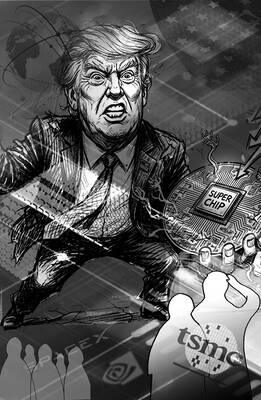
The White House’s decision to take a 9.9 percent stake in Intel Corp is looking like very shrewd business indeed. Since the government bought in at US$20.47 a share last August, the US chipmaker’s surging stock price has delivered the US a US$43 billion return. One of the reasons the investment has so far proved so sound is that the White House has made sure of it. According to The Wall Street Journal, Howard personally pushed deals on Intel’s behalf with some of the most lucrative clients imaginable. They include Nvidia Corp, the company at the heart of the AI
A single photograph can cut through a lot of noise, but it can also be used to misrepresent the truth. At the very least, it can concentrate the mind on something that requires further investigation. On Monday last week, Ma Ying-jeou Foundation CEO Tai Hsia-ling (戴遐齡) and former National Security Council secretary-general King Pu-tsung (金溥聰) held a news conference in which they showed a photograph of former foundation CEO Hsiao Hsu-tsen (蕭旭岑), now Chinese Nationalist Party (KMT) deputy chairman. In the image Hsiao is seated next to Xiamen Taiwan Businessmen Association chairman Han Ying-huan (韓螢煥). The two men were holding
The Ministry of the Interior, working with the navy and coast guard, is organizing Taiwan’s first joint exercise simulating escort tankers carrying liquefied natural gas (LNG) and oil through a Chinese blockade. The drills simulate fuel transport along three maritime corridors leading toward Japan, the Philippines and the US. Deputy Minister of the Interior Sawyer Mars (馬士元) said that a blockade of the Taiwan Strait would amount to “almost a 100 percent blockade of the regional energy supply.” Minister of National Defense Wellington Koo said planning to counter a blockade is standard practice in Taipei. While the exercise is limited in
In a Taiwanese university classroom, a lecturer asks in English: “Can anyone give me an example from Taiwan?” Students look down. No one answers. After class, one student writes on the course platform in Mandarin: “I understood the concept, but I didn’t know how to answer in English.” That moment highlights a key issue in Taiwan’s English-medium instruction (EMI) reform: It is not just about more English-taught courses, but whether students can learn, participate and belong. EMI expansion is part of the Bilingual 2030 policy and the Ministry of Education’s BEST Program, aiming to improve English ability, support EMI teaching


 RSS
RSS