


The banking password might be about to expire — forever.
Some of the US’ largest banks, acknowledging that traditional passwords are either too cumbersome or no longer secure, are increasingly using fingerprints, facial scans and other types of biometrics to safeguard accounts.
Millions of customers at Bank of America, JPMorgan Chase and Wells Fargo routinely use fingerprints to log into their bank accounts through their smartphones. This feature, which some of the largest banks have introduced in the past few months, is enabling a huge share of US banking customers to verify their identities with biometrics, and millions more are expected to opt in as more smartphones incorporate fingerprint scans.
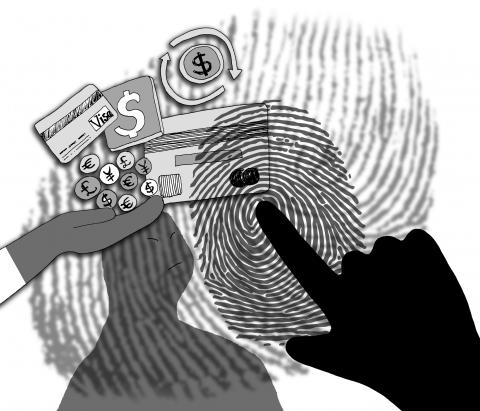
Illustration: Tania Chou
Other uses of biometrics are also coming online. Wells Fargo lets some customers scan their eyes with their smartphones to log into corporate accounts and wire millions of dollars. Citigroup can help verify 800,000 of its credit card customers by their voices. USAA, which provides insurance and banking services to members of the military and their families, identifies some of its customers through their facial contours.
Some of the moves reflect concern that so many hundreds of millions of e-mail addresses, telephone numbers, Social Security numbers and other personal identifiers have fallen into the hands of criminals, rendering those identifiers increasingly ineffective at protecting accounts. And while thieves could eventually find ways to steal biometric data, banks are convinced they offer more protection.
“We believe the password is dying,” said Tom Shaw, vice president for enterprise financial crimes management at USAA, which is based in San Antonio. “We realized we have to get away from personal identification information because of the growing number of data breaches.”
Long regarded as the stuff of science fiction, biometrics have been tested by big banks for decades, but have only recently become sufficiently accurate and cost effective to use in a big way. It has taken a great deal of trial and error: With many of the early prototypes, a facial scan could be foiled by bad lighting and voice recognition could be scuttled by background noise or laryngitis.
Before smartphones became ubiquitous, there was an even bigger obstacle: To capture a finger image or scan an eyeball, a bank would have to pay to distribute the necessary technology to tens of millions of customers. A few tried, but their efforts were costly and short-lived.
PRIVACY CONCERNS
Today, the equation has changed. Many models of the iPhone have touch pads that can scan fingerprints. The cameras and microphones on many mobile devices are so powerful that they can record the minute details needed to create a biometric ID.
The smartphones also provide an extra layer of security: Many biometric features will only work when used on the specific smartphone that belongs to the bank account holder.
“If you have your phone and you are authenticating with your fingerprint, it is very likely you,” said Samir Nanavati, a longtime biometrics expert and a founder of Twin Mill, a security software and consulting firm.
The trade-off, of course, is that in the quest for security and convenience, customers are handing over marks of their unique physical identities. After all, it is easy to change a compromised password, but a fingerprint must last forever.
Some bank executives say customers often ask whether their biometric information will become part of a private database, akin to what the FBI keeps.
The banks themselves are not keeping caches of actual fingerprints or eye patterns. Rather, the banks are creating and storing what they call templates — or what amount to long, hard-to-predict numerical sequences — based on a scan of a person’s fingerprint or eyeballs.
It is possible that the thieves could use the biometric templates to steal money, but the banks say they have worked to develop additional safeguards. With some voice authentication systems, banks use certain prompts to prove it is a living customer and not a recording. Many eye scans require customers to blink or move their eyes to prevent a thief from using a photograph to gain access.
TOP-LEVEL SECURITY
Wells Fargo has been working with EyeVerify, a startup in Kansas City, Missouri, to develop its eye scan feature, which is being tested with a small group of corporate customers. The technology creates a map of the veins in the whites of an eye.
To log into an account, a customer taps open a Wells Fargo app on a smartphone. When prompted, the customer’s eyes are lined up with a pair of yellow circles on the smartphone screen. If they match, the customer — typically a chief financial officer or other top executive — gains instant access to the account and can start moving money or conducting other transactions.
Wells Fargo executives said the eye scan could eventually offer an alternative to the authentication system used for corporate accounts, which involves physical tokens that generate numeric pass codes every few seconds. Although generally considered secure, these tokens can be a hassle to carry around.
For now, Wells Fargo is offering eye scans — among the most foolproof biometric technologies, according to security experts — only to select corporate customers, for whom the stakes are arguably higher because there is potentially so much money involved.
“It is harder to take someone’s eyeball than someone’s user ID and password,” said Steve Ellis, who leads Wells Fargo’s innovation group that worked on developing the eye scan authentication.
The bank also made an investment in EyeVerify.
Instead of eye scans, Bank of America has embraced fingerprints. Since it began offering the option in September last year, about 33 percent of the bank’s 20 million mobile banking customers have started using a fingertip to get into their accounts.
There are limits, though, on how far an average retail customer can proceed through the banking process without a password.
For example, JPMorgan Chase customers can gain access to their bank accounts with their fingerprints, but have to use a traditional password to transfer money.
Still, the speed and accuracy of the banks’ biometric capabilities are especially notable because they are emerging from an industry known for its antiquated system of tellers and branches and endless reams of paperwork.
Wells Fargo’s eye scan technology, for example, worked so quickly that the developers had to slow it down by a few seconds so customers knew it had actually registered their identities.
It takes only about 40 seconds to capture enough information about a customer’s vocal patterns to create a voice imprint that can be used as a form of identification, according to Andrew Keen, director of program management for Global Consumer Operations at Citigroup.
Once a print is established, it can reduce the time that customers spend identifying themselves to a call center representative.
Many financial firms emphasize the convenience of biometrics, but USAA is one of the few that highlights the effectiveness of these technologies at thwarting thieves.
Since the bank began offering biometric authentication early last year, more than 1.7 million customers have been accessing their accounts using either their fingerprints, voices or facial scans.
“We can’t rely on personal identification information any longer,” Shaw said. “We believe we have to rely on biometrics.”

A gap appears to be emerging between Washington’s foreign policy elites and the broader American public on how the United States should respond to China’s rise. From my vantage working at a think tank in Washington, DC, and through regular travel around the United States, I increasingly experience two distinct discussions. This divergence — between America’s elite hawkishness and public caution — may become one of the least appreciated and most consequential external factors influencing Taiwan’s security environment in the years ahead. Within the American policy community, the dominant view of China has grown unmistakably tough. Many members of Congress, as

After declaring Iran’s military “gone,” US President Donald Trump appealed to the UK, France, Japan and South Korea — as well as China, Iran’s strategic partner — to send minesweepers and naval forces to reopen the Strait of Hormuz. When allies balked, the request turned into a warning: NATO would face “a very bad” future if it refused. The prevailing wisdom is that Trump faces a credibility problem: having spent years insulting allies, he finds they would not rally when he needs them. That is true, but superficial, as though a structural collapse could be caused by wounded feelings. Something
Former Taipei mayor and Taiwan People’s Party (TPP) founding chairman Ko Wen-je (柯文哲) was sentenced to 17 years in prison on Thursday, making headlines across major media. However, another case linked to the TPP — the indictment of Chinese immigrant Xu Chunying (徐春鶯) for alleged violations of the Anti-Infiltration Act (反滲透法) on Tuesday — has also stirred up heated discussions. Born in Shanghai, Xu became a resident of Taiwan through marriage in 1993. Currently the director of the Taiwan New Immigrant Development Association, she was elected to serve as legislator-at-large for the TPP in 2023, but was later charged with involvement
Out of 64 participating universities in this year’s Stars Program — through which schools directly recommend their top students to universities for admission — only 19 filled their admissions quotas. There were 922 vacancies, down more than 200 from last year; top universities had 37 unfilled places, 40 fewer than last year. The original purpose of the Stars Program was to expand admissions to a wider range of students. However, certain departments at elite universities that failed to meet their admissions quotas are not improving. Vacancies at top universities are linked to students’ program preferences on their applications, but inappropriate admission


 RSS
RSS