


Following the inauguration of President Tsai Ing-wen (蔡英文) and her Democratic Progressive Party (DPP) government, former American Institute in Taiwan (AIT) chairman Richard Bush, who is a senior fellow at the Brookings Institution in Washington, wrote a commentary titled Tsai’s inauguration in Taiwan: It could have been worse.
The title of course should have read: Beijing’s response to Tsai’s Inauguration: It could have been worse. The incomplete title set the reader off on the wrong foot. Under normal circumstances, one could blame the editors of a publication for not catching the essence of the article. However, in this case, the commentary is on the Brookings Institution’s own Web site.
Bush examines Tsai’s inauguration speech on Friday last week and gives an analysis of Beijing’s response. There is of course nothing wrong with a thorough analysis, but in approaching it this way, Bush makes several fundamental errors.
First, by zooming in on the cross-strait issue only, Bush totally negates the fact that Tsai was elected by Taiwanese and therefore is first and foremost responsible to them. She focused most of her speech — and rightly so — on the domestic economic, social and political challenges, emphasizing economic reform, judicial reform and legislative reform to “make Taiwan a better country.”
Tsai said that Taiwan is a young democracy and that it needs to move forward to strengthen the democracy for the wellbeing of all its people. She also said that democracy had been kidnapped by ideology — a clear reference to former president Ma Ying-jeou (馬英九) — and that it needs to be redirected to solve society’s economic and social problems.
Second, in her speech, Tsai also focused on regional peace and stability and cross-strait relations, emphasizing the broader picture. By narrowly zooming in on "She said, They said", Bush is losing sight of the broader perspective. In other words, he makes it appear as if Tsai moving another inch on the wording might bring less tension or even a resolution.
That is simply fiction: By its actions across the board — in the South China Sea, East China Sea, Tibet and East Turkestan to name a few — Beijing has shown a distinct disdain for finesse and is riding roughshod over the interests of others. It is a mistake to think China would act differently regarding Taiwan.
Third, in his analysis, Bush is uncritical and unquestioning of Beijing’s ulterior motives: Chinese President Xi Jinping (習近平) and other Chinese leaders have made it clear that their ultimate goal is incorporation of Taiwan into the unwelcome embrace of China. The so-called “1992 consensus” and “one China” principle are indeed a slippery slope toward political incorporation and subordination to Beijing.
However, Taiwan and its transition to democracy is a major showcase for democracy in East Asia, and letting Beijing have its way would be a major betrayal of the values and principles for which the US stands.
So, rather than painstakingly weighing words spoken by one side or the other, it would be better if the best and brightest minds in Washington would express clear support for the momentous advance Taiwan has made in its quest for democracy. That is something to celebrate.
The US and Western Europe need to work harder to bring Taiwan out from the cold of international political isolation. Taiwan is not the repressive Republic of China of the 1970s claiming to represent all of China, but has morphed into a vibrant and proud democracy, and should be accepted by the international community as a full and equal member.
Gerrit van der Wees is former editor of Taiwan Communique, a publication based in Washington.
This article has been corrected since it was first published to indicate that it was President Tsai Ing-wen who "focused on regional peace and stability and cross-strait relations, emphasizing the broader picture," not Richard Bush.
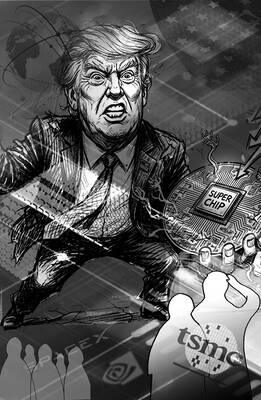
The White House’s decision to take a 9.9 percent stake in Intel Corp is looking like very shrewd business indeed. Since the government bought in at US$20.47 a share last August, the US chipmaker’s surging stock price has delivered the US a US$43 billion return. One of the reasons the investment has so far proved so sound is that the White House has made sure of it. According to The Wall Street Journal, Howard personally pushed deals on Intel’s behalf with some of the most lucrative clients imaginable. They include Nvidia Corp, the company at the heart of the AI
A single photograph can cut through a lot of noise, but it can also be used to misrepresent the truth. At the very least, it can concentrate the mind on something that requires further investigation. On Monday last week, Ma Ying-jeou Foundation CEO Tai Hsia-ling (戴遐齡) and former National Security Council secretary-general King Pu-tsung (金溥聰) held a news conference in which they showed a photograph of former foundation CEO Hsiao Hsu-tsen (蕭旭岑), now Chinese Nationalist Party (KMT) deputy chairman. In the image Hsiao is seated next to Xiamen Taiwan Businessmen Association chairman Han Ying-huan (韓螢煥). The two men were holding
I first met Professor Ray Jiing (井迎瑞) as a film and documentary student at Shih Hsin University’s (SHU) Department of Radio Television and Film in 1988. The following year, he went on to become the director of the Chinese Taipei Film Archive — forerunner of the Taiwan Film and Audiovisual Institute (TFAI). Over his eight-year tenure, Jiing rescued and restored over 200 classic Taiwanese films. In 1997, he established the Graduate Institute of Studies in Documentary and Film Archiving at Tainan National University of the Arts (TNNUA), and I joined the program in his third cohort of students. Beyond a
A recent report concerning a student who is suing his teacher posed the question in its headline: Does failing a student in two subjects constitute bullying? The college student in Chiayi County apparently sought NT$2 million (US$63,603) in state compensation, but a court dismissed the case. The first reaction of many might have been to ask: What has happened to students nowadays? Some say that teachers have lost their authority, while others say students are overindulged. Some even start reminiscing over the days when “whatever the teacher says goes.” However, the real issue might be overlooked if emotional reactions like that are the


 RSS
RSS