


As the legislature discusses regulations regarding illicit party assets, each party has been proposing its own version of how such a bill should be worded. Even the Chinese Nationalist Party (KMT) has seemingly accepted its fate and proposed its own version, while a few days ago, the KMT’s legislative caucus suggested that the party give up its assets, after deducting retirement funds for party workers.
At a glance, this looks good, but it is neither reasonable nor just; it is just another attempt to fudge the issue. A party that for so long has made huge profits by not distinguishing between itself and the government — using its power to amass funds and using that money to further increase its power — should not be let off the hook so easily.
Transitional justice means holding public hearings to scrutinize the source of every party asset and how it was obtained since the party came to Taiwan, through the 228 Incident, the White Terror era and up to this day. Only with a factual basis will it be possible to ascertain how much wealth the party has stolen.
The Palace luxury complex in Taipei, for example, is on the site occupied by Taiwan Broadcasting Corp’s headquarters during the Japanese colonial era. When Chiang Kai-shek (蔣介石) came to Taiwan, he ordered that the Central Broadcasting Affairs Management Office, the predecessor of the Broadcasting Corp of China (BCC), take over that plot of land, thus turning public property into a KMT asset. The party sold the land for NT$9 billion (US$273 million at today’s exchange rates) — raising funds for election expenses — to Hung Sheng Construction Ltd (宏盛建設), which built The Palace.
This plot of land should belong to the Republic of China (ROC) government and all Taiwanese. This was not an isolated case of turning public property into party property, and this was generally how the KMT gained its assets.
The manner in which almost every asset of local party branches was acquired — the National Women’s League, the China Youth Corps and other organizations in the KMT periphery — is equally problematic.
In the past, the net value of the KMT’s assets was frequently estimated to be about NT$100 billion, but the party has recently been saying that it is no more than NT$16 billion. Most of the KMT’s assets were stolen or seized from the public during the early years of its one-party rule. If NT$16 billion is all that remains, surely an investigation must be launched to find out who has been emptying the coffers and who profited from it.
The talk about deducting pension funds for party workers is even more absurd. The party assets were stolen; who has ever heard of thieves saying that they must be allowed to share the loot with their gang members before they can return whatever is left?
During their stints as KMT chairmen, President Ma Ying-jeou (馬英九) and New Taipei City Mayor Eric Chu (朱立倫) said that they would handle the party assets issue, but nothing ever came of it. They insist that the party’s current assets are legal, but many of them were made legal by passing whatever legislation or administrative regulations were required to make them so.
Appropriate investigations and reviews will be required to determine whether the assets are truly legal and legitimate.
The KMT has lost the opportunity to handle the issue by itself. The party no longer decides matters on its own and it can no longer distribute its remaining assets as it sees fit.
If the party cannot even understand this point, it deserves to be swept into the dustbin of history.
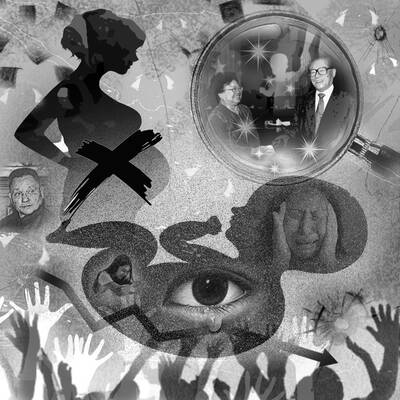
Jan. 1 marks a decade since China repealed its one-child policy. Just 10 days before, Peng Peiyun (彭珮雲), who long oversaw the often-brutal enforcement of China’s family-planning rules, died at the age of 96, having never been held accountable for her actions. Obituaries praised Peng for being “reform-minded,” even though, in practice, she only perpetuated an utterly inhumane policy, whose consequences have barely begun to materialize. It was Vice Premier Chen Muhua (陳慕華) who first proposed the one-child policy in 1979, with the endorsement of China’s then-top leaders, Chen Yun (陳雲) and Deng Xiaoping (鄧小平), as a means of avoiding the
In the US’ National Security Strategy (NSS) report released last month, US President Donald Trump offered his interpretation of the Monroe Doctrine. The “Trump Corollary,” presented on page 15, is a distinctly aggressive rebranding of the more than 200-year-old foreign policy position. Beyond reasserting the sovereignty of the western hemisphere against foreign intervention, the document centers on energy and strategic assets, and attempts to redraw the map of the geopolitical landscape more broadly. It is clear that Trump no longer sees the western hemisphere as a peaceful backyard, but rather as the frontier of a new Cold War. In particular,
As the Chinese People’s Liberation Army (PLA) races toward its 2027 modernization goals, most analysts fixate on ship counts, missile ranges and artificial intelligence. Those metrics matter — but they obscure a deeper vulnerability. The true future of the PLA, and by extension Taiwan’s security, might hinge less on hardware than on whether the Chinese Communist Party (CCP) can preserve ideological loyalty inside its own armed forces. Iran’s 1979 revolution demonstrated how even a technologically advanced military can collapse when the social environment surrounding it shifts. That lesson has renewed relevance as fresh unrest shakes Iran today — and it should

The last foreign delegation Nicolas Maduro met before he went to bed Friday night (January 2) was led by China’s top Latin America diplomat. “I had a pleasant meeting with Qiu Xiaoqi (邱小琪), Special Envoy of President Xi Jinping (習近平),” Venezuela’s soon-to-be ex-president tweeted on Telegram, “and we reaffirmed our commitment to the strategic relationship that is progressing and strengthening in various areas for building a multipolar world of development and peace.” Judging by how minutely the Central Intelligence Agency was monitoring Maduro’s every move on Friday, President Trump himself was certainly aware of Maduro’s felicitations to his Chinese guest. Just


 RSS
RSS