


The leaders of South Korea and Japan on Tuesday faced a barrage of criticism from nationalists upset about a landmark deal aimed at resolving a dispute over Korean women who had been pressed into sexual servitude in Japanese military brothels before and during World War II.
South Korean President Park Geun-hye and Japanese Prime Minister Shinzo Abe had long cultivated reputations as hardliners in their countries’ recurring battles over history. While Park had demanded that Japan do more to atone for its 35 years of colonial rule on the Korean Peninsula, Abe had suggested that Japanese rule was less brutal than Koreans say it was.
In recent years, their stances had deepened the conflict but won support from professed patriots at home.

Illustration: Mountain People
So the compromise agreement announced on Monday, in which Japan offered a new apology and US$8.3 million to help care for surviving victims — in return for a South Korean promise not to press future claims — seemed to some observers to borrow a page from the diplomatic playbook of former US president Richard Nixon. They drew comparisons to his decision to seek detente with China in 1972, a move that was both surprising and politically feasible given his longstanding anti-communist credentials.
Yet the apparently sudden change of course by Park and Abe has inevitably left some feeling betrayed. And analysts said it carried unequal political risks, with Park facing a fiercer backlash, in part because the surviving women themselves said they had no voice in shaping the diplomatic deal.
“Which country do you belong to?” Lee Yong-su, 88, shouted at South Korean First Vice Minister of Foreign Affairs Lim Sung-nam as he entered a shelter for the women in Seoul, a visit arranged by Park’s government as part of a damage-control effort, according to the Yonhap news agency.
“You could have at least let us know what kind of deal you were striking with Japan,” Lee said.
Only 46 Korean women who said they were among the tens of thousands who were forced to work in brothels from the early 1930s until 1945 are still alive. They are reported to object that the money offered by Japan did not take the form of official reparations, which would carry an acknowledgment of legal as well as moral responsibility, but instead were presented as a humanitarian contribution.
And although the two governments did not see the amount paid as being as important as putting the issue to rest, many found the US$8.3 million — about US$180,000 per survivor — insulting.
“That’s really stingy,” said Lee Sung-yoon, a professor of Korean studies at the Fletcher School of Law and Diplomacy at Tufts University. “You know what you get for a personal injury lawsuit after spilling hot coffee on yourself in America?”
“Victims of systematic and widespread rape or, in today’s parlance, crime against humanity, deserve much more than that,” he said.
Lee Sung-yoon said Park’s political foes could now paint her as “a pro-Japanese collaborator, as they already have her father.”
Her father, former South Korean military dictator/president Park Chung-hee, had served as an officer in the Japanese Imperial Army.
In the South Korean parliament, some opposition lawmakers on Tuesday called for an apology from Park and the resignation of Minister of Foreign Affairs Yun Byung-se, holding them responsible for what at least one lawmaker called a “traitorous” deal.
The two governments may be hoping that pragmatic considerations outweigh such sentiments. The agreement was welcomed by the US, for whom both South Korea and Japan are vital allies. All three countries are eager to improve security cooperation in the face of an increasingly assertive China and an advancing North Korean nuclear weapons program.
South Korean newspapers offered limited endorsements of the deal, tempered by criticism that it did not include an admission of legal responsibility by Japan.
“It is pivotal to the Korea-US-Japan alliance,” the mass-circulation daily JoongAng Ilbo said in an editorial: “You can choose your friends, but not your neighbors. Both nations must move forward.”
Park has some political room to take risks. She is barred by law from seeking another term in the next presidential election, in 2017. The main opposition party is fractured by infighting, and her governing party holds a majority in parliament and leads by a large margin in approval ratings.
Insisting on formal reparations would almost certainly have scuttled the deal. South Korea renounced legal claims against Japan in a 1965 treaty normalizing relations between the two countries. Although South Korea says that the military brothel issue was never discussed during negotiations for that treaty and that it should be treated as an exception, Japan has been adamant in sticking to the letter of that agreement.
“For us, 1965 is final, legally speaking,” a Japanese government official said, speaking on the condition of anonymity because he was not authorized to discuss the negotiations.
Making an exception for Korean “comfort women” — as they were euphemistically called by the Japanese — he said, would have opened Japan to a deluge of potential claims, including from women from other countries and from men who were rounded up to work in Japanese wartime industries such as coal mining. Many died from the dangerous work, as well as from malnutrition and other ill-treatment.
Abe also faced criticism after the deal, although analysts said he would probably gain more support from moderate Japanese voters than he would lose from the far right.
“Conservatives won’t abandon Abe, and from the point of view of middle-of-the-road Japanese, it’s a positive development,” Kinjo Gakuin University professor Masatoshi Honda said.
“If a dovish prime minister had done it, he would have been eviscerated by the right,” Honda added. “It’s precisely because Abe is a conservative that he could pull this off.”
Some right-wing members of Abe’s governing Liberal Democratic Party demanded that the prime minister press Park to remove what they consider a provocative anti-Japanese symbol: the statue of a girl representing the “comfort women” that was installed by a civic group in front of the Japanese embassy in Seoul.
In the deal announced on Monday, South Korea agreed only to take the matter up with the group, which has insisted it will not remove the statue. On Tuesday, the group and the women confirmed that they would continue their weekly protests in front of the embassy, which they have held every Wednesday since 1992.
In what struck some as an effort to retain credibility with the right, Abe’s wife, Akie, on Monday visited the Yasukuni Shrine in Tokyo that honors Japanese war dead, including leaders convicted as war criminals by Allied tribunals.
Much of the criticism in Japan came from further in the political margins, including from anonymous online ultranationalists known collectively as the “Net Right.” Some posted messages on Abe’s Facebook page and other forums calling him a “rotten traitor” and worse.
“I feel completely deceived,” one wrote.
Kyoko Nakayama, a former political ally of Abe’s who leads a small breakaway party of disgruntled former members of the Liberal Democratic Party, denounced the agreement as “the biggest stain on Abe’s diplomatic record.”
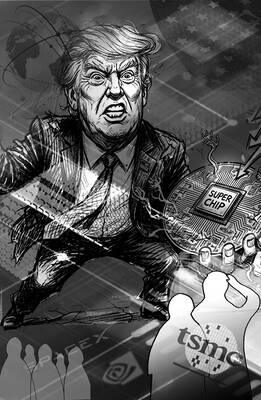
The White House’s decision to take a 9.9 percent stake in Intel Corp is looking like very shrewd business indeed. Since the government bought in at US$20.47 a share last August, the US chipmaker’s surging stock price has delivered the US a US$43 billion return. One of the reasons the investment has so far proved so sound is that the White House has made sure of it. According to The Wall Street Journal, Howard personally pushed deals on Intel’s behalf with some of the most lucrative clients imaginable. They include Nvidia Corp, the company at the heart of the AI
A single photograph can cut through a lot of noise, but it can also be used to misrepresent the truth. At the very least, it can concentrate the mind on something that requires further investigation. On Monday last week, Ma Ying-jeou Foundation CEO Tai Hsia-ling (戴遐齡) and former National Security Council secretary-general King Pu-tsung (金溥聰) held a news conference in which they showed a photograph of former foundation CEO Hsiao Hsu-tsen (蕭旭岑), now Chinese Nationalist Party (KMT) deputy chairman. In the image Hsiao is seated next to Xiamen Taiwan Businessmen Association chairman Han Ying-huan (韓螢煥). The two men were holding
I first met Professor Ray Jiing (井迎瑞) as a film and documentary student at Shih Hsin University’s (SHU) Department of Radio Television and Film in 1988. The following year, he went on to become the director of the Chinese Taipei Film Archive — forerunner of the Taiwan Film and Audiovisual Institute (TFAI). Over his eight-year tenure, Jiing rescued and restored over 200 classic Taiwanese films. In 1997, he established the Graduate Institute of Studies in Documentary and Film Archiving at Tainan National University of the Arts (TNNUA), and I joined the program in his third cohort of students. Beyond a

President William Lai Ching-te’s (賴清德) May 20 second-anniversary address was not just a routine policy review; it was damage control. US President Donald Trump’s remarks — that he did not want to see anyone move toward independence and that the delivery of a major Taiwan arms package could depend on the progress of US-China relations — unsettled Taiwan’s public and created an opening for opposition parties to question whether Taiwan was being treated as a bargaining chip in Washington’s dealings with Beijing. Lai’s speech was designed to close that opening. The address covered the expected ground: sovereignty, cross-strait relations, defense spending,


 RSS
RSS