


China has been making major efforts to increase its ability to influence other countries without force or coercion. In 2007, then-Chinese president Hu Jintao (胡錦濤) told the Chinese Communist Party (CCP) that the country needed to increase its soft power; incumbent Chinese President Xi Jinping (習近平) repeated the message last year. They know that, for a country like China, whose growing economic and military power risks scaring its neighbors into forming counterbalancing coalitions, a smart strategy must include efforts to appear less frightening. However, their soft-power ambitions still face major obstacles.
China’s efforts have had some impact. As it enrolls countries as members of its Asian Infrastructure Investment Bank and doles out billions of dollars in aid during state visits abroad, some observers worry that, when it comes to soft power, China could actually be taking the lead over countries like the US.
US sinologist David Shambaugh, for example, estimates that Beijing spends about US$10 billion a year in “external propaganda.” By comparison, the US spent only US$666 million on public diplomacy last year.
Yet the billions of dollars China is spending on its charm offensive have had only a limited return. Polls in North America, Europe, India and Japan show that opinions about China’s influence are predominantly negative. The country is viewed more positively in Latin America and Africa, where it has no territorial disputes and human-rights concerns are not always high on the public agenda. However, even in many countries in those regions, Chinese practices like importing labor for infrastructure projects are unpopular.
Combining hard and soft power into a smart strategy is not easy. A country derives its soft power primarily from three resources: its culture (in places that find it appealing), its political values (when it lives up to them at home and abroad) and its foreign policies (when they are seen as legitimate and having moral authority). China has emphasized its cultural and economic strengths, but it has paid less attention to the political aspects that can undermine its efforts.
Two major factors limit China’s soft power as measured by recent international polls. The first is nationalism. The CCP has based its legitimacy not only on a high rate of economic growth, but also on appeals to nationalism. Doing so has reduced the universal appeal of Xi’s “Chinese Dream,” while encouraging policies in the South China Sea and elsewhere that antagonize its neighbors.
With, for example, China bullying the Philippines over possession of disputed islands in the South China Sea, the Confucius Institute that China established in Manila to teach Chinese culture can win only so much goodwill. China has opened about 500 such institutes in more than 100 countries. The consequences of the country’s foreign policy can be seen in last year’s anti-Chinese riots in Vietnam following the positioning of a Chinese oil drilling rig in waters claimed by both countries.
The other limit is China’s reluctance to take full advantage of an uncensored civil society. As noted by The Economist, the CCP has not bought into the idea that soft power springs largely from individuals, the private sector and civil society. Instead, it has clung to the view that the government is the main source of soft power, promoting ancient cultural icons that it thinks might have global appeal, often using the tools of propaganda.
In today’s media landscape, information is abundant. What is scarce is attention, which depends on credibility — and government propaganda is rarely credible. For all of China’s efforts to position the Xinhua news agency and China Central Television as competitors of CNN and the BBC, the international audience for brittle propaganda is vanishingly small.
The US, by contrast, derives much of its soft power not from the government, but from civil society — everything from universities and foundations to Hollywood and pop culture. China does not yet have global cultural industries on the scale of Hollywood or universities capable of rivaling the US’. Even more importantly, it lacks the many non-governmental organizations that generate much of Washington’s soft power.
For example, non-governmental sources of soft power can sometimes compensate for the government’s unpopular policies — like the US invasion of Iraq — through their critical and uncensored reaction. China, by contrast, has watched its government policies undermine its soft-power successes.
Indeed, the domestic crackdown on human-rights activists undercut the soft-power gains of the 2008 Beijing Olympics. And the benefits of the 2009 Shanghai Expo were rapidly undermined by the jailing of Nobel Peace Prize laureate Liu Xiaobo (劉曉波). Marketing experts call this “stepping on your own message.”
China’s aid programs are often successful and constructive. Its economy is strong and its traditional culture is widely admired, but if the country is to realize its enormous soft-power potential, it will have to rethink its policies at home and abroad. As long as China fans the flames of nationalism and holds tight the reins of party control, its soft power will always remain limited.
Joseph Nye Jr is a professor at Harvard University and a member of the World Economic Forum Global Agenda Council on the Future of Government.
Copyright: Project Syndicate
A gap appears to be emerging between Washington’s foreign policy elites and the broader American public on how the United States should respond to China’s rise. From my vantage working at a think tank in Washington, DC, and through regular travel around the United States, I increasingly experience two distinct discussions. This divergence — between America’s elite hawkishness and public caution — may become one of the least appreciated and most consequential external factors influencing Taiwan’s security environment in the years ahead. Within the American policy community, the dominant view of China has grown unmistakably tough. Many members of Congress, as

After declaring Iran’s military “gone,” US President Donald Trump appealed to the UK, France, Japan and South Korea — as well as China, Iran’s strategic partner — to send minesweepers and naval forces to reopen the Strait of Hormuz. When allies balked, the request turned into a warning: NATO would face “a very bad” future if it refused. The prevailing wisdom is that Trump faces a credibility problem: having spent years insulting allies, he finds they would not rally when he needs them. That is true, but superficial, as though a structural collapse could be caused by wounded feelings. Something
Former Taipei mayor and Taiwan People’s Party (TPP) founding chairman Ko Wen-je (柯文哲) was sentenced to 17 years in prison on Thursday, making headlines across major media. However, another case linked to the TPP — the indictment of Chinese immigrant Xu Chunying (徐春鶯) for alleged violations of the Anti-Infiltration Act (反滲透法) on Tuesday — has also stirred up heated discussions. Born in Shanghai, Xu became a resident of Taiwan through marriage in 1993. Currently the director of the Taiwan New Immigrant Development Association, she was elected to serve as legislator-at-large for the TPP in 2023, but was later charged with involvement
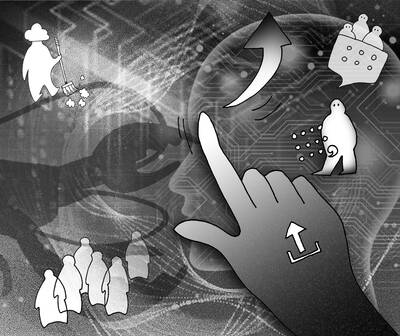
Weeks into the craze, nobody quite knows what to make of the OpenClaw mania sweeping China, marked by viral photos of retirees lining up for installation events and users gathering in red claw hats. The queues and cosplay inspired by the “raising a lobster” trend make for irresistible China clickbait. However, the West is fixating on the least important part of the story. As a consumer craze, OpenClaw — the AI agent designed to do tasks on a user’s behalf — would likely burn out. Without some developer background, it is too glitchy and technically awkward for true mainstream adoption,


 RSS
RSS