


President Ma Ying-jeou (馬英九) has been busy meeting foreign media in recent days. At the same time he and his administration have also been busy correcting reports following the interviews. Reported misquotes and mistranslations might have been simple mistakes by reporters, but they could also be justified inferences. If the inferences were valid, the government’s corrections show that it has engaged in opportunistic and double-faced tactics, and exposes how it has helped drive the country into a corner.
The Ministry of Foreign Affairs last week chided the “over-interpretation” of a Chinese-language report by Deutsche Welle, which was not among the media outlets that interviewed Ma, for “misquoting” the president as saying he aims to learn from the experience of East Germany and West Germany in their “realizing ultimate unification.”
The “unification” spoken about in the report was indeed “of the two Germanys,” as the Ministry of Foreign Affairs has clarified and according to the transcript provided by the Presidential Office after the hubbub. Ma extolled the setting up of mutual embassies and called the 1972 agreement between the two Germanys “a good move” because it “went so far as to recognize [the two side’s mutual] territory ... but short of recognition of sovereignty.”
The president further underlined that even though the word “sovereignty” was not used in the agreement, former German “chancellor Willy Brandt “wrote a letter to his East German counterpart, attached to the agreement, saying that whatever was said in the agreement would not affect the eventual unification of the two Germanys.”
Ma called it “a delicate maneuver” and said he has replaced the idea of “one Germany, two states” with “one China, with respective interpretations.”
Deutsche Welle is hardly to be blamed for saying that Ma is learning from Germany’s history of unification, after all, the president praised the agreement and said that eventual unification was not hindered by it.
Ma’s long-standing principle of “one China, with respective interpretations” puzzles the world. If it does not prescribe the eventual unification of “one China,” what does it mean? Plural interpretations do not make for separate “Chinas” — if “one,” as in unity, is all that matters.
It is an “over-interpretation,” the government said, sternly refuting the reports when facing legislators and local reporters. However, how is it an “over-interpretation” when the Chinese Nationalist Party has insisted that the Republic of China’s territories include “the mainland” and, to add to the surreal nature of it, the now-independent Mongolia?
It might not be a big problem for a political party to defend outdated tenets, but being hypocritical about them is. In a democratic country, being pro-unification is certainly tolerated, as the existence of high-profile pro-unification parties shows, but being evasive and to shun questions from the public, knowing the idea is widely rejected, is reason to criticize.
While Taiwanese and various groups are fighting against Chinese aggression and Beijing’s unilateral claim of sovereignty over Taiwan, it is most unfortunate to see the government pushing in exactly the opposite direction, canceling the efforts to remain separate from China.
The administration corrected a report by al-Jazeera, which mistranslated the president’s “ethnic Chinese society” (華人) as “China.”
It might have been a bit hasty for al-Jazeera’s translator to infer that the term could be translated that way, but it was not entirely out of context considering how enthusiastically Ma has been pitching “one China.”
Why the corrections then? The party and the administration know why, and so does the electorate.
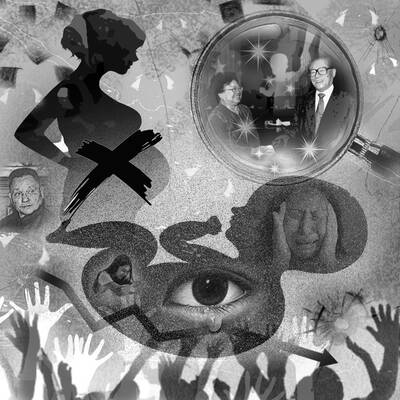
Jan. 1 marks a decade since China repealed its one-child policy. Just 10 days before, Peng Peiyun (彭珮雲), who long oversaw the often-brutal enforcement of China’s family-planning rules, died at the age of 96, having never been held accountable for her actions. Obituaries praised Peng for being “reform-minded,” even though, in practice, she only perpetuated an utterly inhumane policy, whose consequences have barely begun to materialize. It was Vice Premier Chen Muhua (陳慕華) who first proposed the one-child policy in 1979, with the endorsement of China’s then-top leaders, Chen Yun (陳雲) and Deng Xiaoping (鄧小平), as a means of avoiding the
In the US’ National Security Strategy (NSS) report released last month, US President Donald Trump offered his interpretation of the Monroe Doctrine. The “Trump Corollary,” presented on page 15, is a distinctly aggressive rebranding of the more than 200-year-old foreign policy position. Beyond reasserting the sovereignty of the western hemisphere against foreign intervention, the document centers on energy and strategic assets, and attempts to redraw the map of the geopolitical landscape more broadly. It is clear that Trump no longer sees the western hemisphere as a peaceful backyard, but rather as the frontier of a new Cold War. In particular,
As the Chinese People’s Liberation Army (PLA) races toward its 2027 modernization goals, most analysts fixate on ship counts, missile ranges and artificial intelligence. Those metrics matter — but they obscure a deeper vulnerability. The true future of the PLA, and by extension Taiwan’s security, might hinge less on hardware than on whether the Chinese Communist Party (CCP) can preserve ideological loyalty inside its own armed forces. Iran’s 1979 revolution demonstrated how even a technologically advanced military can collapse when the social environment surrounding it shifts. That lesson has renewed relevance as fresh unrest shakes Iran today — and it should

The last foreign delegation Nicolas Maduro met before he went to bed Friday night (January 2) was led by China’s top Latin America diplomat. “I had a pleasant meeting with Qiu Xiaoqi (邱小琪), Special Envoy of President Xi Jinping (習近平),” Venezuela’s soon-to-be ex-president tweeted on Telegram, “and we reaffirmed our commitment to the strategic relationship that is progressing and strengthening in various areas for building a multipolar world of development and peace.” Judging by how minutely the Central Intelligence Agency was monitoring Maduro’s every move on Friday, President Trump himself was certainly aware of Maduro’s felicitations to his Chinese guest. Just


 RSS
RSS